Kitchen-diner party hosts
Hosts need a screen that works with the room’s light and seating positions, so players and spectators can follow the game without arranging everyone around a single chair.


Choose a TV that fits the kitchen-diner seating layout and remains comfortable to watch under its usual lighting, then check the exact model for a low-latency game mode or automatic low-latency mode (ALLM). An OLED model may appeal if contrast matters most during evening play, while a bright-room-focused LCD or Mini LED model is worth comparing for daytime use; neither display type settles the question without model-specific checks. Treat high refresh rates and variable refresh rate (VRR) as relevant only when your connected equipment and games can use them.
Hosts need a screen that works with the room’s light and seating positions, so players and spectators can follow the game without arranging everyone around a single chair.
Players who care about prompt controller response should check the exact TV for a low-latency game mode or ALLM. LG UK says ALLM can reduce the delay between console input and TV output on supported models.
Households using both devices may want higher refresh modes or VRR as well as a straightforward console set-up. Samsung UK notes that its 4K 144Hz, 165Hz and 240Hz modes require compatible PC-connected games and graphics hardware.
For daytime use, compare how individual screens suit the room’s light; for evening play, decide how much contrast matters to you. Both routes still need a size that fits the seating layout and gaming features that work with your equipment.
Consider when: The TV will be a shared everyday screen in a kitchen diner used under daylight or overhead lighting.
Check: Reflection handling, brightness and viewing positions on the particular model; the display label alone does not establish how it will look in your room.
Consider when: Evening viewing and contrast-rich game scenes are higher priorities.
Check: The chosen model’s lighting suitability, size and gaming inputs. LG UK describes pixel-level true blacks for its OLED C5 line, not for every TV or viewing condition.
| Concern | What to check | Who this matters to |
|---|---|---|
| Visibility in a bright room | Locate windows and overhead lights relative to the screen; compare the exact model’s reflection handling. | If daylight reaches the screen while friends are playing, I need to follow the action without fighting reflections. Around 36% of consumers put clear visibility first. |
| Responsive controller play | Confirm game mode or ALLM on the exact model and the HDMI input you intend to use. | When turns pass quickly between players, I want the TV to respond promptly to the controller. Roughly 29% of consumers make responsiveness their primary concern. |
| Shared viewing layout | Measure the available width and stand depth; check where seated players and spectators will watch from. | I need a screen everyone can see without it taking over the kitchen-diner furniture. Around 21% of consumers prioritise room fit and shared viewing. |
| Useful gaming modes | Check the refresh-rate output of your console or PC and whether your games support the advertised modes. | For casual console mini-games, I would rather choose features my equipment can use than focus on a headline PC refresh figure. About 14% of consumers put that practical match first. |
A high-refresh mode may go unused in a console-led party-game set-up. Samsung UK says its 4K 144Hz, 165Hz and 240Hz modes require compatible PC-connected games and graphics hardware.
Start with the device and games you will connect, then check the TV’s supported mode and HDMI input.
HDMI 2.1, ALLM and VRR depend on the model. TCL UK says only some TCL TVs support HDMI 2.1, and LG UK limits its ALLM guidance to supported models.
Check the full model number, size variant, port specifications and manual before ordering.
A screen can fit the available width yet still be awkward to watch from the players’ seats or catch light from a nearby window.
Measure the surface and stand space, note the light sources, and map out where players and spectators will sit or stand.
Replacing a television also means arranging what happens to the old electrical equipment.
Plan an appropriate electrical-waste collection or recycling route in advance; GOV.UK explains the UK waste electrical and electronic equipment framework.
Relevant when comparing an OLED model for evening contrast with other display options.
Relevant to households comparing model-specific low-latency features with options for compatible PC gaming.
Relevant when comparing particular QLED models with documented console and PC gaming modes.
These TVs include Mini LED and QLED models to consider for shared-room use, plus a Direct LED option for console-led games. Compare each screen’s fit and lighting suitability in your kitchen diner; the gaming modes named in a listing still need to match your equipment.
 Image unavailable
Consider this size if it suits the available surface and the group’s viewing positions.
The product title specifies a native 144Hz refresh rate. Check which HDMI input supports the gaming mode you need and how the screen handles reflections where it will stand.
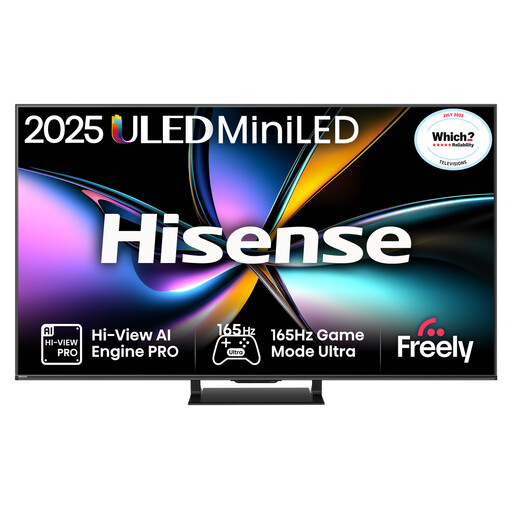 Image unavailable
Consider the 65-inch size if players and spectators have room to view it comfortably.
The title names a 165Hz Game Mode Ultra; confirm the modes your connected equipment can use. Measure the stand footprint and assess reflections in the intended position.
 Image unavailable
Consider this 55-inch variant if it fits the seating arrangement and the planned TV position.
Its title names a 165Hz Game Mode Ultra. Check the modes available with your source device, along with the stand footprint and reflections at your viewing times.
 Image unavailable
This 55-inch model is an option to assess against the available space and shared seating.
The title lists a 288Hz Game Accelerator, which should not be treated as a native 4K refresh rate. Check its operating conditions, your device’s supported modes and reflections in the room.
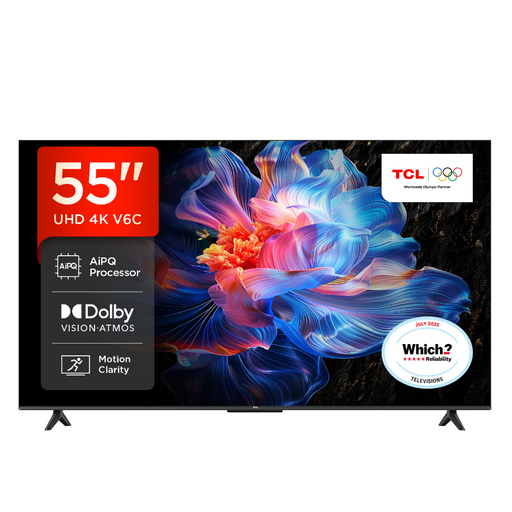 Image unavailable
Consider this model for console-led party play if its size works for the shared seating layout.
The named 120Hz Game Accelerator applies at FHD, not as a native 4K refresh rate. Confirm the physical dimensions and assess reflections before deciding where to place it.
No: make a high-refresh mode a priority only if your connected device and games can use it. Samsung UK says its 4K 144Hz, 165Hz and 240Hz modes require compatible PC-connected games and graphics hardware; for console-led play, also check game mode and the room layout.
Connect it by HDMI and select the relevant game mode or ALLM if both the TV model and console support it. LG UK says its ALLM guidance applies to selected models, so check the manual and the capabilities of the HDMI input you plan to use.
No: confirm both features on the exact model and check which HDMI inputs provide them. TCL UK says only some TCL TVs support HDMI 2.1, so a feature listed for one model cannot be assumed for another.
Arrange an appropriate electrical-waste collection or recycling route before replacing it. GOV.UK describes the UK waste electrical and electronic equipment framework as aiming to reduce electrical waste sent to landfill or incineration; ask the retailer about collection options or check local electrical-waste services.