For a sofa-based PlayStation or Xbox setup, choose a TV that fits the room and supports the console modes you intend to use; a general-purpose TV can suffice if its particular HDMI input supports those modes. A gaming-focused 4K TV is more relevant when you use supported 120Hz or variable refresh rate (VRR) modes, while a monitor is worth considering for close, desk-like viewing rather than a shared living-room screen. Check the input and connected display’s reported capabilities before treating a higher panel refresh-rate figure as a console benefit.
Who is this setup for?
PS5 or Xbox Series X players considering 4K at 120Hz
If your games offer a 120Hz mode, check whether your console, game and chosen TV input can use it together. PS5 settings also show the connected display’s reported resolution, VRR and HDR capabilities.
Players sharing a TV with the rest of the household
Screen size, seating position and everyday viewing matter alongside gaming features. Sony UK’s September 2026 guidance lists approximate minimum viewing distances of 1 m for a 55-inch 4K TV and 1.2 m for a 65-inch set, with room layout and comfort still determining the choice.
Buyers considering a QD-Mini LED TV
If you are comparing LCD-based and OLED sets, assess the exact model’s gaming modes and its picture in your room rather than choosing by panel label alone. Expert Reviews UK included the TCL C7K in its April 2026 gaming-TV selections; that assessment does not establish the capabilities of other TCL models.
What should you check before choosing?
Start with the viewing position and intended console mode, then check the exact display and HDMI input against both.
Gaming-focused 4K TV
Consider it when: You want a shared sofa-distance screen and play games with supported 120Hz or VRR modes.
Keep in mind: Not every game uses those modes, so gaming features do not replace a check of room fit and everyday picture quality.
General-purpose TV
Consider it when: Films and television share the screen with games, and the set supports the console mode you plan to use.
Keep in mind: An HDMI socket alone does not establish 4K at 120Hz; Xbox Support warns that inputs on the same TV can support different resolutions.
Computer monitor
Consider it when: You play close to the screen at a desk-like position and prefer a smaller display.
Keep in mind: Check the monitor’s console input modes and audio arrangement; a smaller screen may not serve a shared sofa-based setup.
| Priority |
What to check |
Your needs |
| HDMI compatibility |
Check the intended input, cable and supported resolution. Xbox Support specifies an Ultra High Speed HDMI cable and a TV supporting HDMI 2.1 for Xbox Series X gaming at 4K and 120Hz; it warns that some inputs support lower resolutions. |
I want the console connected to an input that supports the mode I plan to use, rather than relying on the presence of an HDMI socket. |
| Gaming modes |
Check 120Hz output, VRR, automatic low-latency mode (ALLM) and HDR against the console, game and display. PlayStation says PS5 120Hz output and ALLM depend on TV and game support. |
Fast-paced games are a priority for me, but I only need modes that my games and connected display can use. |
| Screen and room |
Measure the seating distance and available space. Sony UK’s September 2026 4K guidance gives approximate minimum distances of 1 m for 55 inches and 1.2 m for 65 inches, subject to layout and comfort. |
The screen needs to work from my usual seat and fit the furniture or wall position, not just have an appealing diagonal size. |
| Everyday viewing |
Assess picture performance for films and television as well as games. Expert Reviews UK says its April 2026 gaming-TV guide evaluates input lag, brightness and SDR/HDR colour and greyscale accuracy. |
Other people will use this screen for films or TV, so gaming specifications alone will not settle my choice. |
Common buying mistakes
-
Assuming every HDMI input supports the same mode
Xbox Support warns that some TV inputs support lower resolutions than others. Using a different port from the one specified for your intended mode can change what the console reports as available.
Check the exact model’s manual and input settings, then inspect Xbox 4K TV details or the PS5 connected-display information after connecting the console.
-
Choosing a panel above 120Hz solely for console play
A panel advertised at 144Hz or 165Hz does not, by itself, establish an additional benefit for a PS5 or Xbox game. PlayStation’s 120Hz output depends on compatible games and displays.
Confirm the console’s intended resolution and 120Hz mode on the relevant HDMI input before weighing higher advertised refresh rates.
-
Choosing screen size without measuring the room
A screen diagonal does not show whether the set fits the seating position, furniture or wall space. Sony UK presents its 4K viewing distances as guidance to adjust for layout and comfort.
Measure from the usual seat to the planned screen position, and check the set’s dimensions, viewing angle and cable route.
A different stand, wall mount or installation arrangement may also be needed for the position you choose.
-
Treating a gaming feature list as a test result
Support for VRR or ALLM describes available functions, not how every game and picture mode will look or respond. Exact model and size also matter when comparing specifications.
Separate manufacturer specifications from independent model reviews, and confirm the selected set’s input allocation and console-reported capabilities.
Relevant brand references
These examples illustrate features to compare on specific models; they do not describe every television made by each brand.
Samsung
The S95F is an OLED gaming-TV example, distinct from the S90F in the Joybuy selection below.
- Expert Reviews’ 2025 S95F review lists four HDMI 2.1 inputs, VRR and ALLM for that model.
- The same S95F review notes no Dolby Vision HDR or Freeview Play support. Do not apply those findings to other Samsung models without checking them.
LG
The 55-inch OLED C6 is a model to examine if you want an OLED screen for both games and other viewing.
- LG says its OLED55C64LA supports up to 4K at 165Hz, G-SYNC compatibility and FreeSync Premium.
- Those are manufacturer specifications, not a test of your console setup. Check the intended HDMI input and the panel-cover terms for the exact model.
TCL
The C7K is a QD-Mini LED model included in Expert Reviews UK’s April 2026 gaming-TV selections; it is not the same model as the TCL sets below.
- The 55C7K is specified with 144Hz VRR and FreeSync Premium Pro.
- Refresh-rate descriptions and input details should be checked for the exact model and size you are considering.
Joybuy TV options
These are 4K televisions to consider for a shared PlayStation or Xbox living-room setup. Match their screen sizes to your room and confirm the intended console mode on the exact HDMI input.
 No image available
TCL 55P8K-UK 55-inch QLED 4K TV
Consider this 55-inch set if you want one screen for console games and everyday viewing. Its listing describes four HDMI 2.1 ports, VRR, ALLM, HDR and Google TV; check which input supports your intended console mode and whether the screen fits your seating position.
Joybuy
 No image available
Samsung S90F 55-inch 4K OLED TV (2025)
This 55-inch OLED is an option for a shared gaming and viewing screen. The listing describes 4K, HDR, VRR and ALLM; check the exact HDMI input’s supported console mode and measure the viewing position before choosing it. This S90F is not the S95F discussed in the brand references.
Joybuy
 No image available
TCL 50Q6C-UK 50-inch QD-Mini LED 4K TV
The 50-inch size is worth measuring against a smaller seating area. The listing describes 4K HDR, HDMI 2.1, VRR, ALLM and Google TV, but its refresh-rate descriptions differ: the title says 144Hz native, while the detailed specification says 120Hz native and up to 144Hz VRR. Confirm the exact specification and console input mode before relying on either figure.
Joybuy
 No image available
TCL 75Q6C 75-inch QD-Mini LED 4K TV
This 75-inch set calls for a check of seating distance, furniture and installation space. Its description lists a 4K QD-Mini LED display, HDMI 2.1, VRR and FreeSync Premium Pro; confirm the specific input’s support for your intended console mode.
Joybuy
 No image available
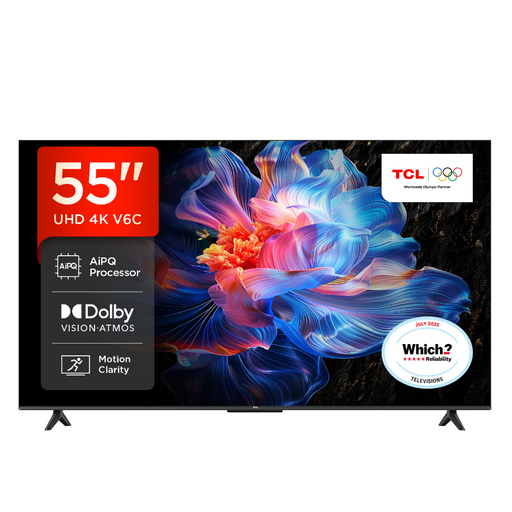
TCL 55V6C 55-inch Direct LED 4K TV
This 55-inch TV offers a 4K screen for games and general viewing. Its description lists HDMI 2.1, VRR and ALLM, but qualifies its 120Hz Game Accelerator as FHD; that feature alone does not establish 4K at 120Hz. Check the exact HDMI input if 4K/120Hz is important to your setup.
Joybuy
Questions about console TVs
Do I need HDMI 2.1 for a PlayStation or Xbox TV?
Not for every console game. Xbox Support specifies an Ultra High Speed HDMI cable and a TV supporting HDMI 2.1 for Xbox Series X gaming at 4K and 120Hz. On PS5, check the connected display’s reported resolution, VRR and HDR capabilities in Screen and Video settings, and use 120Hz output with a compatible TV and game.
Should I choose 120Hz, VRR or a larger screen?
Choose the screen size for your seating position, then prioritise the gaming modes your console and games can use. HDMI Licensing Administrator describes VRR as reducing judder and frame tearing when supported. Sony UK’s September 2026 4K guidance lists approximate minimum viewing distances of 1 m for 55 inches and 1.2 m for 65 inches, to be adjusted for comfort and room layout.
How can I check what mode my Xbox TV connection supports?
Open 4K TV details under Xbox’s TV and display options, then compare the reported capabilities with the TV manual for the HDMI input you are using. Xbox Support warns that some inputs on a TV support lower resolutions than others.
Does using a gaming TV require a UK TV Licence?
Simply owning a TV for console gaming does not trigger the requirement described by GOV.UK. A TV Licence is needed if you watch or record programmes as they are broadcast, or watch on-demand BBC programmes on iPlayer.


