Off-centre multiplayer households
You play football games with friends or family, and someone sits well to the side of the TV. What that player can see matters more than screen size alone.


For local football games with a player sitting off-centre, check how the picture looks from that seat before choosing by refresh rate. OLED is a useful starting point for wide seating; RTINGS describes IPS LCD as a wider-angle alternative to typical VA LCD, but with lower contrast. Then check the TV’s gaming modes and HDMI inputs against the console or PC you will use.
You play football games with friends or family, and someone sits well to the side of the TV. What that player can see matters more than screen size alone.
You want responsive controls and are checking which gaming modes work with your console or PC, its connection and the games you play.
You play with daylight or lamps in the room, making reflections worth assessing from both the central and side seats.
Start with the view from the side seat, then check gaming compatibility and how the screen handles the room’s lighting.
| Concern | What to check when buying | Who this matters to |
|---|---|---|
| Picture from the side | View the exact TV from the planned seat or consult an independent viewing-angle test. RTINGS describes IPS LCD as wider-angle but lower-contrast than typical VA LCD; an OLED review of a different model cannot establish this one’s performance. | If I sit at the edge of the sofa, I need the pitch to remain clear rather than looking good only to the central player; roughly 42% of consumers put side-seat picture consistency first. |
| Responsive play | Match Game Mode or automatic low-latency mode (ALLM), variable refresh rate (VRR), HDMI ports and supported resolution and refresh rate to the console or PC. | During a quick match, I want controls to respond promptly and the selected gaming mode to work with my device; for roughly 33% of consumers, that compatibility is the primary concern. |
| Light and motion | Assess reflections in the room where you play and look for an exact-model motion assessment. Treat a manufacturer’s glare or refresh-rate claim as a feature to check, not a viewing result. | Daylight or a lamp can compete with the pitch on screen, while rapid camera movement makes motion handling noticeable; roughly 25% of consumers put these conditions first. |
RTINGS describes typical VA LCD panels as higher-contrast but narrower-angle than IPS LCD panels. A TV chosen for the central seat may therefore be a poor fit for the player beside it.
Check the exact model’s viewing-angle results, or look at it from your intended side seat before buying.
A headline refresh rate does not establish which modes a particular console, game and HDMI input can use.
Check the TV’s supported resolution and refresh-rate combinations alongside your source device and cable. Follow the manufacturer’s instructions for any enhanced HDMI setting and VRR.
Panel implementation can change within a range. RTINGS found size- and region-dependent panel differences in the earlier Samsung S90D range, so its findings cannot simply be transferred to another variant.
Match the full model code and screen size to the manufacturer’s specification and any independent review.
For a TV used regularly for gaming, the exact model’s stated energy information belongs alongside its picture and gaming features. The UK Department for Energy Security and Net Zero and Office for Product Safety and Standards say in-scope products must be supplied with an accurate printed energy label.
Compare the label and product information for the models you are considering rather than assuming similarly sized TVs use the same amount of electricity.
Electricity use also depends on settings and how long the TV is on.
LG’s OLED C6 range is relevant if you are investigating an OLED TV for wide sofa seating.
Samsung’s S90H OLED range is relevant where room reflections are part of the decision.
Sony’s BRAVIA 8 II is a QD-OLED route for buyers planning a 4K120 gaming setup.
These OLED and Mini-LED TVs offer different screen sizes for a local football setup. Judge each one from the intended side seat and confirm its gaming connections before choosing.
 No image available
Consider this OLED model for shared sofa play if its picture holds up from your side seat. Check the exact TV’s reflection handling, gaming modes and HDMI inputs for your device.
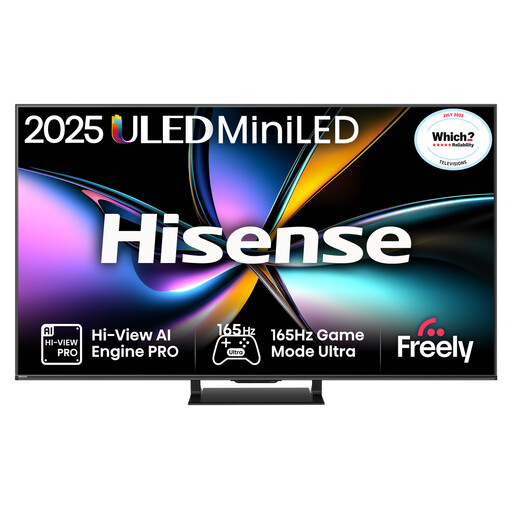 No image available
This larger-screen option is worth assessing where the seating layout calls for 65 inches, but check its picture from the actual side seat. Its product title names a 165Hz Game Mode Ultra; confirm the resolution and input that support the mode you need.
 No image available
If 55 inches suits both players’ seats, assess this Mini-LED model from the side rather than choosing by its gaming label alone. The product title names a 165Hz Game Mode Ultra; check which resolution and HDMI input support your intended setup.
 No image available
Consider this 42-inch OLED model if its size works for both the central and side players. Check its picture from the side and confirm the gaming features available on the HDMI input you intend to use.
 No image available
This 65-inch OLED model is an option for wide sofa seating if the size fits the room and its image works from the planned side seat. Confirm VRR, ALLM, refresh-rate modes and HDMI port assignments for your gaming device; do not assume the BRAVIA 8 II specifications apply to this model.
Check how the exact TV looks from that person’s seat before comparing headline gaming figures. RTINGS describes typical VA LCD as narrower-angle than IPS LCD, while its test of an LG C5 OLED found a very wide viewing angle; test or review the model and size you actually plan to buy.
No: a 165Hz label alone does not establish a benefit for your console and game. Check low-latency operation and the resolution and refresh rates supported by the console, cable and chosen HDMI port; higher refresh modes are relevant when a compatible PC and game can use them.
Use an input that supports the modes required by your console or PC, and follow the TV maker’s setup instructions. For the BRAVIA 8 II specifically, Sony lists VRR on HDMI 3 and 4 and ALLM on HDMI 1 through 4; those port assignments must not be assumed for other Sony models.
Compare the energy label and product information for each exact TV model, then consider your usual settings and playing time. The UK Department for Energy Security and Net Zero and Office for Product Safety and Standards say in-scope products must be supplied with an accurate printed energy label.
Playing a local video game alone does not trigger the live-TV viewing requirement. GOV.UK says a TV Licence is needed to watch or record live TV on any channel or service, so check your viewing use if the set will also show live football broadcasts.