For a shared living room, choose a TV that fits the seating positions and has a usable game mode, then check the exact inputs against your console and sound setup. A 120Hz display and variable refresh rate (VRR) matter most when the console, game and connection can use them; a headline refresh-rate figure alone is not a reason to replace a TV that already meets your needs.
Who is this choice for?
PS5 or Xbox players who favour fast-action games
Check whether the games you play support higher-frame-rate output or VRR before making those features a priority. PlayStation says PS5 120Hz output requires a compatible display and game; Xbox Support specifies an HDMI 2.1-capable TV and Ultra High Speed HDMI cable for 4K at 120Hz on Xbox Series X.
Households sharing a TV for games and video
Choose from the normal sofa positions, not just the gaming specification sheet. Screen size, daylight visibility, built-in sound and connections for a soundbar or other devices all affect how well the TV works for the room.
Players considering a personal desk display
A monitor is worth considering if you usually sit close to the screen and do not need it for communal viewing. Close-up use is a different proposition from the larger-screen experience of a living-room TV.
What should you check before choosing?
Start with the room and the way the screen will be shared, then check the gaming modes and connection path your console can actually use.
| Priority |
What to check |
Your needs |
| Room fit |
Measure the available space and usual viewing distance. Consider daylight, reflections and seats away from the centre. |
I want a screen that works from our usual seats, whether we are playing or watching together. |
| Gaming modes |
Look for a usable game mode and check 120Hz and VRR support for the exact model and input. PlayStation limits PS5 120Hz output to compatible display-and-game combinations. |
Fast-action games matter to me, but I only want to prioritise higher refresh rates if my console and games can use them. |
| Connections and sound |
Map the console and audio-device connections. Check which inputs support the desired gaming modes and which provides eARC; Xbox Support specifies an Ultra High Speed HDMI cable and compatible TV for Xbox Series X 4K at 120Hz. |
There needs to be a workable connection for my console after the soundbar or receiver is connected. |
| TV or monitor |
Compare the sofa viewing arrangement with a close-up desk position. Check screen size and sound arrangements for the place the display will actually be used. |
If I mainly play alone at a desk, a monitor may suit me; if others share the screen from the sofa, I need a TV-sized display. |
Which buying mistakes matter?
-
Assuming HDMI 2.1 or 144Hz guarantees that output in every game
The available mode depends on the console, game, selected TV input and connection. PlayStation limits PS5 120Hz output to supported games and displays, while Xbox Support sets separate TV and cable requirements for Xbox Series X 4K at 120Hz.
Check the exact model’s input specifications and the console’s video settings. Treat a TV’s 144Hz figure as a display specification, not a promised console-game frame rate.
-
Choosing screen size without checking the sofa positions
A diagonal measurement alone cannot tell you whether the TV fits the furniture layout or works for everyone who shares the room.
Measure the space and assess the usual viewing positions and daylight conditions before settling on a size.
-
Overlooking the soundbar or receiver connection
Audio routing and gaming features may depend on different connections. Sony UK’s model-series table, for example, lists eARC separately from 4K120 and VRR.
Plan where the console and audio equipment will connect, then check the exact TV’s port map and any receiver requirements for the signal you intend to use.
If the existing connection path cannot carry the required signal, a suitable cable or change to the equipment arrangement may be needed.
-
Using a desk monitor to solve a shared-screen problem
A compact monitor can suit close-up solo play without providing the viewing arrangement needed for several people on a sofa.
Choose the monitor route for a personal desk position; for communal use, assess a TV’s size, seating fit, sound and console connections together.
Which brands offer useful points of reference?
Brand ranges provide starting points, but gaming features still need checking on the exact model and size.
LG
LG’s UK OLED range includes models to assess for shared viewing and console play.
- LG’s gaming guidance identifies refresh rate, input lag and VRR as features to check.
- Those features cannot be assumed for every LG model or HDMI input. LG identifies the UK OLED55G56LS as a stand-version model with a five-year limited panel warranty; check its connections and placement requirements separately.
Samsung
Samsung’s UK Neo QLED and OLED ranges offer large-screen models to compare for shared rooms.
- Samsung describes its QLED TVs as suited to daylight gaming because of their brightness; assess the particular model in your room rather than applying that claim across the range.
- Samsung lists Motion Xcelerator 144Hz for the QE75QN80HAUXXU, but that figure does not establish the frame rate of a console game. Confirm the exact gaming modes and inputs before choosing it.
Sony
Sony’s UK BRAVIA support table is useful for checking gaming features by series.
- Sony UK lists 4K120, eARC, VRR and automatic low-latency mode (ALLM) for BRAVIA 5 (XR50 series).
- The same Sony UK table lists BRAVIA 3 (S30 series) without 4K120 or VRR. Check the precise model, size and software requirements instead of assuming BRAVIA models share one feature set.
Joybuy TVs to consider
These TV options cover 42-, 55- and 75-inch formats for a shared living-room screen. Compare their stated features with your seating positions, console modes and sound connections; a monitor for personal desk play is a separate choice.
 No image available
TCL 55P8K-UK 55-inch QLED 4K TV
The 55-inch format gives you a specific size to check against the sofa positions. Its title lists 4K HDR PRO, an ONKYO 2.1 sound system and a 288Hz Game Accelerator; check the actual console-compatible resolution and refresh mode rather than reading the accelerator figure as a console frame rate.
Joybuy
 No image available
TCL 75Q6C 75-inch QD-Mini LED 4K TV
Consider this 75-inch format only after checking the furniture space and viewing positions. The title states 4K HDR, Google TV, up to 512 dimming zones and a 144Hz native refresh rate; confirm which modes the intended console can use through the relevant input.
Joybuy
 No image available
Sony BRAVIA XR42A90K 42-inch OLED 4K TV
This 42-inch TV is a size to assess where a larger screen may not fit, while still checking visibility from every usual seat. Its title lists 4K HDR, Google TV, Dolby Vision and Dolby Atmos; verify the exact input and audio-port arrangement for your setup.
Joybuy
 No image available
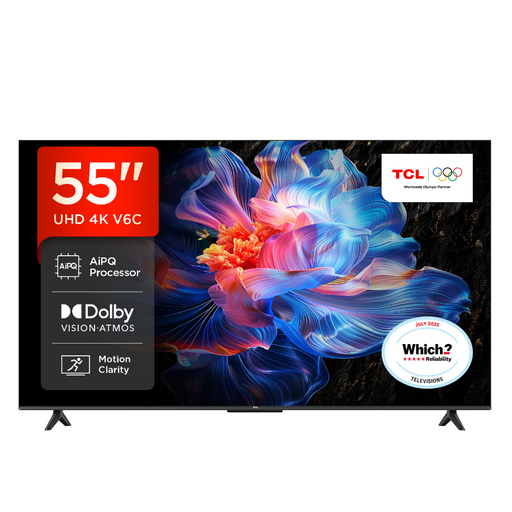
TCL 55V6C 55-inch Direct LED 4K TV
The 55-inch screen can be assessed for shared sofa viewing. Its title lists 4K HDR, Google TV and Dolby Atmos, but specifies the 120Hz Game Accelerator at FHD; do not take that as a claim of 4K at 120Hz.
Joybuy
 No image available
Samsung QE75QN80FAU 75-inch 4K Smart TV
Check whether a 75-inch screen fits the room before comparing gaming modes. The product name identifies a 4K Ultra HD smart TV with Wi-Fi; Joybuy’s listing identifies a 100Hz native refresh rate. Confirm the exact input capabilities needed by your console and audio equipment.
Joybuy
Common questions
Do I need a 120Hz TV for PS5 or Xbox gaming?
Not for every game. PlayStation says PS5 120Hz output requires a compatible TV or display and game. For Xbox Series X gaming at 4K and 120Hz, Xbox Support specifies an HDMI 2.1-capable TV and Ultra High Speed HDMI cable; check the games you play before treating 120Hz as a replacement requirement.
What does VRR change on a console TV?
Variable refresh rate lets a compatible display adjust its refresh rate as a game’s frame rate changes. PlayStation describes VRR as dependent on supported TVs and games, so check the console setting and the exact TV input rather than assuming it improves every title.
Will every HDMI socket support 4K at 120Hz and VRR?
Do not assume so: check the port map for the exact TV model. Sony UK’s support table lists 4K120, VRR, ALLM and eARC separately by series; plan which connection the console and any soundbar or receiver will use.
Should I use a TV or a monitor for console gaming?
Choose according to where and with whom you play. Monitors suit close-up personal gaming, while TVs suit larger-screen viewing; a monitor’s refresh-rate specification does not by itself make it suitable for a shared sofa-based room.


