Daylight desk players
If windows or lamps reflect in the screen, seeing enemies, objectives and the team display clearly takes priority over a headline display specification. RTINGS identifies reflection handling as important for bright-room use.


For co-operative shooters in a bright room, check reflection handling and the modes your gaming platform can use before choosing by refresh rate or HDR specification. A 27-inch anti-glare IPS monitor suits desk play when visibility and resolution flexibility matter; a larger Mini-LED monitor needs more viewing space, while an OLED monitor makes more sense when you can control light falling directly on the screen.
If windows or lamps reflect in the screen, seeing enemies, objectives and the team display clearly takes priority over a headline display specification. RTINGS identifies reflection handling as important for bright-room use.
These players want a fast refresh mode for rapid movement and aiming, and are willing to consider a lower-resolution mode or adjust their room lighting to get it.
Players connecting a PS5 or Xbox need to check the display’s HDMI modes. Those sharing a larger screen also need enough space and a comfortable viewing position.
Consider it when: You play at a desk under room lighting and want a screen surface intended to limit glare alongside a choice of resolution and speed modes.
Trade-off: On Dell’s AW2725QF, the faster 360Hz mode uses FHD rather than its 4K 180Hz mode.
Consider it when: You have room for shared viewing; Samsung describes the 43-inch Odyssey Neo G7 G70NC’s matte display as reducing reflections.
Trade-off: A 43-inch screen changes the space and viewing distance needed compared with a 27-inch desk monitor.
Consider it when: OLED contrast and fast stated response times matter most to you, and you can position the screen away from direct light.
Trade-off: An anti-reflective finish is not a reason to ignore reflections from a window or lamp; also check the model’s static-image care guidance.
| Concern | What to check | Who this matters to |
|---|---|---|
| Reflections and daytime visibility | Look for a matte or anti-glare surface and independent reflection measurements where available. Consider where windows and lamps will sit relative to the screen. | If daylight makes enemies and team information hard to see, I want reflections under control before considering other features. Around 36% of consumers would put that visibility need first. |
| Motion and aiming | Match the refresh rate to the resolution and input you intend to use; check the conditions attached to stated response times and variable refresh rate (VRR). | For fast camera movement, I would accept a lower-resolution mode if it gives me the speed I want. Roughly 29% of consumers would prioritise that motion-focused choice. |
| Console and shared-play fit | Check the HDMI mode and VRR support for your console, plus screen size and seating distance if others will share the view. | When connecting a console or sharing the screen, I need the intended display mode and placement to work for our setup. About 21% of consumers would make that fit their primary concern. |
| Contrast and image detail | Compare native resolution and panel or backlight technology, then check the conditions behind any HDR specification. | For more visually focused co-op sessions, I care most about detail and contrast once I can see the screen comfortably. Around 14% of consumers would place that image preference first. |
The fastest mode may use a different resolution. Dell specifies 4K at 180Hz or FHD at 360Hz for the Alienware AW2725QF, so its 360Hz figure does not describe 4K operation.
Check the resolution, input and gaming platform associated with the mode you expect to use.
A window or lamp can still create distracting reflections. RTINGS treats direct-reflection handling as a separate consideration for bright-room use.
Look at the screen finish, seek reflection measurements where available and plan where the light sources will be.
A monitor’s PC-oriented maximum may not be available from a console. PlayStation and Xbox both describe 4K at 120Hz output, but the game, display input and connection must support the intended mode.
Compare your console’s output settings with the monitor’s HDMI specifications and the cable you will use.
A longer suitable HDMI cable may be needed if the supplied cable cannot reach your setup.
A 43-inch monitor can give co-op partners a larger shared view, but it takes a different amount of space and viewing distance from a 27-inch desk model.
Measure the desk, stand area and seating positions before choosing that format.
Dell UK lists distinct 27-inch IPS and QD-OLED models for desk gaming.
LG UK lists both dual-mode Nano IPS Black and high-refresh OLED monitors.
Samsung lists the 43-inch Odyssey Neo G7 G70NC as a 4K Mini-LED monitor for a larger-screen setup.
These choices include OLED screens to assess against your room lighting, plus two 27-inch dual-mode monitors for players weighing 4K detail against faster lower-resolution play. Check the intended console or PC mode and reflection handling for the particular screen before deciding.
 No image available
Consider this for OLED gaming if you can assess reflections where the screen will sit. Its listed dual mode reaches up to 330Hz; check the resolution and connection required for the mode you want, and follow the listing’s guidance on prolonged static images.
 No image available
This is a desk-sized OLED choice for players considering a 240Hz QHD display; its name also states a 0.03ms response time. Check reflections from your usual light sources and the screen-care guidance rather than assuming the surface treatment will suit every bright room.
 No image available
Consider the 240Hz ultrawide format if your co-op games and available space suit a wider screen. Check how each intended game or console displays on it, assess reflections in your room and follow the listing’s static-image care guidance.
 No image available
This dual-mode model suits a desk player choosing between 4K detail and a faster FHD mode. LG specifies 4K at 240Hz or FHD at 480Hz for the 27G850A-B; confirm the exact variant, input mode and screen-surface behaviour before choosing it for a bright room.
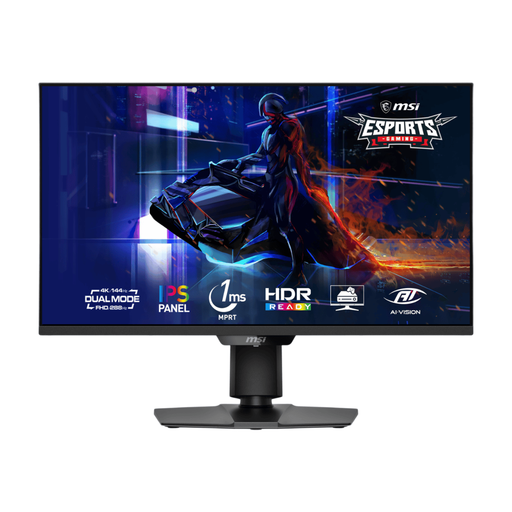 No image available
Consider this for a desk setup where you may switch between UHD at 144Hz and FHD at 288Hz. Check that your input and gaming platform can use the preferred mode, and assess the screen surface against your room lighting.
Check that the monitor’s HDMI input accepts 4K at 120Hz and that the game supports the mode. PlayStation says PS5 supports HDMI 2.1 and 4K 120Hz video output; its video-output settings show the connected display’s reported capabilities.
Yes, if the connected display supports 120Hz at the selected lower resolution. For 4K gaming at 120Hz, Xbox Support specifies an HDMI 2.1-capable display and a suitable Ultra High Speed HDMI cable.
No. HDR specifications do not establish how a screen handles direct reflections. RTINGS advises considering reflection handling for bright-room use, so check the surface and the position of nearby light sources.
Look for an electrical-waste collection or retailer take-back route rather than putting the monitor in general household rubbish. GOV.UK describes retailer take-back arrangements; check eligibility with the retailer and ask whether home collection involves a transport charge.