For point-and-click adventures in a bright room, start with a documented matte or anti-glare finish and the monitor’s typical brightness; a high refresh rate or HDR peak figure does not answer the reflection question. Then choose 27-inch 4K for fine detail if your device can drive it, a QHD OLED for a different balance of detail and fast-game features, or an ultrawide for a wider layout if your desk, games and device suit it.
Who this choice affects
Bright-room detail seekers
If you play near windows or under strong lighting, reflections can interfere with reading dialogue, inventory icons and scene clues. Check the stated screen finish and typical brightness separately from HDR peak brightness.
Adventure-first PC players
If small interface and scene details matter most, a 27-inch 4K display is a route to consider, provided your PC can output the resolution you intend to use.
Mixed-genre players
If you also play faster games, refresh rate and device compatibility deserve attention. For this bright-room setup, check reflection handling before making speed the deciding factor.
What to check before buying
Choose the screen finish and normal-use brightness for your lighting first, then decide how much detail, speed and physical screen space you need.
27-inch 4K matte IPS
Consider it when: You want a conventional 16:9 screen for fine adventure-game detail and an explicitly stated matte finish, as on the BenQ EX2710U.
Trade-off: The EX2710U’s 600-nit HDR peak is not its 300-nit typical brightness, and its 16:9 screen is not an ultrawide layout.
27-inch QHD OLED
Consider it when: You want an OLED screen and also play fast games; LG states anti-glare and low-reflection treatment for its 27GS93QE-B.
Trade-off: Its 2560 × 1440 resolution has fewer pixels than 4K, while its stated 275-nit typical brightness must be considered separately from peak claims.
27-inch dual-mode 4K IPS
Consider it when: You want 4K for adventures and a separate Full HD high-refresh mode for faster games, as offered by the Samsung Odyssey G7 G70F.
Trade-off: Confirm the exact model’s coating and typical brightness before relying on it in a bright room.
34-inch ultrawide OLED
Consider it when: You prefer a wider 21:9 layout and have room for a 34-inch screen; LG lists the 34GX900A-B at 3440 × 1440.
Trade-off: Check game and device support for the format, as well as desk fit, screen finish and typical brightness.
| Concern | What to check | Who this matters to |
|---|
| Reflections and brightness |
Look for a stated matte or anti-glare finish. Compare typical brightness with typical brightness, not HDR peak figures. |
If windows or lamps face my screen, I need scene clues and menus to remain legible. Around 36% of consumers put reflection control and normal-use brightness first. |
| Fine detail |
Compare native resolution at the screen size you want, and confirm your device can output that resolution. |
Small objects and interface text are central to how I play, so detail takes priority over extra speed. For around 29% of consumers, fine detail is the primary concern. |
| Fast-game response |
Check refresh-rate modes and the connection needed to use them with your device. |
My adventure games share a monitor with faster titles, so I want to assess its high-refresh options too. Mixed-genre responsiveness comes first for around 21% of consumers. |
| Screen and setup fit |
Check aspect ratio, desk space, stand adjustment and the ports required by your device. |
A wider screen or a stand I can reposition matters more to my setup than another display specification. Around 14% of consumers prioritise format, positioning or connection fit. |
Common buying mistakes
-
Reading HDR peak brightness as everyday brightness
BenQ lists 300 nits typical and 600 nits HDR peak for the EX2710U; LG lists 275 nits typical and a separate peak claim for the 27GS93QE-B. Those figures describe different conditions.
For a bright-room decision, compare typical or SDR figures on the same basis. Treat an HDR peak figure as an HDR specification, not normal-use output.
-
Treating every HDR label as the same specification
VESA distinguishes its tested DisplayHDR and DisplayHDR True Black certification tiers from lookalike HDR labels.
If HDR matters to you, check the precise model and its stated VESA certification tier rather than relying on a general HDR description.
-
Choosing refresh rate before checking reflections
A high-refresh mode addresses fast-game use, not whether windows or lamps will reflect in the screen. Samsung lists dual-resolution high-refresh modes for the Odyssey G7 G70F, but those modes alone do not settle its bright-room suitability.
Check coating and typical brightness for the exact model before deciding how much refresh rate you need.
Relevant monitor ranges
BenQ MOBIUZ
The EX2710U illustrates a 27-inch, 16:9 4K IPS option with a documented matte finish and an adjustable stand.
- BenQ specifies 3840 × 2160 resolution, 300-nit typical brightness and 100 mm height adjustment for the EX2710U.
- Its 600-nit HDR peak is not its typical brightness; these specifications apply to the EX2710U, not every MOBIUZ model.
LG UltraGear
The range includes a 27-inch QHD OLED with stated anti-glare and low-reflection treatment, as well as a 34-inch ultrawide OLED format.
- LG lists 275-nit typical brightness and 240 Hz for the 27GS93QE-B; it lists a 3440 × 1440, 21:9 screen for the 34GX900A-B.
- Do not compare a model’s peak-brightness claim directly with another model’s typical brightness, or assume the two LG models share every screen specification.
Samsung Odyssey
The Odyssey G7 G70F illustrates a 27-inch Fast IPS route for players who want separate 4K adventure and Full HD high-refresh modes.
- Samsung lists 4K at 180 Hz and Full HD at 360 Hz for the LS27FG702EUXXU.
- Check that exact model’s coating and typical brightness before choosing it for a room with strong reflections.
Joybuy monitor choices
These monitors offer different screen sizes, resolutions and gaming features for the adventure-game setup. Compare their exact finish and normal-use brightness for your room before letting a headline refresh rate decide.
 No image available
Samsung Odyssey G6 S27DG612 27-inch QHD OLED
Consider this 27-inch option if you want a QHD screen for adventures and also play faster games. The title specifies OLED, 240 Hz and a 0.03 ms response-time claim; check typical brightness against your room lighting and confirm the connections needed for your device.
Joybuy
 No image available
LG UltraGear 32GS95UV-B 32-inch 4K OLED
This larger 4K screen is worth considering if you have desk space and also want a fast-game mode. Its title specifies 4K at 240 Hz or Full HD at 480 Hz, HDMI 2.1 and DisplayPort. Confirm the exact model variant, screen finish and typical brightness for your setup; an HDR peak figure cannot replace the latter.
Joybuy
 No image available
Samsung Odyssey OLED G8 LS32DG802SUXXU 32-inch UHD
The 32-inch Ultra HD format may suit players who want a larger screen for scene detail. Check the exact variant’s reflection treatment, typical brightness, ports and desk fit before choosing it for a bright room.
Joybuy
 No image available
LG UltraGear 34GX900A-B 34-inch OLED WQHD
Consider the wider screen if your games, device and desk suit an ultrawide layout. LG identifies this model as a 34-inch, 3440 × 1440 OLED monitor; the product title also specifies 240 Hz. Check its typical brightness for your lighting rather than treating a peak figure as normal-use brightness.
Joybuy
 No image available
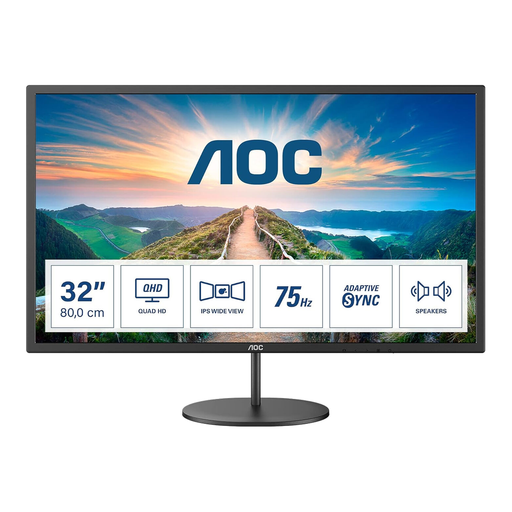
AOC Q32V4 31.5-inch IPS monitor
This is a larger-screen option to assess for adventure games, rather than a dedicated high-refresh gaming model. Its title specifies an IPS panel and AdaptiveSync. Confirm the exact resolution, typical brightness and connection support before deciding whether it fits your room and device.
Joybuy
Frequently asked questions
Can I use HDR peak brightness to judge a monitor for a bright room?
No: compare typical or SDR brightness separately from HDR peak brightness. BenQ lists 300 nits typical and 600 nits HDR peak for the EX2710U, while LG lists 275 nits typical and a separate peak claim for the 27GS93QE-B.
Is an HDR label enough to compare two monitors?
No: check the precise certification and model. VESA distinguishes its tested DisplayHDR and DisplayHDR True Black tiers from labels that merely resemble certification names.
What should I check before connecting a PC or console?
Confirm that the monitor’s port, your device output and your cable support the resolution and refresh rate you intend to use. BenQ lists HDMI 2.1 and DisplayPort 1.4 for the EX2710U; LG states QHD at 240 Hz over HDMI 2.1 for the 27GS93QE-B.
What should I do with an old monitor in the UK?
Check the electrical-equipment collection arrangements available through your retailer or local authority rather than putting a replacement monitor into an ordinary waste stream. GOV.UK identifies the Waste Electrical and Electronic Equipment Regulations 2013, as amended, as the underpinning UK legislation for the WEEE framework.


