For detective adventures played in a dim room, consider OLED for deep blacks or VA for a higher-contrast LCD alternative. If reading small clues and using the monitor for desktop work matter more, a 4K IPS model is another route, provided its dark-scene performance suits you. Check room lighting, OLED care requirements and your console’s supported output modes before prioritising a very high refresh rate.
Who this choice suits
Dark-room story explorers
If you usually play in subdued lighting, shadow detail and controlled HDR highlights may matter more to you than competitive-gaming speed. VESA describes its DisplayHDR True Black standard as relevant to gaming in subdued lighting.
Clue-focused 4K players
If you spend time reading maps, documents and small environmental details, consider a 4K screen at a size that works for your desk distance. The choice also matters if you use the same monitor for desktop reading.
Console detective gamers
If you play on PS5 or Xbox Series X|S, match the monitor’s HDMI, resolution, HDR and variable refresh rate capabilities to the output modes you intend to use. PlayStation’s guidance makes clear that supported PS5 modes depend on the connected display.
What matters when choosing
Choose the panel and screen size around your lighting and viewing distance, then check the precise input modes your PC or console can use. OLED, VA and IPS offer different trade-offs rather than one answer for every detective-adventure setup.
OLED
Consider it when: You mainly play dark, atmospheric games in subdued lighting and value deep blacks.
Allow for: Prolonged static high-contrast content can cause image persistence or burn-in, so check panel care and the exact warranty.
VA LCD
Consider it when: Dark-room contrast matters, but you prefer an LCD without OLED-specific burn-in risk.
Allow for: IPS generally offers wider viewing angles; assess motion handling on the individual VA model.
4K IPS
Consider it when: Fine on-screen detail and mixed gaming and desktop use drive your choice.
Allow for: RTINGS notes that VA LCD panels generally have higher contrast than IPS, a difference worth assessing for dark-room play.
| Concern |
What to check |
Who this matters to |
| Shadows and HDR |
Compare panel type, the precise HDR certification and model-specific dark-scene tests where available. VESA’s DisplayHDR True Black standard concerns emissive displays; a generic HDR label does not establish the same black-level behaviour. |
If clues disappear into dark scenes, I want blacks and highlights that preserve the atmosphere without obscuring what I need to see. Around 36% of consumers put dark-scene fidelity first. |
| Small clues |
Check native resolution, screen size and your usual viewing distance, as well as whether your device can output the resolution you want. |
When I examine case files or distant details, I need them to be comfortable to read at my desk. For around 29% of consumers, clue clarity is the primary concern. |
| Console modes |
Match the monitor’s documented HDMI input modes to the resolution, HDR, refresh rate and variable refresh rate combination you intend to use. |
If I play on a console, I want to know which display modes my setup can actually deliver, rather than relying on an HDMI badge alone. Console compatibility comes first for around 21% of consumers. |
| Mixed-use care |
For OLED, read the exact model’s care instructions and written burn-in warranty terms; consider how long fixed desktop elements will remain on screen. |
When the monitor doubles as a work screen, I need to weigh long periods of static content against the appeal of OLED blacks. Around 14% of consumers make mixed-use longevity their first priority. |
Buying pitfalls
-
Assuming every HDR label means the same dark-scene performance
HDR standards and implementations differ. VESA describes DisplayHDR True Black as a standard for emissive displays with deep black levels suited to subdued-lighting gaming.
Check the precise certification and panel technology, then consult independent tests of the specific monitor’s contrast and HDR behaviour where available.
-
Choosing OLED without planning for static desktop content
ASUS warns that prolonged static, high-contrast images can cause OLED image persistence or burn-in. A protection feature should not be treated as eliminating that risk.
Read the care guidance and written warranty for the exact model, and consider IPS or VA if fixed desktop elements will be on screen for long periods.
-
Expecting an HDMI 2.1 label to guarantee every console mode
A selected resolution, HDR setting, refresh rate and variable refresh rate mode must be supported by the console, game, cable and display together. PlayStation provides separate PS5 checks for several of these capabilities.
Compare the monitor’s documented input modes with your console’s settings, then test the combination you want after setup.
-
Relying on a return policy alone if something is faulty
A retailer’s voluntary returns policy is distinct from rights concerning faulty goods. GOV.UK provides consumer-rights guidance on faulty goods and refunds.
Keep your order details and test the monitor’s pixels, ports and intended display modes promptly. If you find a fault, contact the seller and consult the applicable consumer-rights guidance.
Brands to consider
Alienware
Dell UK lists the Alienware AW2725Q as a 27-inch 4K QD-OLED gaming monitor with a 240 Hz refresh rate.
- Its stated size, resolution and panel type make the AW2725Q relevant if you want compact 4K detail for dim-room play.
- Assess room brightness, desktop use and the exact OLED warranty before choosing this model.
LG UltraGear
LG UK lists both IPS and OLED UltraGear models, including the 27-inch 4K IPS 27G810A-B and the 32-inch 4K OLED 32GX850A-B.
- The two models give you distinct panel routes to assess against your lighting and desktop-use needs.
- The 27G810A-B’s HDMI 2.1 and the 32GX850A-B’s DisplayHDR True Black 400 are model-specific specifications, not features of every UltraGear monitor.
MSI
MSI UK lists the MPG 321URXW as a 4K QD-OLED gaming monitor.
- MSI states that its MPG 321URXW OLED-panel warranty runs for three years and includes burn-in safeguards.
- Read the written terms for the precise model and sales channel; this statement does not establish identical cover across MSI monitors.
ASUS ROG
ASUS provides OLED-monitor care guidance, including information about its Pixel Shift protection mechanism.
- The guidance is relevant if your gaming monitor will also display fixed desktop elements.
- ASUS warns that prolonged static high-contrast images can cause image persistence or burn-in; protection does not eliminate the need for model-specific care.
Samsung Odyssey
Samsung UK lists the 32-inch Odyssey OLED G80SD as a 4K QD-OLED gaming monitor.
- Its stated panel type and resolution make the G80SD a model to assess if you want OLED blacks alongside 4K detail.
- Check the exact connections, support terms and suitability for your room rather than extending this model’s specifications to the whole Odyssey range.
Joybuy monitors for detective adventures
These OLED monitors offer different screen sizes, shapes and stated resolutions for story-led gaming. Compare each format with your desk, viewing distance and need for fine clues; check OLED care and console modes for the exact model before ordering.
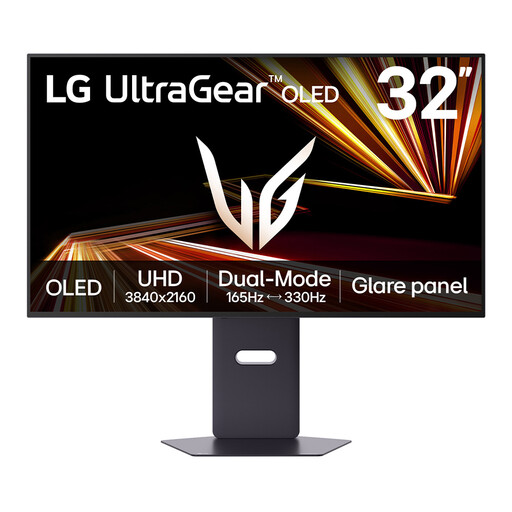 Image unavailable
LG UltraGear 32GX850A-B 32-inch 4K OLED
Consider this model for dark-room play when you also want 4K detail on a 32-inch screen.
LG UK specifies a 4K UHD OLED panel, VESA DisplayHDR True Black 400 and dual modes of UHD at 165 Hz or Full HD at 330 Hz for the 32GX850A-B.
Check the model’s OLED-care guidance and written burn-in cover if you will also use it for prolonged desktop work.
Joybuy
 Image unavailable
LG UltraGear 32GS95UV-B 32-inch 4K OLED
This model is worth considering if dark scenes and 4K detail matter, while its stated high-refresh modes also serve other kinds of gaming.
The product name specifies dual modes of 4K at 240 Hz and Full HD at 480 Hz, plus HDMI 2.1.
For detective adventures, check the display modes your device can use and read the model’s OLED-care and warranty terms before choosing it for mixed desktop use.
Joybuy
 Image unavailable
LG UltraGear 34GX900A-B 34-inch WQHD OLED
Consider the wider 34-inch format if it fits your desk and the games you intend to play.
The product name specifies WQHD and a 240 Hz refresh rate; WQHD is not 4K UHD.
Confirm the resolution modes supported by your device, and read the model’s OLED-care and warranty terms if it will display static desktop content.
Joybuy
 Image unavailable
Dahua 32-inch curved 4K OLED, 165 Hz
The curved 32-inch OLED format may suit a desk setup where you want 4K detail alongside OLED blacks.
The product name specifies 3840 × 2160 resolution, 165 Hz, HDMI 2.1 and HDR400.
Check the precise HDR certification rather than treating HDR400 as a DisplayHDR True Black claim, and review the model’s OLED-care and warranty terms.
Joybuy
 Image unavailable
Acer X Predator X49X 49-inch 32:9 QD-OLED
Consider this ultra-wide format only if you have room for a 49-inch screen and your games and devices suit a 32:9 display.
The product name specifies a 1800R curve, 240 Hz and DisplayHDR 400 True Black; it describes Double Quad HD rather than 4K UHD.
Check desk space, aspect-ratio support and the exact model’s OLED-care and warranty terms.
Joybuy
Common questions
Should I choose OLED, VA or IPS for dark detective games?
Choose OLED if you mainly play in subdued lighting and value deep blacks enough to accept OLED-care requirements; consider VA for higher-contrast LCD viewing without OLED-specific burn-in risk. IPS is another option when wide viewing angles, 4K detail or mixed desktop use matter, but assess the exact model’s blacks for dark-room play. RTINGS identifies higher contrast as a general VA advantage over IPS, not a guarantee for every monitor.
Is 240 Hz necessary for detective adventures?
No: establish dark-scene quality, readable detail and device compatibility before making 240 Hz a buying priority for story-led games. A higher refresh rate may still matter if you also play fast-paced games; check which rates your device and games can use.
What should I check before connecting a PS5?
Check the monitor’s documented HDMI modes and the resolution, HDR, refresh rate and variable refresh rate combination you want to use. PlayStation says the PS5 can inspect connected-display capabilities, while its 1440p test checks supported SDR and HDR modes at 60 Hz or 120 Hz and variable refresh rate.
How should I use an OLED monitor for both games and desktop work?
Follow the exact model’s panel-care instructions and keep its recommended protection features enabled. ASUS warns that prolonged static high-contrast images can cause image persistence or burn-in; its Pixel Shift guidance does not establish identical features or warranty cover on other models.


