Start by comparing 27-inch-class monitors, but measure the stand and available desk space before choosing one. For detailed RPG environments, consider 4K if your gaming system can deliver the performance you want; QHD places less demand on graphics hardware, while OLED and IPS offer different panel characteristics. Check the exact input modes and, for an OLED model, the care features and warranty terms.
Who these monitors suit
RPG players with limited desk space
A 27-inch-class screen gives you a useful size to compare without starting at 32 inches. RTINGS identifies 27 inches as a suitable gaming-monitor size for many people, but your desk still needs room for the stand, cables and viewing position.
Players who prioritise fine detail
If spacecraft interiors, environments and on-screen text matter more to you than reaching the highest frame rates, compare 27-inch-class 4K models. Check how your PC or console performs at 3840 × 2160 before settling on that resolution.
Players balancing detail and frame rate
QHD is worth considering if you want to reduce the rendering demand of 4K. QHD OLED and Fast IPS are distinct panel routes, so compare their characteristics alongside the frame rates your system achieves in the games you play.
What matters when choosing
For a small-desk RPG setup, establish physical fit first, then choose the resolution and panel that suit your games and hardware. Confirm the connection mode before ordering.
| Concern | What to check | Who this matters to |
|---|
| Detail and HDR |
Compare 4K with QHD at the same screen size, then check panel type and the conditions attached to HDR brightness figures. |
If fine environmental detail and dark-scene presentation are my priorities, I want to judge the image characteristics rather than rely on an HDR label alone. Around 29% of consumers would put detail and HDR first. |
| Resolution and frame rate |
Check your game frame rates at QHD and 4K, plus the refresh rate available through your intended input. |
When my PC struggles at 4K, I would rather choose a mode that delivers the frame rates I want in my RPGs. Roughly 36% of consumers would prioritise this performance balance. |
| Desk fit |
Measure usable desk width and depth; compare stand dimensions, cable clearance and any VESA-arm requirements. |
With little room behind my keyboard, I need the stand or arm to fit before screen specifications matter. About 21% of consumers would make physical fit their primary concern. |
| Device connections |
Confirm resolution, refresh rate and variable refresh rate for each input; check USB-C display and power functions if needed. |
If I switch between a PC, console or dock, each device needs to work at the display mode I intend to use. Around 14% of consumers would put connection compatibility first. |
Buying pitfalls
-
Choosing by screen diagonal alone
A 27-inch screen does not tell you how much desk depth its stand uses or how much clearance the cables need.
Measure the usable desk area against the exact stand dimensions. If you plan to use an arm, check the monitor mount, weight and desk-clamp compatibility.
-
Buying refresh rate without checking game FPS
A high-refresh monitor cannot display unique frames that your PC has not generated. The benefit of an extreme refresh rate also depends on the games you play.
Compare frame rates for your own RPGs at QHD and 4K, then choose a monitor and input mode that match your priorities.
-
Reading peak HDR brightness as full-screen brightness
Peak and typical brightness figures can describe different test conditions, particularly on OLED monitors.
Compare figures stated under equivalent conditions. If you play in a bright room, assess the screen in comparable lighting where possible.
-
Leaving an old monitor until disposal day
If you are replacing a monitor, the retailer’s electrical-equipment take-back arrangement may affect how you return the old one.
Ask the seller which like-for-like take-back or collection option applies to your order before checkout.
Brands to consider
These examples illustrate particular monitor lines, not a judgement about every model from each brand.
ASUS ROG
The UK-listed ROG Swift OLED PG27UCDM is a 26.5-inch 4K QD-OLED model with a 240Hz refresh rate, according to ASUS ROG UK.
- Its stated connections include HDMI 2.1, DisplayPort 2.1a and USB-C power delivery.
- ASUS describes OLED Care Pro and a proximity sensor as burn-in risk-reduction features, not a guarantee against image retention.
Alienware
Dell UK lists two different 27-inch routes: the 4K 240Hz QD-OLED AW2725Q and the QHD Fast IPS AW2725DM.
- The two models give buyers a clear resolution and panel-type comparison within the Alienware range.
- Check the exact model’s stand and input specifications; the features of one do not establish those of the other.
LG UltraGear
LG UK lists the 27GS95QE-B as a 27-inch QHD OLED monitor with a 240Hz refresh rate.
- It is a QHD OLED option for buyers comparing panel type alongside resolution.
- LG publishes brightness figures for different conditions; compare like-for-like conditions rather than a peak figure alone.
MSI
MSI UK specifies the MPG 271QR QD-OLED X50 as a QHD QD-OLED model with a 500Hz refresh rate.
- Its stated connections include HDMI 2.1, DisplayPort 2.1a and USB-C DisplayPort Alt Mode.
- For RPG-led play, judge that refresh rate against the frame rates your system produces rather than treating the specification as a game-performance result.
Joybuy product choices
These models cover QHD OLED and 4K IPS choices for a 27-inch-class setup. Compare their stated screen specifications, then confirm stand fit and the modes supported by your gaming system.
 Image unavailable
Samsung Odyssey G6 S27DG612 27-inch QHD OLED 240Hz
Consider this QHD OLED model if you want to compare an OLED screen with 4K alternatives for RPG play.
The product name states a 27-inch screen, 240Hz refresh rate and 0.03ms response time. Check the stand footprint against your desk and review the warranty terms if static interface elements are part of your routine.
View on Joybuy
 Image unavailable
Acer X Predator X27U W3 26.5-inch QHD QD-OLED 240Hz
This is another QHD OLED-panel choice for players comparing dark-scene presentation with the graphics demand of 4K.
The product name specifies QD-OLED, HDR10 and a 0.03ms response time. Confirm the full stand dimensions before deciding whether it fits your desk.
View on Joybuy
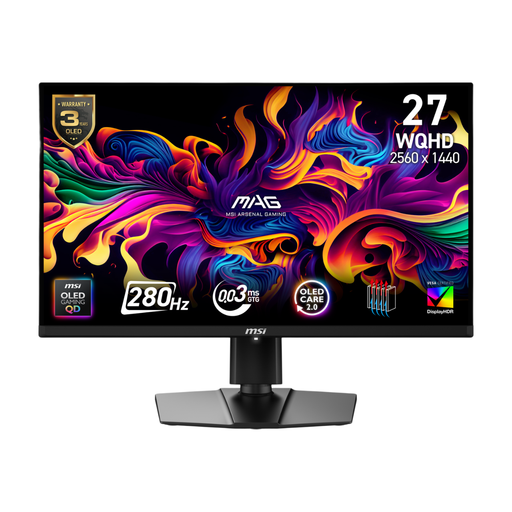 Image unavailable
MSI MAG 271QP QD-OLED X28 27-inch QHD 280Hz
Consider this QHD QD-OLED model if OLED-panel characteristics matter to you and you also play games that may benefit from high refresh rates.
The product name states a 0.03ms response time. Check your game frame rates and the monitor’s actual stand footprint rather than assuming either from its screen size.
View on Joybuy
 Image unavailable
LG UltraGear G8 27G850A 27-inch 4K Nano IPS Dual-Mode
This 4K IPS option suits a comparison focused on fine image detail without choosing an OLED panel.
The product name identifies a dual-mode design, but the stated refresh-rate modes conflict. Confirm the modes for this exact model and input before buying, and check the stand footprint against your desk.
View on Joybuy
 Image unavailable
LG UltraGear 27G810A-B 27-inch 4K IPS Dual Mode
Consider this 4K IPS model if resolution is a priority and your system can deliver the performance you want in your RPGs.
The product name identifies a dual-mode monitor, but its stated refresh-rate modes conflict. Verify the exact modes and full stand dimensions for this model before ordering.
View on Joybuy
Frequently asked questions
Is 27 inches sensible for a small RPG desk?
It is a useful starting size, not a guarantee of fit. RTINGS identifies 27 inches as a suitable gaming-monitor size for many people; measure your desk against the complete stand dimensions, cable clearance and intended viewing position.
Should I choose 4K or QHD for science-fiction RPGs?
Choose 4K when fine detail matters most and your system runs your games satisfactorily at 3840 × 2160. Choose QHD when reducing graphics demand or pursuing higher frame rates matters more; compare performance using the games and settings you intend to use.
Do OLED-care features remove image-retention concerns?
No. ASUS describes the care features on its PG27UCDM as measures to reduce burn-in risk, not eliminate it. Consider how often you display static desktop or game-interface elements and read the terms for the exact monitor.
What should I check when connecting a PC, console or USB-C device?
Confirm the resolution, refresh rate and variable refresh rate supported through the exact input you will use. Check USB-C display capability and power delivery separately if your setup needs them; a port name alone does not establish every supported mode.
What should I do with an old monitor when buying a replacement?
Ask the seller which electrical-equipment take-back arrangement applies to your replacement purchase. GOV.UK says distributors generally have like-for-like take-back responsibilities, but the available route and applicable conditions should be confirmed with the seller.


