Dark-scene world builders
You play in a dim room and want to distinguish shadowed buildings, night skies and torchlit areas while viewing your settlement. Panel type and a named HDR certification are useful starting points.


If night scenes and torchlit buildings matter most, consider an OLED monitor with a named VESA DisplayHDR True Black certification, but check the exact model’s static-image care and warranty before using it for long sessions with a fixed game interface. Choose 4K for finer map and interface detail if your PC can run the game at that resolution; a QHD IPS monitor is a non-OLED alternative when persistent management panels matter more than OLED black levels.
You play in a dim room and want to distinguish shadowed buildings, night skies and torchlit areas while viewing your settlement. Panel type and a named HDR certification are useful starting points.
You spend long sessions looking between the town, placement grids and resource panels. Screen size, native resolution and the detail your PC can render are central to your choice.
You often leave menus or management elements in fixed positions. ASUS UK warns that prolonged display of a static, high-contrast image can cause image persistence or burn-in on OLED displays, making model-specific care guidance important.
For dark-room medieval settlement building, decide how much you value night-scene contrast and map detail before choosing between OLED panel care and a conventional IPS option. A wider screen is a separate consideration: its shape does not replace checks on resolution, panel type or game-interface fit.
Consider it when: You want OLED dark-scene presentation alongside fine detail in settlement maps and interface text.
Trade-off: 4K places greater demands on the PC than QHD, while prolonged static, high-contrast interface elements require OLED care.
Consider it when: OLED black levels matter more to you than the extra map and text detail of 4K.
Trade-off: QHD has fewer pixels than 4K, and choosing OLED still calls for attention to static-image care.
Consider it when: Fixed management panels and long mixed-use sessions take priority over OLED black levels.
Trade-off: The BenQ MOBIUZ EX271Q’s specified 1000:1 native contrast is a different dark-scene proposition from OLED’s per-pixel blacks.
| Concern | What to check | Who this matters to |
|---|---|---|
| Dark-scene contrast and HDR | Check the panel type and the exact VESA DisplayHDR or DisplayHDR True Black tier, rather than relying on an HDR label alone. | When I explore my settlement at night, I want shadowed buildings and light sources to remain visually distinct. Around 37% of consumers put dark-scene contrast and HDR first. |
| Map and interface detail | Compare native resolution with screen size, then consider whether your PC can run your game at the resolution you want. | Reading resource panels while planning building placement makes small details a priority for me; around 27% of consumers put map and interface clarity first. |
| Static HUD and panel care | For OLED, read the exact model’s protection guidance and warranty terms for prolonged static, high-contrast images. | If management panels stay in place throughout my sessions, I want a screen whose care requirements suit that use. Roughly 18% of consumers prioritise persistent-interface use. |
| Movement and connections | Match the intended resolution and refresh rate to the monitor input, your device output and cable; check adaptive-sync compatibility where relevant. | I want town panning and view changes to work as intended with my PC, without choosing a display mode my connection cannot deliver. Around 18% of consumers make smooth play and connectivity their primary concern. |
An HDR label alone does not identify a VESA certification tier. VESA says its DisplayHDR and DisplayHDR True Black certifications indicate that a display meets the relevant tested specification.
Look up the named certification for the exact monitor, then decide whether its panel type and tier meet your priorities for night scenes.
Menus, resource bars and minimaps can stay in the same positions for long periods. ASUS UK warns that prolonged static, high-contrast images can cause OLED image persistence or burn-in.
Read the model’s OLED care instructions and warranty terms before buying. If keeping a fixed interface visible is your overriding concern, compare a QHD IPS option as well.
An OLED model may also require regular attention to its panel-care guidance during long sessions.
Dell UK lists the Alienware AW3225QF as a 4K 240Hz monitor, but that specification does not establish which mode your PC, port and cable can deliver together.
Check the monitor’s supported modes by input against your graphics card, cable and expected game performance before ordering.
These model examples illustrate different ways to balance dark-room viewing, map detail and persistent interface use; a brand name alone does not establish the features of every monitor in its range.
Dell UK lists 4K QD-OLED choices at two sizes: the 27-inch AW2725Q and 31.6-inch AW3225QF.
The LG UK listing for the 27GS95QE-B offers a 27-inch QHD OLED example for players considering OLED without choosing 4K.
The EX271Q is a 27-inch QHD IPS alternative for players who prefer a conventional LCD monitor.
RTINGS describes the ROG Swift OLED PG32UCDM Gen3 as a 4K 240Hz QD-OLED gaming monitor.
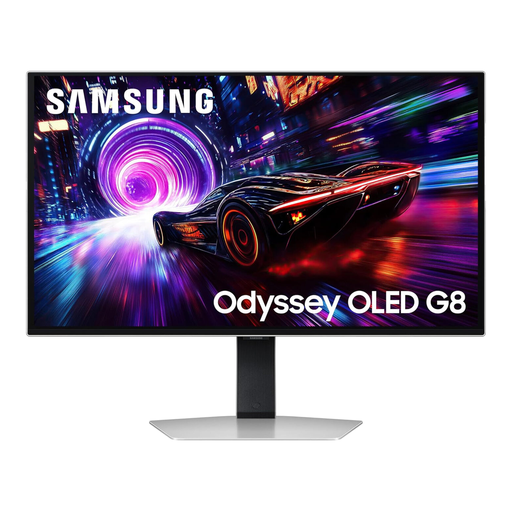
Joybuy’s listing for the Samsung Odyssey G81SF illustrates a 32-inch 4K QD-OLED option.
These monitors cover 4K OLED, QHD OLED, a wide 49-inch OLED format and a 32-inch QHD choice. Compare each one with the space on your desk, your game’s interface and the display mode your PC can support.
 No image available
Consider this model if you want a large 4K OLED view for night scenes and detailed settlement maps. Joybuy lists a 32-inch QD-OLED panel, 240Hz and VESA DisplayHDR True Black 400. Check this variant’s OLED care and warranty terms, and confirm that its inputs support the mode you intend to use.
 No image available
Consider the wider format if a broad settlement view appeals to you and you have room for the screen. Its stated specifications include a 32:9 shape, 1800R curve and 240Hz refresh rate; this is not a 4K-format choice. Check how your game uses 32:9, along with OLED care guidance and the display mode supported by your PC and connections.
 No image available
This 32-inch Ultra HD OLED model is another option for players prioritising map detail alongside an OLED screen. Check the exact model’s HDR certification, OLED care and warranty terms, and supported input modes before choosing it for long sessions with a persistent interface.
 No image available
This is a QHD OLED choice if dark-room viewing matters more to you than 4K map detail. The model name specifies a 27-inch screen and 240Hz refresh rate. Check its exact HDR certification and OLED care and warranty terms before using it for prolonged sessions with fixed management panels.
 No image available
Consider this 32-inch QHD model if you want a larger screen for viewing your settlement without choosing a 4K monitor. Its stated specifications include 2560 × 1440 resolution and 165Hz. Check the panel and HDR characteristics against your dark-scene priorities, and confirm which refresh mode your chosen connection supports.
OLED is worth considering when deep blacks and night-scene contrast are your priorities, but it is not an automatic choice for long sessions with a fixed interface. ASUS UK warns that prolonged static, high-contrast images can cause OLED image persistence or burn-in; read the protection guidance and warranty for the exact model.
Choose 4K if finer map and interface detail matters to you and your PC can run the game at your intended settings. QHD is less demanding on the PC; LG UK lists the 27-inch 27GS95QE-B OLED at 240Hz, while BenQ UK specifies 180Hz through DisplayPort for its 27-inch EX271Q IPS model.
Check the monitor’s supported mode for the input you plan to use, then match it to your graphics card, cable and expected game performance. Dell UK lists the AW3225QF at 4K and 240Hz, but that monitor specification alone does not establish what every connected PC can deliver.
Keep the order confirmation, product listing and evidence of the fault, then contact the seller about the remedy available in your circumstances. GOV.UK states that consumer law protects purchases of goods made remotely or in person; a retailer’s voluntary returns policy does not replace applicable statutory rights.