What matters when choosing
Choose a route only after checking that its screen and stand can be positioned on your desk. From there, decide whether your main priority is compactness, room for game interfaces or features for faster games.
Compact Full HD
Consider it when: desk width and stand space constrain where the screen can go.
Trade-off: 1920×1080 provides fewer pixels for maps and open panels than QHD.
27-inch QHD IPS
Consider it when: a 27-inch screen fits comfortably and you want more room for menus, maps and desktop windows.
Trade-off: the larger panel and its stand need sufficient desk space; a higher refresh rate is a separate choice.
27-inch QHD OLED
Consider it when: management games are part of a wider mix that makes OLED image characteristics and fast motion important to you.
Trade-off: RTINGS flags prolonged static content as a burn-in consideration; it is not a prediction about an individual monitor.
| Concern |
What to check |
Who this matters to |
| Desk fit and positioning |
Measure usable width and depth from your seated position. Compare the stand footprint and adjustment range; check desk and monitor compatibility before choosing an arm. |
If I need room for my keyboard and mouse, the screen still has to sit directly ahead at a workable distance. Around 34% of consumers put desk fit first. |
| Maps, text and menus |
Compare 2560×1440 QHD with 1920×1080 Full HD alongside screen size, and check the game’s text-scaling options. |
I want to keep maps and information panels visible without constantly rearranging them. For around 33% of consumers, interface space is the primary need. |
| Mixed-game smoothness |
Distinguish native from overclocked refresh rates and check the required graphics output, cable and variable-refresh compatibility. |
If I switch between management games and faster titles, I may use a higher refresh rate beyond my strategy sessions. Around 20% of consumers put mixed-game smoothness first. |
| OLED presentation |
Consider time spent with fixed interface elements, and read the exact model’s warranty and panel-care guidance. |
I value OLED image characteristics for my wider game library, but my management-game menus may stay in place for hours. OLED presentation comes first for around 13% of consumers. |
Joybuy monitor options
These options span compact Full HD screens and 27-inch QHD IPS and OLED models. Compare each one with the space available on your desk and the kinds of games you play, rather than treating a higher refresh rate as a substitute for a suitable viewing position.
 No image available
Samsung Odyssey G6 S27DG612 27-inch QHD OLED 240Hz
Consider this QHD OLED model if you have room for a 27-inch screen and also play faster games. The product name specifies 240Hz and a 0.03ms response time. For long sessions with fixed management-game interfaces, consider RTINGS’ general OLED static-content caution and check the model’s warranty and panel-care guidance.
View on Joybuy
 No image available
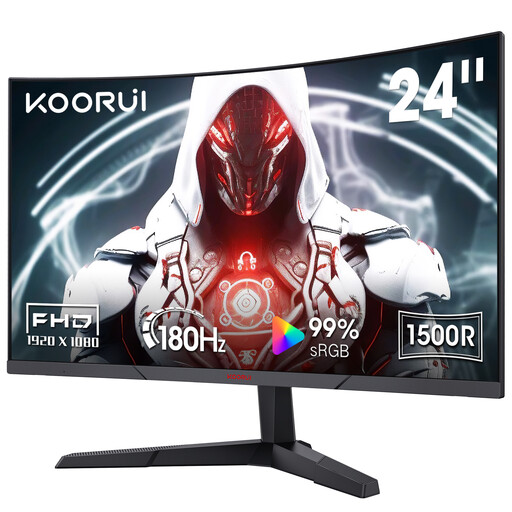
KOORUI MG24A12FV2 24-inch curved Full HD 180Hz
Consider the 24-inch format when desk width is a priority but you also play faster games. The product name specifies a VA panel, 1500R curvature, 180Hz and Adaptive Sync. Full HD offers fewer pixels for dense interfaces than QHD; check the stand footprint and available adjustment against your desk setup.
View on Joybuy
 No image available
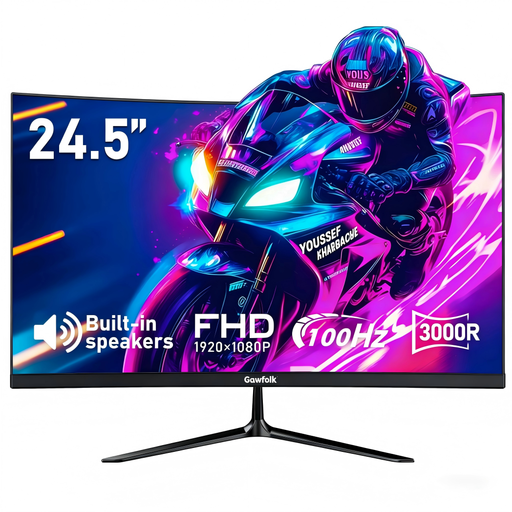
Gawfolk 24.5-inch curved Full HD 100Hz
This 24.5-inch option is worth considering when a compact screen matters more than QHD workspace. Its product name specifies 3000R curvature, built-in speakers and VESA 75×75mm mounting. Check where the supplied stand will sit and whether its adjustment meets your viewing needs.
View on Joybuy
 No image available
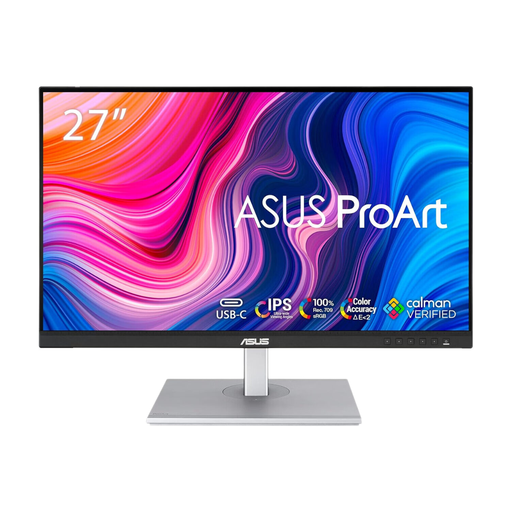
ASUS ProArt PA278CFRV QHD IPS 100Hz
Consider this 27-inch QHD option when room for management-game interfaces matters more than a gaming-focused refresh specification. Its product name specifies an IPS panel and 100Hz. Check that the screen and stand fit your desk at a comfortable viewing distance.
View on Joybuy
 No image available
HKC G27H2DPro 27-inch QHD Fast IPS 220Hz
Consider this QHD model if a 27-inch screen fits and faster games are also part of your routine. Its product name specifies 2560×1440 resolution and 220Hz. Check the stand’s footprint and adjustment against your desk, and consider reflections at your viewing position.
View on Joybuy
Common questions
What screen size should I consider for a small desk?
Start with the space and viewing position you can actually provide, not the diagonal measurement alone. The Health and Safety Executive advises placing a screen directly ahead, about an arm’s length away, with its top around eye level; compare stand depth as well as panel width before deciding whether 23.8 or 27 inches will work.
Is QHD useful for management games?
QHD is useful if you want more pixels for maps, menus and other windows and can accommodate the screen comfortably. Dell’s 27-inch P2725D, for example, is specified at 2560×1440 and 100Hz; a smaller Full HD model remains a reasonable choice when physical fit takes priority.
Do management games need a monitor above 100Hz?
A higher refresh rate is not the starting requirement for choosing a management-game monitor. Consider it if faster genres also matter to you, and check connection requirements for the mode you want: LG says the 200Hz overclocked mode on its 27GS85Q-B requires a DisplayPort 1.4-capable graphics card and cable.
Should I rule out OLED if a game has a fixed interface?
Not automatically, but prolonged fixed-interface use deserves consideration. RTINGS identifies constant static elements as an OLED burn-in risk, particularly for extensive desktop or fixed-HUD use; read the exact monitor’s warranty and care guidance and compare how you would use an IPS alternative.
What if I also work at this desk?
Pay attention to screen position, lighting and breaks as well as monitor features. The Health and Safety Executive advises these measures for display-screen work; a monitor feature alone should not be treated as a substitute for an appropriate workstation setup.


