What matters when buying
Measure the space first, then decide how much map and interface detail you want; assess motion and connections against the games and devices you actually use.
| Concern | What to check | Who this matters to |
|---|
| Desk fit |
Compare usable desk width and depth with the monitor’s full dimensions, including its stand. |
If my keyboard and mouse would be cramped, I need the screen and stand to fit before anything else; around 39% of consumers put desk fit first. |
| Map and menu detail |
Compare native resolution and screen size; check whether your PC can run the game satisfactorily at QHD. |
When I spend hours reading build menus and surveying a settlement, I want enough pixels to make that information usable; around 31% of consumers prioritise interface detail. |
| Smooth play |
Check the standard refresh rate separately from overclocked modes, plus the required port and adaptive-sync compatibility. |
If I switch between settlement building and faster games, smooth camera movement matters to me too; roughly 15% of consumers make motion their primary concern. |
| Connections and positioning |
Match device outputs to monitor inputs, and check stand adjustment or the VESA pattern if you plan to use an arm. |
With a laptop or console sharing my desk, I need the intended connection and screen position to work in practice; about 15% of consumers put setup compatibility first. |
Joybuy product choices
These near-27-inch choices include QHD gaming displays, a 27-inch 4K gaming display and a QHD professional display for shoppers who also use the desk for other work. Check each model’s footprint and connections against your setup rather than treating the list as interchangeable options.
 Image unavailable
Samsung Odyssey G6 S27DG612 27-inch QHD OLED 240Hz
Consider this for settlement detail alongside faster games if a 27-inch screen fits your desk.
The product name specifies QHD OLED and 240Hz. Compare its full stand dimensions with your available width and depth, and check that your device supports the refresh mode you want.
View on Joybuy
 Image unavailable
LG UltraGear G8 27G850A 27-inch 4K UHD Nano IPS, Dual-Mode 240Hz/480Hz
Consider the higher-resolution route if you want a 27-inch screen for detailed maps and your PC can run your chosen games at the intended setting.
The product name specifies 4K UHD, Nano IPS and dual refresh modes. Check the full stand footprint and the resolution, port and cable conditions for the mode you plan to use.
View on Joybuy
 Image unavailable
Acer X Predator X27U W3 26.5-inch QHD QD-OLED 240Hz
This near-27-inch QHD option suits a desk that can accommodate its full stand as well as your keyboard and mouse.
The product name specifies 2560 × 1440, QD-OLED and 240Hz. Confirm stand dimensions, mounting details and the connection needed for your chosen mode.
View on Joybuy
 Image unavailable
HKC G27H2DPro 27-inch QHD Fast IPS 220Hz
Consider this 27-inch QHD option if desk fit and readable settlement interfaces are your starting requirements.
The product name specifies 2560 × 1440, Fast IPS and 220Hz. Confirm the dimensions with stand, adjustment and mounting options before planning its position.
View on Joybuy
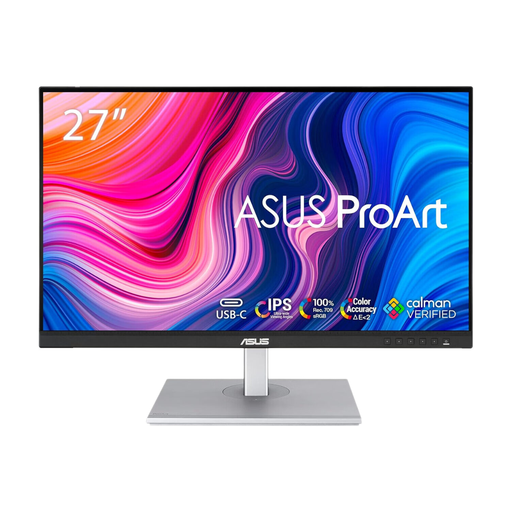 Image unavailable
ASUS ProArt PA278CFRV QHD IPS 100Hz
This QHD professional display is an option if you use the desk for settlement building and other screen-based work rather than choosing solely for gaming features.
The product name specifies IPS and 100Hz. Check its full footprint and the exact ports on the variant offered if those affect your setup.
View on Joybuy
Common questions
Is a 27-inch monitor too large for a small desk?
Not necessarily: the deciding measurement is the monitor’s full width and depth with its stand, not just its diagonal. Check that the keyboard and mouse still have usable space; choose 24–25 inches if a 27-inch setup would crowd them out.
Should I choose QHD over 1080p for a settlement-building game?
Start with QHD if a 27-inch screen fits and your PC runs your games satisfactorily at 2560 × 1440; it provides more pixels for maps and menus than 1920 × 1080. A smaller 1080p display remains an option when desk space or PC performance is the tighter limit.
Will a USB-C monitor show video from my laptop?
Only if the laptop’s output and the monitor’s input support a compatible video mode. For the ASUS ROG XG27ACS, ASUS specifies DisplayPort Alt Mode on the source device, so check the laptop’s port rather than relying on its connector shape.
Do I need DisplayPort for the highest refresh rate?
Check the particular monitor and mode: LG requires a DisplayPort 1.4-capable graphics card and cable for the 27GS75QN-B’s 200Hz overclocked mode, while Dell specifies different QHD limits for DisplayPort and HDMI on the G2725D. Match the monitor’s input requirements with your device and cable before ordering.


