What to check when choosing
Decide whether your primary task is drawing 2D icons, sharing the PC with current games, or creating 3D assets. That choice determines which specification deserves the closest check.
| Concern |
What to check |
Who this matters to |
| Responsive 2D work |
Check installed RAM for your mix of open applications, plus SSD capacity for projects and games. Adobe describes 8GB RAM as an Illustrator baseline, not a target for every workload. |
If I mainly draw flat icons, I want my design application and reference material open without choosing graphics hardware for work I do not do. Around 44% of consumers put responsive 2D work first. |
| Games and multitasking |
Compare the fitted processor, GPU, RAM and SSD against the games and applications you plan to run. MSI calls 16GB RAM a baseline for most modern games and positions 32GB for higher-load use. |
My icon projects share a PC with current games, so I need a configuration that accounts for both activities. For around 33% of consumers, that balance is the primary concern. |
| 3D asset creation |
For Blender on Windows, compare installed RAM and the GPU’s graphics memory with Blender Foundation’s recommended 32GB and 8GB respectively; check software and driver compatibility too. |
When I model or render the object behind an icon, I need to choose for that 3D workload rather than the size of the finished image. Around 23% of consumers prioritise 3D creation. |
Gaming PCs for icon work and games
These laptops and desktops offer different ways to combine icon work with gaming or planned 3D asset creation. Compare the fitted memory, graphics and storage with your own software and games; the laptops also provide built-in displays, while display arrangements for towers and bundles need checking.
 No image available
Lenovo Legion Pro 7 16IAX10H, 83F5000UUK
Consider this laptop if gaming and planned 3D asset work call for substantial fitted memory; check your software’s GPU and driver requirements separately.
16-inch model with Intel Core Ultra 9, 64GB RAM, 2TB SSD, NVIDIA GeForce RTX 5090 and Windows 11 Home.
If colour matching matters for your icons, confirm the display’s colour coverage before buying.
Joybuy
 No image available
Lenovo LOQ Essential 15ARP11 gaming laptop
This laptop is an option for consumers combining icon design with gaming; if 3D work is planned, check its memory limits against the applications you use.
AMD Ryzen 7 170, 16GB RAM, 1TB SSD and GeForce RTX 5050; 15.6-inch, 144Hz FHD display.
Its fitted 16GB RAM is below Blender Foundation’s recommended 32GB for Windows.
Joybuy
 No image available
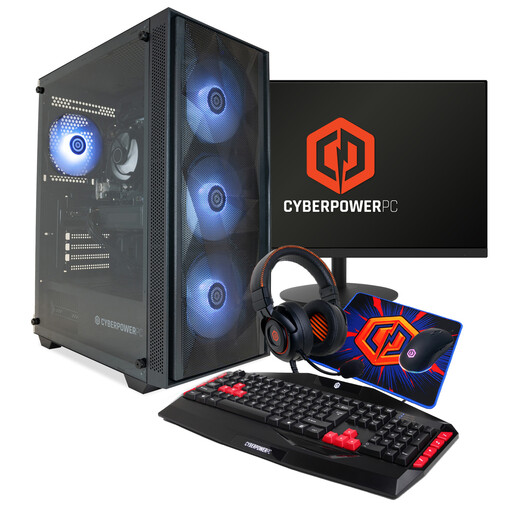
CyberPowerPC JOYB1004 gaming PC bundle
Consider this desktop bundle if you need a monitor and input devices as well as a PC for games and icon work.
AMD Ryzen 5 7500F, NVIDIA GeForce RTX 5060 with 8GB graphics memory, 16GB DDR5 RAM, 1TB NVMe SSD and Windows 11 Home. The bundle lists a monitor, keyboard, mouse, headset and mousepad.
Confirm the supplied monitor’s resolution and colour coverage for your artwork. The fitted RAM is below Blender Foundation’s recommended 32GB for Windows.
Joybuy
 No image available
CyberPowerPC JOYB1013 gaming desktop
Consider this tower if 3D asset work is part of your plans: its named RAM and graphics-memory capacities can be compared with your software’s requirements.
AMD Ryzen 7 9800X3D, NVIDIA GeForce RTX 5080 with 16GB graphics memory, 32GB DDR5 RAM, 2TB NVMe SSD and Windows 11 Home.
A monitor, keyboard, mouse, headset and mousepad are not included. Check software and driver compatibility for your intended creative workflow.
Joybuy
 No image available
Lenovo Legion T7 34IAS10 gaming tower
This tower is worth comparing if your icon projects may involve 3D assets as well as games; check the requirements of the particular applications you intend to run.
Intel Core Ultra 7 265K, 32GB RAM, 1TB SSD, RTX 5070 Ti and Windows 11 Home.
Confirm whether your order includes a monitor or whether you need to arrange one separately.
Joybuy
Frequently asked questions
Do I need a powerful gaming GPU just to draw 2D inventory icons?
Not solely for that task. Adobe says available RAM can help Illustrator performance, particularly with several applications open, although GPU acceleration is available. Choose the graphics card with any games, GPU-accelerated tools or 3D work in mind as well.
When is 32GB RAM worth considering?
Consider 32GB if you plan to run demanding games and creative applications together or create assets in Blender. MSI positions 16GB as a baseline for most modern games and 32GB for higher-load gaming and content creation; Blender Foundation recommends 32GB for its Windows configuration. Check the needs of your actual applications before treating either figure as a universal requirement.
What should I check before ordering a configured gaming PC?
Save the final component list, including the processor, exact GPU and graphics memory, fitted RAM, SSD and display connections, then check the seller’s cancellation and warranty terms. For England, Citizens Advice notes that the usual distance-purchase change-of-mind period has an exception for personalised or custom-made goods; whether it applies to a particular configuration depends on the order, and this is separate from remedies for faulty goods.
Does a gaming PC listing tell me whether its display suits icon design?
No: assess the display separately from the PC’s gaming components. For a laptop or bundled monitor, confirm the exact screen specification and colour coverage you need; for a tower, check whether a monitor is included and that its connections suit the PC.
How should I dispose of an old desktop PC?
Use an appropriate electrical-equipment recycling or take-back route rather than treating the PC as ordinary rubbish. GOV.UK describes the UK waste electrical and electronic equipment framework as supporting recovery, reuse and recycling; check the options offered by your local authority or retailer.


