Latency-focused competitive trainees
If responsive-feeling games or reaction drills are your priority, assess the PC alongside your input devices and display. NVIDIA describes all three as parts of system latency.


Choose a gaming PC that can run your intended games at your monitor’s resolution and refresh rate, then check the monitor and peripherals as part of the same setup: the tower alone cannot determine end-to-end reaction latency. NVIDIA identifies peripheral, PC and display latency as separate parts of that chain. In a game that supports NVIDIA Reflex, a compatible RTX setup offers a rendering-latency feature, but it does not replace checks on headset connections, display settings and the exact PC configuration.
If responsive-feeling games or reaction drills are your priority, assess the PC alongside your input devices and display. NVIDIA describes all three as parts of system latency.
If the desktop will also handle games, voice chat and browser tasks, compare complete CPU, graphics, memory and storage configurations rather than choosing on a latency feature alone.
If you already own headphones and a monitor, the exact audio, USB and display connections affect whether they fit your setup. Check the selected desktop’s ports, not just its gaming-PC label.
Start with the game or training application and the monitor you will use. That establishes what to check in a PC before you compare headset connections and other desk-setup details.
| Concern | What to check | Who this matters to |
|---|---|---|
| Reaction responsiveness | Check the intended game’s requirements and Reflex support, if relevant; confirm that the PC’s display output and your monitor can use its intended refresh rate. | If I practise in a latency-sensitive game, I want the PC and monitor working together rather than assuming a GPU label tells the whole story. Around 43% of consumers put end-to-end responsiveness first. |
| Gaming and task headroom | Compare the exact processor, GPU, memory and storage for the games and background applications you plan to run. | When I practise alongside gaming, chat or browser tasks, I need a configuration suited to that combined workload. Balanced use is the primary concern for around 29% of consumers. |
| Desk connectivity | Match your headphone connector to the audio or USB ports, and check the required monitor and network connections on the precise model. | I already have headphones and a monitor, so straightforward connections matter before I choose a tower. Around 28% of consumers make compatibility with their desk setup the priority. |
A frame-rate figure applies to particular game conditions; it does not measure the delay from input through the PC to the display. NVIDIA distinguishes peripheral, PC and display latency.
Match the PC to your game and monitor, select the monitor’s intended refresh rate, and check whether your game offers a supported latency feature.
An analogue headphone socket will not answer the same connection need as a USB port or Bluetooth support. Port layouts also vary between desktop configurations.
Identify your headphones’ connector and your monitor’s input, then compare both with the exact model’s front and rear connections.
A connection mismatch may mean using an adapter or a different cable.
One Joybuy Acer Nitro N20 listing uses a desktop title but describes a laptop. Conflicting form-factor information makes the precise model important to establish before ordering.
Cross-check the model number, desktop specification and included equipment against the product you intend to buy.
Configurable desktops can differ in their final operating-system selection. If you plan to install Windows 11 yourself, its hardware requirements also matter; Microsoft lists TPM 2.0 and UEFI Secure Boot capability among them.
Confirm the supplied operating system and final component list for the chosen configuration before purchase.
A configurable gaming-desktop route if you want to specify components around an existing monitor and headset.
Dell’s gaming-desktop line offers higher-tier configurations for buyers whose wider gaming workload calls for them.
The ROG GM700 is a prebuilt example worth examining if convenient front connections matter to your desk setup.
The MAG Infinite S3 line provides a prebuilt route for comparing a stated desktop configuration.
Nitro and Predator are fixed-configuration desktop lines to compare by complete model code.
These prebuilt desktops offer different ways to assemble a gaming-and-reaction-practice setup, including one bundle with a monitor and headset. Match any choice to your game, display and headphone connections; component lists alone do not establish full-system latency.
 No image available
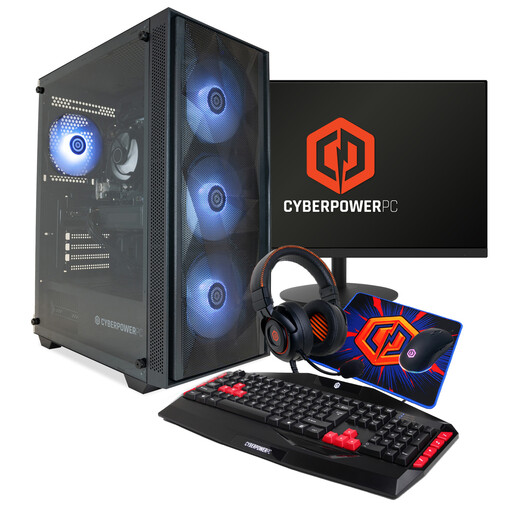
Consider this bundle if you need a desktop and desk peripherals together; confirm the monitor’s refresh rate and the headset’s connection before choosing it.
The named configuration has an AMD Ryzen 5 7500F, NVIDIA GeForce RTX 5060 8 GB, 16 GB DDR5, 1 TB NVMe SSD and Windows 11 Home. The bundle also names a keyboard, mouse and mousepad.
 No image available
Consider this configuration if your intended gaming and background tasks call for its stated components; check the monitor and headset connections needed for your setup.
Its name specifies an AMD Ryzen 7 9800X3D, NVIDIA GeForce RTX 5080 16 GB, 32 GB DDR5, 2 TB NVMe SSD and Windows 11 Home. These specifications do not establish a full-system latency result.
 No image available
Consider this desktop if you want its stated configuration for gaming alongside other applications; verify the audio and display connections for your existing equipment.
Its name specifies an Intel Core Ultra 7 265KF, NVIDIA GeForce RTX 5070 12 GB, 32 GB DDR5, 1 TB NVMe SSD and Windows 11 Home. Check game-specific latency-feature support rather than assuming it from the tower specification.
 No image available
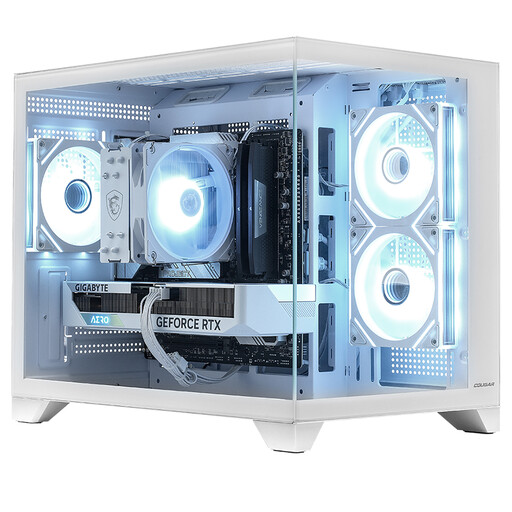
Consider this prebuilt desktop for gaming and everyday tasks if its connections suit your monitor and headphones; also confirm which desk peripherals are included.
The named variant has 16 GB RAM, a 1 TB SSD and Windows 11. Check the precise processor and graphics variant against your intended games before ordering.
 No image available
Consider this configuration if gaming alongside other tasks makes its stated memory and storage relevant to you; confirm the display outputs, headphone connection and included equipment.
Its name specifies an AMD Ryzen 7 5700X, RTX 5070, 32 GB RAM, 2 TB SSD and Windows 11. The component list alone cannot establish reaction latency across your setup.
Not necessarily: a gaming PC is only one part of the latency chain. NVIDIA separates peripheral, PC and display latency, so check your game settings, monitor and input-device setup as well as the desktop.
No NVIDIA GPU is a universal requirement for reaction practice. NVIDIA Reflex is relevant when your game supports it; for other games or browser-based drills, assess the PC against that application and your display rather than assuming Reflex will apply.
Match the headphones’ connection type to the exact desktop’s ports or wireless capabilities. Check whether they use a 3.5 mm plug, USB, a wireless USB receiver or Bluetooth; an ASUS ROG GM700 listing, for example, specifies front headphone and microphone sockets, but those details apply to that configuration.
Confirm whether Windows 11 is supplied and, if you will install it yourself, whether the final PC configuration meets its requirements. Microsoft lists a compatible processor, TPM 2.0, UEFI Secure Boot capability and compatible graphics among its requirements; meeting them is not a gaming-performance measure.
A retailer warranty is not the only consideration for faulty goods: section 9 of the UK Consumer Rights Act 2015 says a contract to supply goods includes a term that they are of satisfactory quality. Keep the listing, final configuration and order documents so you can identify what was supplied when raising a problem with the seller.