For point-and-click adventures in a shared bedroom, start by considering a compact Windows desktop with SSD storage, then check the games you intend to play and the noise of the exact PC. A larger tower makes more sense if future expansion matters; a mini PC addresses a particularly tight desk, but neither form factor guarantees quiet operation. The published requirements for two adventure games on GOG.com show why a powerful graphics card should not be assumed necessary for every title.
Who this setup suits
Quiet-evening adventure players
Another person sleeps, studies or takes calls in the bedroom, so fan noise and where the PC sits matter as much as game audio. HP’s UK guidance notes that room choice and desktop-on-desk placement affect noise management.
Players focused on their adventure-game library
The aim is to run particular point-and-click games, not to select hardware by its gaming label alone. The requirements published by GOG.com for Gibbous and The Secret of Monkey Island: Special Edition illustrate why compatibility should be checked title by title.
Small-desk players planning ahead
Bedroom space is limited, but ports, storage or later upgrades may still matter. The compact HP OMEN 16L, Lenovo’s expandable Legion Tower 5 Gen 10 range and ASUS’s ROG mini PCs illustrate different approaches to those needs; the exact configuration remains the deciding factor.
What matters when choosing
Choose the space and expansion trade-off before comparing graphics specifications. For any of these desktop routes, check the exact configuration’s game compatibility, connections and shared-room noise.
Compact desktop
Consider it when: you want a separate Windows desktop without committing desk space to a large tower; HP lists the OMEN 16L chassis at 337 × 155 × 308 mm.
Trade-off: a compact gaming configuration may include graphics capability beyond the requirements of your intended adventure games.
Upgradeable tower
Consider it when: later storage or memory expansion is important; Lenovo describes these options for its Legion Tower 5 Gen 10 range.
Trade-off: allow room for the larger chassis and check noise for the selected configuration rather than relying on a range-wide cooling description.
Mini gaming PC
Consider it when: a very small separate PC is the priority; ASUS identifies the ROG GR70 as a 3L mini PC.
Trade-off: confirm the particular model’s ports, upgrade access and fan noise rather than treating small size as proof of any of them.
| Concern |
What to check |
Who this matters to |
| Shared-room noise |
Seek noise measurements for the exact configuration where available, and check fan controls and possible placement away from the other occupant. |
If someone else is sleeping or studying nearby, I need the PC itself to be unobtrusive, even when I use headphones. Around 44% of consumers put shared-room noise first. |
| Game compatibility |
Compare each intended game’s operating-system, memory and graphics requirements with the exact PC configuration. |
I mainly play particular adventures, so meeting those games’ requirements matters more than choosing a powerful graphics card by default. Roughly 33% of consumers make game-specific compatibility their primary concern. |
| Space and flexibility |
Measure the chassis location, cable and ventilation clearance; check the required ports and exact-model expansion options. |
My desk is crowded, but I may need more storage or connections later. About 23% of consumers prioritise that balance between physical fit and flexibility. |
Buying pitfalls
-
Choosing by the word ‘gaming’ alone
Point-and-click games do not all have the same requirements. GOG.com lists 4GB RAM and Intel HD Graphics 4000 for Gibbous, while its listing for The Secret of Monkey Island: Special Edition specifies 2GB RAM and DirectX 9.0c-compatible graphics. Neither listing establishes what a different game needs.
List the titles you intend to play and compare their published requirements with the PC’s exact operating system, processor, memory and graphics configuration. Treat plans for more demanding games as a separate reason to consider stronger hardware.
-
Reading ‘quiet cooling’ as a noise measurement
Fan sound can change with workload, configuration and placement. A manufacturer’s description of its cooling does not give a comparable measurement for the machine that will sit in your bedroom.
Look for acoustic information for the exact model where available. Check its fan controls, where it can be placed and the seller’s applicable return terms before relying on quiet operation.
-
Checking the tower but not the whole setup
A desktop that fits the available space may still need room behind it for cables and ventilation. A listing for the computer alone also does not establish which display or peripherals are supplied.
Check the exact package contents, display and USB connections, network options and the space available around the chassis.
A separate monitor, keyboard, mouse or suitable cable may be needed if it is not supplied.
-
Assuming a small PC is easy to upgrade
Size does not establish access to memory or storage. Lenovo describes expansion for the Legion Tower 5 Gen 10 range, but that does not establish the upgrade options of a different tower or mini PC.
Check the selected model’s memory and storage slots, service instructions and warranty conditions if later upgrades are part of your plan.
Brands to consider for these desktop routes
HP OMEN
HP lists its OMEN 16L desktop chassis at 337 × 155 × 308 mm, making the range worth examining when a conventional desktop must fit a measured space.
- HP’s UK OMEN 16L listing shows a configuration with 16GB RAM and a 1TB SSD; check which configuration a particular offer describes.
- HP’s cooling descriptions are manufacturer statements, not measurements of noise from the exact PC in your room.
Lenovo Legion
Lenovo positions the Legion Tower 5 Gen 10 range around expandable memory and storage for people considering a conventional tower.
- Lenovo also describes tool-free access for selected configurations; confirm the access and available slots on the model you choose.
- The Tower 5 is a 30L range, so measure the intended location. Lenovo’s quiet-operation wording should not be treated as an acoustic result for every configuration.
ASUS ROG
ASUS lists ROG mini gaming PCs, including the 3L ROG GR70, for shoppers whose available desk space strongly favours a mini PC.
- The stated volume gives a starting point for assessing physical fit alongside the model’s full dimensions and connections.
- Check the exact model’s ports, upgrade access, warranty terms and fan noise; its small enclosure alone settles none of those questions.
Joybuy desktop choices
These Windows gaming desktops cover a peripheral bundle and separate towers for shoppers weighing a shared-bedroom setup against possible broader gaming use. Check each machine against your games, available space and noise requirements rather than treating its gaming specification as a measure of bedroom suitability.
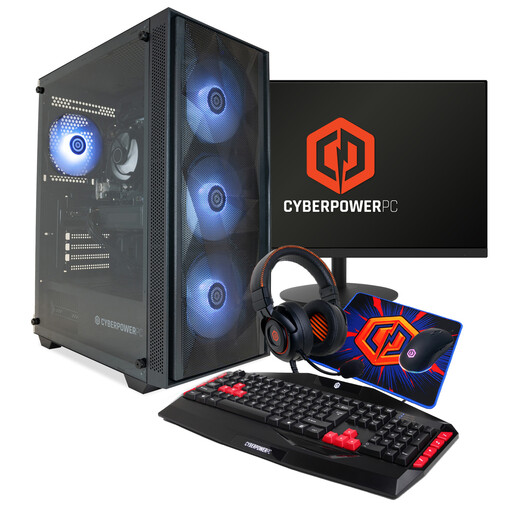 Image unavailable
CyberPowerPC JOYB1004 Ryzen 5 7500F and RTX 5060 bundle
For a setup needing a display and peripherals, this bundle lists a monitor, keyboard, mouse, headset and mousepad.
AMD Ryzen 5 7500F; NVIDIA GeForce RTX 5060 8GB; 16GB DDR5; 1TB NVMe SSD; Windows 11 Home.
Confirm the supplied monitor’s specifications, measure the tower’s location and seek exact-configuration noise information if someone else shares the room.
Joybuy
 Image unavailable
Lenovo Legion T7 34IAS10 Core Ultra 7 265K and RTX 5070 Ti
Consider this tower if future access to components and gaming beyond adventure titles matter more than a small footprint.
Intel Core Ultra 7 265K; 32GB RAM; 1TB SSD; RTX 5070 Ti; Windows 11 Home.
Check the space and ventilation available for the tower, whether a monitor and peripherals are supplied, and noise information for this configuration.
Joybuy
 Image unavailable
CyberPowerPC JOYB1013 Ryzen 7 9800X3D and RTX 5080, White
This separate tower is more relevant if you also plan to use its gaming hardware and storage beyond the point-and-click titles you have in mind.
AMD Ryzen 7 9800X3D; NVIDIA GeForce RTX 5080 16GB; 32GB DDR5; 2TB NVMe SSD; Windows 11 Home.
The monitor, keyboard, mouse, headset and mousepad are not included. Check available space and exact-configuration noise before placing it in a shared bedroom.
Joybuy
 Image unavailable
Stormforce Defiance Ryzen 7 5700X and RTX 5070
For a Windows desktop that may serve a wider game library, compare this configuration with the requirements of the titles you will actually play.
AMD Ryzen 7 5700X; 32GB RAM; 2TB SSD; RTX 5070; Windows 11.
Confirm the chassis dimensions, required ports and supplied peripherals for your setup, and seek model-specific noise information for shared-room use.
Joybuy
Common questions
Do point-and-click adventures need a powerful dedicated graphics card?
Not necessarily: the requirements GOG.com publishes for Gibbous include Intel HD Graphics 4000, while The Secret of Monkey Island: Special Edition specifies DirectX 9.0c-compatible graphics. Those are examples, not a guarantee for the genre; check each game you intend to play against the exact PC.
How can I reduce disruption from a gaming PC in a shared bedroom?
Choose and place the PC with fan noise in mind, rather than relying on headphones to address the sound of the machine itself. HP’s UK guidance identifies room choice and desktop-on-desk placement as relevant; seek noise information for the exact configuration and check its fan controls and possible placement.
Should I choose a mini PC or a tower?
A mini PC merits consideration when desk space is the deciding constraint; a tower merits consideration when future component access matters more. ASUS identifies its ROG GR70 as a 3L mini PC, while Lenovo describes expandable memory and storage for the Legion Tower 5 Gen 10 range. Check ports, upgrade access and noise on the specific model either way.


