
24/7 Customer Support

Free returns

Same-day & Next-day Delivery

Quality Guaranteed

Unlock Your Welcome Offers: FREE Delivery | Up to 80% OFF | Free 30-day JoyPlus trial
Download the APP
Juggling a laptop, smartphone and tablet often means carrying a tangled mess of separate chargers. A GaN charger promises a neat, powerful solution, but the market is filled with options that can be confusing. As a Joybuy Product Recommendation Officer, my role is to help you see past the marketing jargon and choose a charger that genuinely meets your needs without wasting your money.
Before you buy, be aware of these common pitfalls that many UK consumers encounter.
To make an informed choice, focus on these three non-negotiable specifications. They determine whether a charger will be a daily convenience or a source of frustration.
The most critical factor is understanding how a charger distributes its power. A charger's total wattage is the maximum power it can supply across all ports simultaneously. However, the power delivered to each individual port is what truly matters.
The right mix of ports ensures you can charge all your devices efficiently.
GaN, or Gallium Nitride, is the technology that makes these powerful chargers so compact. GaN semiconductors are more efficient and generate less heat than traditional silicon. This allows manufacturers to build a powerful 100W charger that is significantly smaller and lighter than an old 60W laptop brick, making it an ideal portable travel charger. For anyone in the UK who commutes or travels frequently, a compact GaN charger is a game-changer for reducing bag clutter and weight.
Instead of a generic list, we've matched specific chargers to different user needs. This helps you find a model that is genuinely right for you.
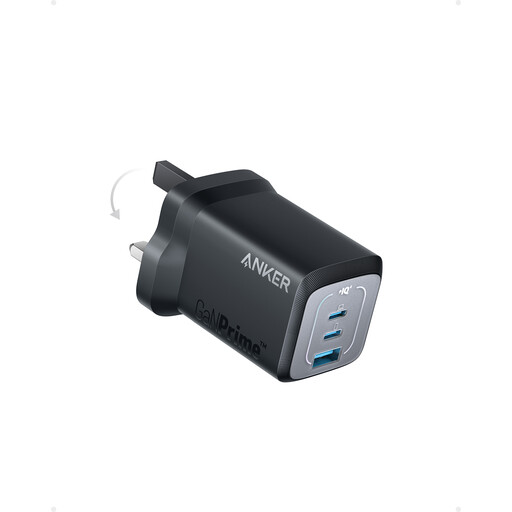
Why This Fits Their Persona: This charger is ideal for someone who carries a standard laptop (like a MacBook Air or Dell XPS 13), a phone and a tablet. Its 67W output is ample for charging a laptop, and the three-port design means you can power all your daily devices from one compact unit that fits easily in a backpack or work bag.
It avoids the wattage trap by clearly stating its power distribution—it delivers up to 67W from a single port or a combined 65W when two ports are in use. This transparency ensures you know exactly what charging speeds to expect.
Its main advantage is its compact size, which is noted as being 51% smaller than an original 67W MacBook charger. It also features the ActiveShield 2.0 safety system for added protection.
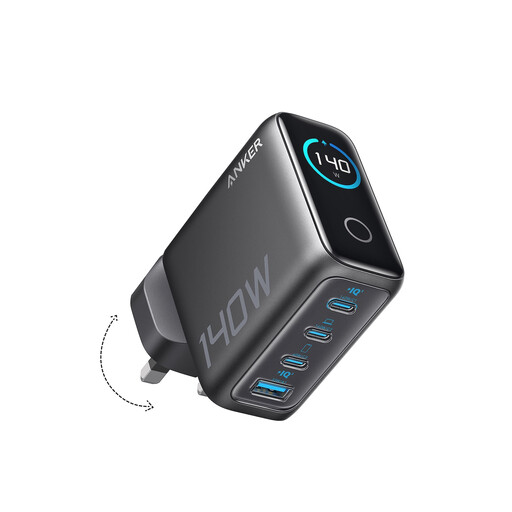
Why This Fits Their Persona: For the digital nomad or creative professional with a high-performance MacBook Pro charger requirement, a powerful tablet and a phone, this is a top-tier choice. It can power a demanding laptop at full speed while simultaneously charging three other devices, consolidating an entire tech arsenal into one plug.
This charger directly counters the inflated wattage trap by offering a genuine 140W maximum output from either of its two main USB-C ports. This ensures it can fast-charge even the most power-hungry laptops without compromise.
Its standout feature is the ability to power four devices at once with a high total output. The colour display, which shows real-time charging status and temperature, is a practical feature for monitoring performance.
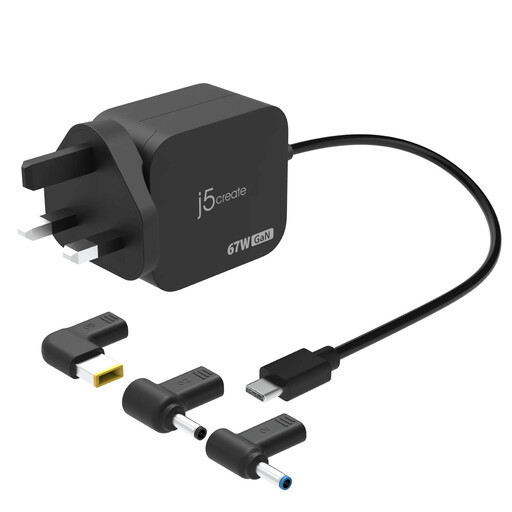
Why This Fits Their Persona: This is for the user who has a modern smartphone but still relies on an older work or personal laptop from brands like Dell, HP or Lenovo that uses a traditional DC barrel connector for charging. It bridges the gap between old and new technology.
It directly solves the "mismatched port" problem by including a set of six detachable DC connectors. This ensures broad compatibility beyond the USB-C ecosystem, preventing the need to buy a separate, bulky power brick for an older laptop.
The primary advantage is its unique versatility. The inclusion of multiple DC tips makes it a highly practical solution for users and households with a mix of new and legacy devices, all in one compact GaN charger.
We have compiled a complete, real-time list of products that fully satisfy these strict selection criteria and UK safety regulations.
Yes, it is completely safe. Modern GaN chargers with USB-C Power Delivery (PD) are intelligent. They communicate with the connected device to determine the maximum power it can safely handle. The charger will only supply the 20W your phone requests, not the full 100W. This prevents overcharging and damage to your device's battery.
Yes, the cable is just as important as the charger. To take full advantage of a high-wattage charger (60W or more), you need a USB-C cable that is rated for that power level. A standard, low-wattage cable can create a bottleneck, slowing down charging speeds and potentially overheating. Look for cables that explicitly state they support 100W or higher power delivery.
A well-made GaN charger from a reputable brand should last for several years. Lifespan depends on build quality, internal components and heat management. GaN technology is inherently more efficient and produces less waste heat, which contributes to a longer operational life compared to older silicon-based chargers. Always ensure the charger has good ventilation during use and avoid using it in excessively hot or humid environments.