
24/7 Customer Support

Free returns

Same-day & Next-day Delivery

Quality Guaranteed

Unlock Your Welcome Offers: FREE Delivery | Up to 80% OFF | Free 30-day JoyPlus trial
Download the APP
Navigating the market for a new charger can feel unnecessarily complicated. With every brand promising the fastest speeds and smallest sizes, it is easy to end up with a product that underdelivers or, worse, is unsuitable for your devices. As the Joybuy Product Recommendation Officer, my role is to help you identify the key factors that matter and sidestep the common purchasing mistakes.
Many UK consumers find themselves disappointed by chargers that fail to live up to their advertised potential. This often stems from a few common but easily avoidable pitfalls:
To make an informed choice, focus on a few core parameters instead of marketing buzzwords. These specifications will determine whether a charger is right for your needs.
Wattage dictates how much power a charger can supply. Matching the wattage to your device is crucial for efficient charging.
Look for chargers that support Power Delivery (PD), a universal fast-charging standard used by most modern devices, including Apple, Google and many laptop manufacturers.
The ports on a charger determine its versatility. While USB-C is the new standard for its speed and reversible design, many people still own devices and cables that use the older USB-A format.
A modern USB C mains charger is a necessity for new electronics. However, a multi-port USB charger featuring a combination of USB-C and USB-A ports offers the most practical solution, allowing you to charge both new and legacy devices from a single plug.
GaN, or Gallium Nitride, is a semiconductor material that has revolutionised charger design. Compared to traditional silicon, GaN is far more efficient at conducting electricity. This allows manufacturers to build chargers that are significantly smaller and lighter and which generate less waste heat. This efficiency and compact size make a GaN charger an ideal travel adapter and a tidy solution for any workspace.
Instead of a one-size-fits-all approach, the right charger depends on your specific lifestyle and the devices you use daily. Here are some recommendations matched to different user profiles.
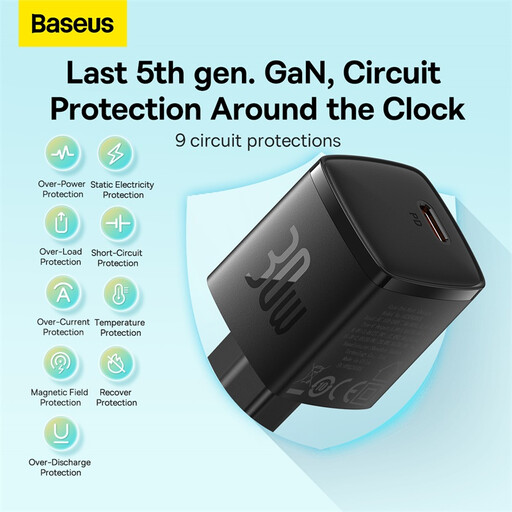
Why This Fits Their Persona: This charger is exceptionally small and lightweight, making it ideal for commuters and travellers in the UK who prioritise packing space. Its 30W output is perfect for fast-charging a phone, tablet or earbuds on the go.
With a single USB-C port, it delivers a dedicated 30W, eliminating any confusion about split wattage. It supports the PD protocol, ensuring it works as an effective iPhone fast charger or for other compatible devices.
Its primary advantage is its compact, travel-friendly design, enabled by GaN5 technology for better efficiency and heat management.
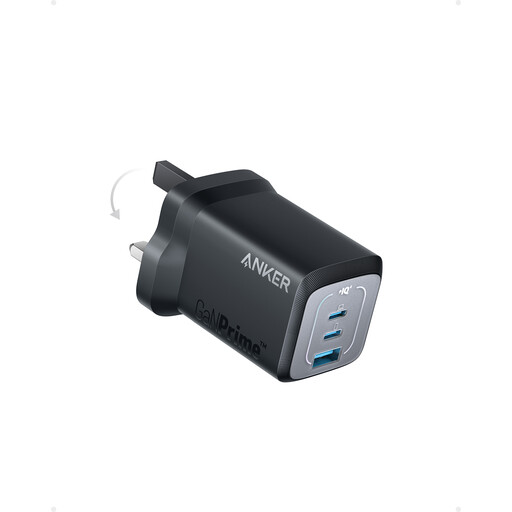
Why This Fits Their Persona: This is for the professional who needs to power a work laptop, personal phone and another device like headphones from a single mains socket. It declutters the desk and provides enough power for a productive workflow.
It clearly states its power capabilities: up to 67W from a single port for a laptop or a maximum of 65W intelligently distributed when multiple ports are in use. This transparency helps you avoid the "total wattage" trap.
High versatility with two USB-C ports and one USB-A port. It is also significantly smaller than a standard 67W MacBook charger, saving space on a power strip.
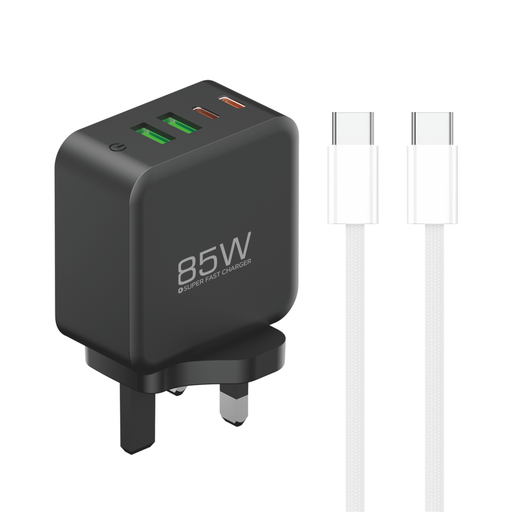
Why This Fits Their Persona: This is for the user with a demanding collection of gadgets—a powerful laptop, a tablet, a phone and more. It offers a high total output and four ports to consolidate all charging needs into one powerful hub.
It provides a detailed power allocation chart (e.g., single C2 port delivers 65W), and explicitly lists support for a wide range of protocols, including those for Samsung, Huawei and Apple, directly addressing the protocol mismatch trap.
Excellent power and port density with two USB-C and two USB-A ports. Its intelligent power distribution ensures devices receive an appropriate charge without overloading.
We have compiled a complete, real-time list of products that fully satisfy these strict selection criteria and UK safety regulations.
Yes. Modern chargers and devices communicate to determine the appropriate amount of power. A PD charger will only deliver the maximum power your phone can safely handle, so using a 65W laptop charger for your phone is perfectly safe and will not cause damage.
The most critical mark is the UKCA (UK Conformity Assessed) marking. This indicates the product meets Great Britain's safety, health and environmental protection standards. You should avoid any charger that does not clearly display this mark on the product or its packaging.
To get the full benefit of a fast charger, especially for outputs above 60W, you need a cable rated for that power. Look for USB-C to USB-C cables that specify support for 60W, 100W or higher Power Delivery (PD) to ensure you are not being limited by the cable itself. Using an underrated cable can result in slower charging speeds.