
24/7 Customer Support

Free returns

Same-day & Next-day Delivery

Quality Guaranteed

Unlock Your Welcome Offers: FREE Delivery | Up to 80% OFF | Free 30-day JoyPlus trial
Download the APP
By Joybuy Product Recommendation OfficerPublished on 26 August 2026
If your desk, travel bag or bedside table is cluttered with a tangle of different chargers for your phone, laptop and tablet, you are not alone. Gallium Nitride (GaN) technology promises a solution: a single, compact and powerful fast charger for all your devices. However, the market is flooded with options, and misleading marketing can lead to a purchase that is either underpowered, inefficient or even unsafe.
Before you buy a new GaN charger in the UK, it is crucial to understand the common pitfalls that many consumers fall into. This guide will help you sidestep these issues, ensuring you select a charger that truly meets your needs.
Navigating the specifications of modern chargers can be confusing. Many brands highlight impressive numbers, but the reality of their performance can be quite different. Here are three key traps to watch out for.
A charger advertised as "100W" often leads buyers to believe it can deliver 100 watts of power to any device. This is rarely the case for a multi-port USB charger. The total wattage is the maximum power the charger can supply across all its ports combined. When you plug in multiple devices, that power is split. A 100W charger might only provide 65W to your laptop and 20W to your phone simultaneously, which could be insufficient for fast charging the laptop. Always check the detailed power distribution specifications, not just the headline number.
One of the main appeals of GaN technology is its ability to create smaller chargers. However, extreme compactness can come at a price. Pushing high power through a tiny device generates significant heat. Without proper thermal management and robust internal components, an ultra-small charger can overheat, reducing its lifespan and posing a potential fire risk. For any travel charger UK residents purchase, it is vital to prioritise models with proven safety certifications.
The term "fast charging" is not universal. For a device to charge rapidly, both the charger and the device must support the same charging protocol. The most common standard for modern devices like the iPhone and MacBook is Power Delivery (PD). If you buy a charger that doesn't support the correct PD profile for your laptop, it may charge at a frustratingly slow pace or not at all. Simply having a USB-C port does not guarantee it is a suitable iPhone fast charger or MacBook Pro charger.
To make an informed decision, focus on these core parameters. They are the true indicators of a charger's performance and safety.
Look beyond the total wattage. The product description should detail the maximum output for each port when used alone and when used in combination. For a 100W laptop charger, ensure a single USB-C port can deliver at least 65W-100W on its own. This information tells you if the charger can handle your most power-hungry device while also charging others.
A quality PD charger is essential for most modern electronics.
Check that the charger explicitly lists support for the protocols your main devices use.
Never compromise on safety. A reliable USB C wall charger sold in the UK must carry the UKCA (UK Conformity Assessed) mark. This indicates that the product meets the UK's stringent safety, health and environmental protection standards. Additionally, look for chargers made from flame-retardant materials (often listed as V0 or UL94 V-0 rated PC) and those with built-in protections against over-voltage, over-current and overheating.
Based on these practical criteria, we have identified several chargers that align with different user needs, from daily commuting to powering a complete mobile workstation.
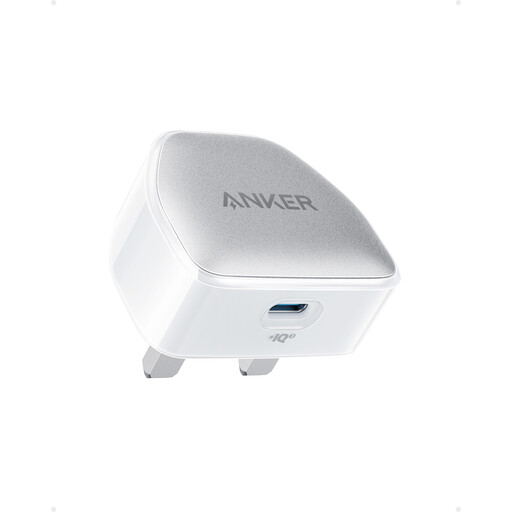
Why This Fits Their Persona: Ideal for the UK commuter who needs a small, reliable charger for their smartphone. Its compact size fits easily into a pocket or small bag, providing a quick power boost between the office and home without adding bulk.
It avoids the "fast charging" trap by clearly stating its 20W PD output, which is specifically suited for fast-charging modern iPhones and similar smartphones, rather than making vague claims.
Its primary advantage is its extremely compact and lightweight design. It also includes Anker's ActiveShield safety system for temperature monitoring.
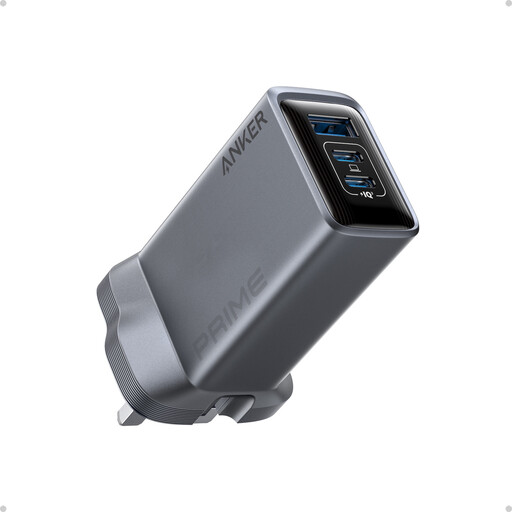
Why This Fits Their Persona: Perfect for the professional juggling a laptop, phone and tablet. This charger can replace three separate power bricks, decluttering a workspace or travel bag while ensuring all devices are charged efficiently.
It avoids the "total wattage" myth by providing clear specifications: a single USB-C port can deliver a full 100W, enough for a high-performance laptop like a MacBook Pro. It also details power splits for multi-device use.
Its key advantage is high-power versatility. With two USB-C ports and one USB-A port, it offers flexible, high-speed charging for both new and older devices from a single, compact unit.
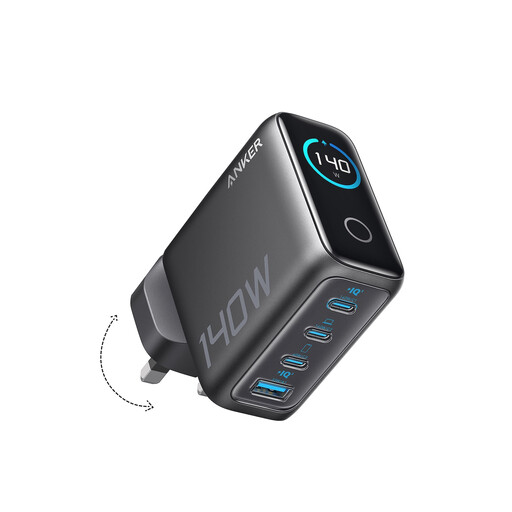
Why This Fits Their Persona: For the user who wants a single charging station for their entire tech ecosystem. This is for the household or individual with multiple laptops, tablets and phones who needs maximum power and port availability without compromise.
It avoids the safety trap associated with high power by incorporating an advanced safety system (ActiveShield 2.0) that actively monitors temperature, providing peace of mind even when delivering 140W.
Its standout feature is the massive 140W total output distributed across four ports, including two high-speed USB-C ports. It can comfortably fast-charge two laptops simultaneously.
We have compiled a complete, real-time list of products that fully satisfy these strict selection criteria and UK safety regulations.
Yes. While a standard 5W charger works, a GaN charger with at least 20W Power Delivery (PD) can charge a modern iPhone significantly faster. For example, it can take the battery from 0% to 50% in around 30 minutes, a noticeable improvement for users on the go.
This depends on your laptop model. A lightweight ultrabook like a MacBook Air can be charged effectively with a 30W-45W charger. However, a high-performance machine like a 16-inch MacBook Pro requires a charger that can deliver 96W or more to charge at full speed, especially while in use. Check your laptop's original charger for its wattage rating.
No, they are not. A USB C wall charger can have vastly different power outputs and supported protocols. A simple 15W USB-C charger designed for a small accessory will not be able to power a laptop. It is essential to match the charger's wattage and its support for Power Delivery (PD) to your device's requirements.