
24/7 Customer Support

Free returns

Same-day & Next-day Delivery

Quality Guaranteed

Unlock Your Welcome Offers: FREE Delivery | Up to 80% OFF | Free 30-day JoyPlus trial
Download the APP
Tired of that tangled mess of chargers? One for your laptop, another for your phone and a third for your tablet? You’re not alone. The promise of a single, powerful GaN charger to replace them all is appealing, but the market is filled with confusing claims and technical jargon. Many UK consumers end up with a plug that either underperforms or, worse, is unsuitable for their devices.
As a Joybuy Product Recommendation Officer, my role is to help you navigate these choices. Before you buy, be aware of these common pitfalls that lead to buyer's remorse:
To make a smart purchase, you don't need to be an engineer. You just need to check three key details. Focusing on these will ensure you get a charger that is efficient, safe and built to last.
This is the most critical factor. Ignore the single large number on the box and look for the power distribution details.
A good multi-port wall charger will clearly state how the power is split when multiple devices are connected (e.g., 65W on one USB-C port, 20W on the other). This transparency is the hallmark of a quality product.
The future is USB-C, and for good reason. It's reversible, durable and supports high-power standards.
GaN, or Gallium Nitride, is a semiconductor material that is more efficient than the traditional silicon used in older chargers. This efficiency means less energy is wasted as heat, allowing manufacturers to build a powerful travel charger that is significantly smaller and lighter without compromising on safety or performance. When you see "GaN" advertised, it signifies a modern design focused on efficiency and portability.
Instead of a generic list, we've matched specific chargers to different user needs. This ensures you get a product that fits your lifestyle, not just a list of features.
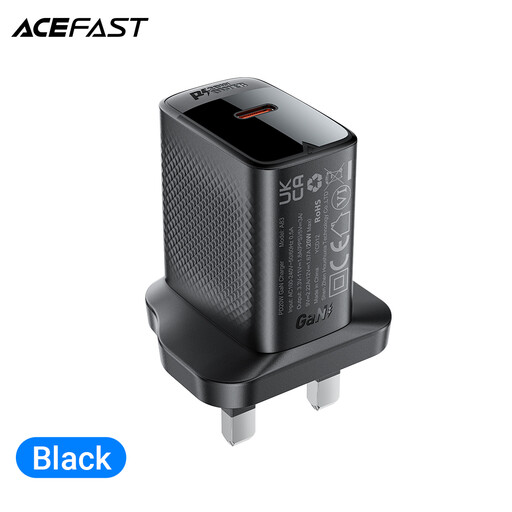
Why This Fits Their Persona: Ideal for someone who primarily needs to fast-charge their smartphone on the go or at the office. It's a no-fuss, compact and affordable solution that gets the job done without unnecessary bulk or features.
With a single USB-C port, there is no confusion about power distribution. You get the full 20W for your device. It supports PD 3.0, avoiding the incompatibility flaw with modern phones.
Its GaN construction makes it smaller and more efficient than older 20W chargers. It includes multiple safety certifications (UKCA, CE) for peace of mind.

Why This Fits Their Persona: For those who live out of a suitcase or simply hate clutter, this charger's tiny size is a major benefit. It can fast-charge a phone and a tablet, or two phones simultaneously, making it a versatile travel companion.
The advanced GaN5 technology prevents overheating despite its compact size. The power output is clearly defined: it can deliver up to 40W to one port, or 20W to each port when both are used.
Its exceptionally small form factor is its main selling point. The dual USB-C ports are perfect for charging modern devices like an iPhone and an iPad at the same time.
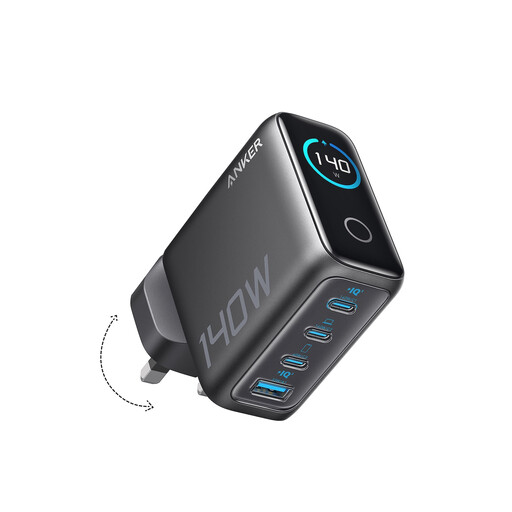
Why This Fits Their Persona: This is for the professional who needs to power a high-end laptop (like a 15-inch MacBook), a tablet and a phone simultaneously. It replaces a bag full of bricks with one streamlined, high-performance unit.
It directly solves the "total wattage" trap with a colour display that shows real-time power distribution to each port. The ActiveShield 2.0 system actively monitors temperature to prevent overheating.
A massive 140W maximum output from a single port can charge even the most demanding laptops at full speed. Four ports (2x USB-C, 2x USB-A) offer maximum versatility.
We have compiled a complete, real-time list of products that fully satisfy these strict selection criteria and UK safety regulations.
No. A quality charger featuring a protocol like Power Delivery (PD) communicates with your device to determine the maximum safe power it can accept. A 140W charger will only deliver the ~27W an iPhone 15 Pro can handle, for example. It will not overload or damage the battery.
Yes, the cable is just as important as the charger. To achieve charging speeds above 60W, you must use a USB-C cable that is rated for that power level (e.g., a 100W or 140W cable). Using a standard, lower-rated cable will limit the charging speed, regardless of how powerful your charger is.
Reputable GaN chargers that carry the UKCA mark are required to have multiple built-in safety systems. These include protection against over-voltage, over-current and overheating. These features make them as safe for overnight use as any traditional charger from a trusted brand. Always purchase from a reliable retailer to ensure you are getting a certified product.