
24/7 Customer Support

Free returns

Same-day & Next-day Delivery

Quality Guaranteed

Unlock Your Welcome Offers: FREE Delivery | Up to 80% OFF | Free 30-day JoyPlus trial
Download the APP
A GaN USB-C fast charger UK shoppers can rely on should do more than advertise a high wattage. The right model needs suitable power delivery, practical port allocation, a compatible UK plug and safety features that match everyday use.
For commuters, students, professionals and travellers, the main challenge is avoiding a charger that looks powerful on the box but performs poorly when several devices are connected. Before choosing a compact travel charger or multi-port USB-C charger, check these common pitfalls.
Gallium nitride, or GaN, allows manufacturers to create smaller power adapters with efficient heat management. However, GaN does not automatically mean every device will charge at its maximum speed. The phone, tablet or laptop must support a compatible charging protocol, and the cable must also be rated for the required output.
A 30W USB-C charger may be suitable for many phones and tablets, but it is not an automatic replacement for a 67W laptop charger or a 100W USB-C charger.
A charger may advertise 100W or 140W total output, but that figure can change when multiple ports are used. A laptop may receive less power if a phone and earbuds are connected at the same time.
Check the output for each port and the total output when charging two or more devices. This is particularly important when comparing a 40W dual USB-C charger with a larger multi-port model.
A charger designed for an EU socket is not the same as a UK plug charger. UK households generally require a suitable three-pin plug or an appropriate, safety-compliant travel solution. Also check whether a USB-C cable is included, as many wall chargers are sold without one.
Avoid damaged, uncertified or unsuitable cables. They may limit charging performance and can become excessively warm during use.
USB-C Power Delivery (PD) is a charging standard used by many modern smartphones, tablets, handheld consoles and laptops. A USB-C PD charger negotiates an appropriate voltage and current with the connected device rather than simply sending its maximum output.
As a practical guide:
Always compare the charger’s output with the laptop manufacturer’s recommended adapter. A charger with a lower rating may charge slowly or fail to maintain battery level during demanding use.
A single-port charger is often smaller and simpler, while a multi-port USB-C charger can replace several adapters. For flexible everyday use, consider how many USB-C ports you actually need and whether USB-A remains necessary for older cables and accessories.
For example, the Baseus GaN5 Pro provides two USB-C ports with a stated 40W maximum per port when used individually, while its combined output is listed as 20W + 20W. This makes the distribution specification more relevant than the headline number when charging two devices.
Compact dimensions are useful for crowded sockets, office bags and travel, but small chargers can still become warm under load. Keep the adapter uncovered and well ventilated, and stop using it if you notice damage, smoke, unusual odours or abnormal overheating.
Look for clearly stated protections such as over-voltage, over-current, over-power and short-circuit protection. Product markings and documentation should also be clear. Where a product listing provides certification information, check whether it is suitable for your intended UK use rather than assuming every charger has identical approvals.
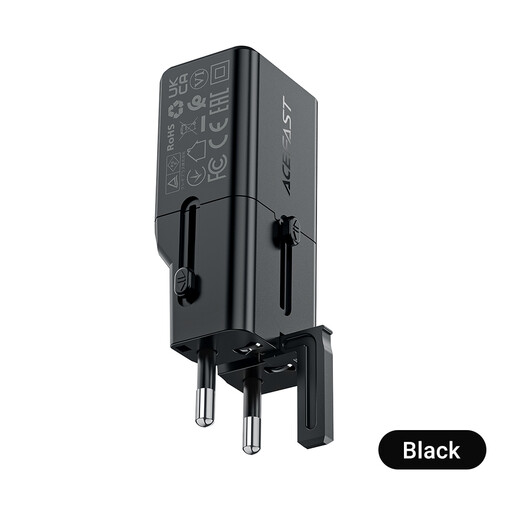
Why This Fits Their Persona: Its 30W USB-C PD output and mini format suit shoppers who mainly charge a phone, tablet or small everyday device and want to keep the adapter compact.
The listing states the maximum 30W output clearly, helping buyers avoid assuming that a compact charger can replace a higher-powered laptop adapter.
GaN construction, compact design and stated over-current, over-voltage and short-circuit protection.

Why This Fits Their Persona: Two USB-C ports make it practical for a desk, bedside table or shared household charging point where two devices are often connected.
Its listing distinguishes individual-port output from the 20W + 20W combined output, reducing confusion around simultaneous charging.
Two USB-C ports, 40W maximum single-port output and a stated 50 × 40.1 × 53.2mm body size excluding pins.
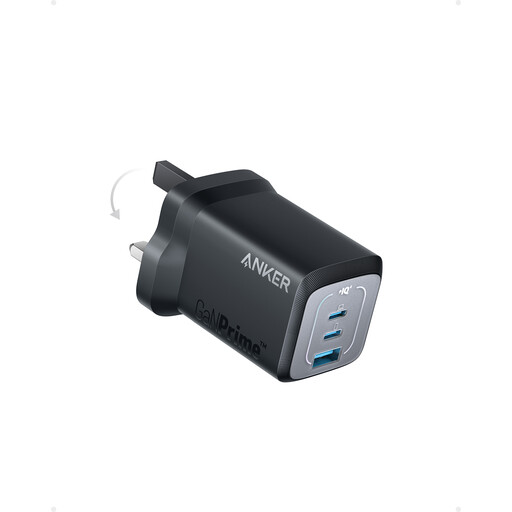
Why This Fits Their Persona: This option is suited to professionals and frequent commuters who need to power a laptop, phone and accessory from one adapter.
The product information separates single-device 67W output from its stated 65W maximum when two ports are used.
Two USB-C ports plus one USB-A port, with a listed 67W single-device maximum and ActiveShield 2.0 protection.
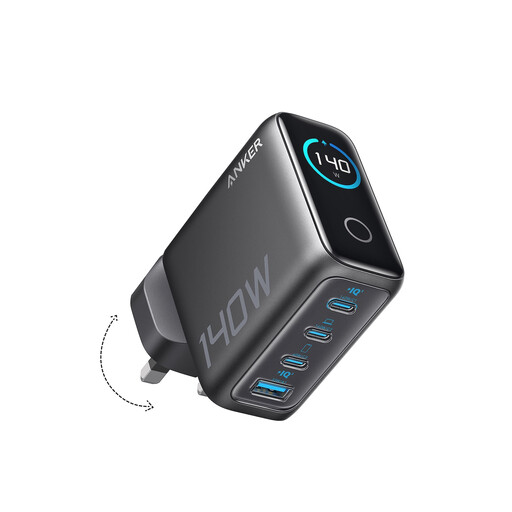
Why This Fits Their Persona: A four-port layout is appropriate for users carrying a high-power laptop alongside phones, tablets and smaller USB accessories.
It provides four ports and identifies two high-speed USB-C ports, making the layout clearer for multi-device charging than a single high-output socket.
Four-device charging, two high-speed USB-C ports and a built-in display showing charging status, temperature and port details.
We have compiled a complete, real-time list of products that fully satisfy these strict selection criteria and UK safety regulations.
It can be, provided its USB-C PD output meets the laptop’s required wattage and charging protocol. A 30W model may suit lightweight devices, while many laptops require a 67W laptop charger, 100W or more. Check the computer manufacturer’s specification before replacing the supplied adapter.
No. The device controls the negotiated charging level. A 140W USB-C charger will not force a phone to accept 140W if the phone is designed for a lower input. Higher wattage mainly provides additional capacity for compatible laptops and simultaneous charging.
Use the charger indoors in a dry, ventilated area, avoid covering it and use compatible certified cables. Do not continue using an adapter that is cracked, damaged, unusually hot, smoking or producing an unusual smell. Unplug it when it will not be used for an extended period.