Garden-office workers needing dependable access
For a detached workspace where intermittent garden coverage is not enough for calls or cloud work, prioritise a cable route or a clear-line-of-sight bridge before choosing a basic extender.


Choose a routed Ethernet connection with an access point in the outbuilding where a safe, permitted cable route is practical, as it avoids relying on Wi-Fi travelling through exterior walls and building materials. If cabling is impractical, a point-to-point wireless bridge suits a clear path between suitable mounting points; mesh needs a reliable backhaul signal, while powerline needs both outlets on the same electrical circuit. Ofcom, TP-Link and Electrical Safety First guidance highlights the importance of site conditions, outdoor equipment and power arrangements.
For a detached workspace where intermittent garden coverage is not enough for calls or cloud work, prioritise a cable route or a clear-line-of-sight bridge before choosing a basic extender.
Consider the separation between buildings and the materials in each structure. Ofcom notes that water, metal and glass can block Wi-Fi, so a mesh node needs a viable backhaul location.
Mesh or powerline may avoid trenching and long cable runs, but powerline needs outlets on the same electrical circuit and wireless routes still need suitable signal conditions and outdoor installation planning.
Start with the physical path between the house and outbuilding, then check cable access, power arrangements and the intended location of any wireless equipment.
| Priority | What to check | Your needs |
|---|---|---|
| Path between buildings | Check walls, glazing, metal, insulation, trees and the possible mounting path. Test a proposed mesh location before relying on its wireless backhaul. Consider Ethernet or a directional bridge where the radio path is weak. | I need the connection to reach a separate building without depending on a weak signal through exterior construction. |
| Reliable day-to-day use | Decide whether calls, cloud work or connected equipment need a stable link. Check whether a cable path is feasible; otherwise assess two aligned bridge endpoints with suitable power and UK radio settings. | I want a usable connection for regular work or equipment, not simply a Wi-Fi icon at the edge of coverage. |
| Outdoor installation | Check equipment enclosure rating, mounting, cable entry points and the specified power method. Electrical Safety First advises outdoor-suitable cables and connectors, plus RCD protection for outdoor electrical equipment. | The equipment and connections need to suit moisture, weather exposure and the risk of accidental damage. |
| Electrical layout | For powerline, confirm the house and outbuilding outlets are on the same electrical circuit and test the actual outbuilding socket. TP-Link states that adapters on different circuits will not communicate. | I need to know whether powerline can establish a link before I make it the main connection route. |
Ofcom identifies water, metal and glass as Wi-Fi signal blockers. A mesh system can improve coverage, but it cannot make a poor path through detached-building construction dependable.
Test signal and throughput at the intended outbuilding and mounting locations at different times before committing to mesh. Choose wired backhaul or a bridge if the backhaul is weak.
A weak path may mean needing extra nodes, a bridge pair or a different connection route.
TP-Link states that powerline adapters on different electrical circuits will not communicate, so mains access alone is not enough.
Confirm the circuit arrangement and test a pair at the actual outbuilding socket before selecting powerline as the primary connection.
Outdoor bridge equipment needs appropriate power, mounting, environmental protection and alignment. The UK radio configuration must also meet the applicable Ofcom conditions.
Check the exact model's power method, mounting requirements, environmental rating and UK frequency and power configuration before purchase and installation.
The installation may require suitable mounts, PoE equipment, surge protection, weather-appropriate cable routing or professional help.
Ofcom distinguishes licence-exempt low-power RLAN use from higher-power and fixed outdoor use in part of the 5 GHz range that requires a licence and compliance with IR2007.
Use compliant UK equipment and check the exact band, power and fixed-outdoor status before deployment rather than changing settings without understanding the applicable requirements.
Relevant across outdoor bridge, outdoor mesh and powerline routes through its UK-listed network equipment.
Relevant for purpose-built wireless bridging between buildings, including NanoBeam equipment and building-bridge product lines.
Relevant for technically confident buyers considering a pre-paired point-to-point wireless link rather than a consumer mesh extender.
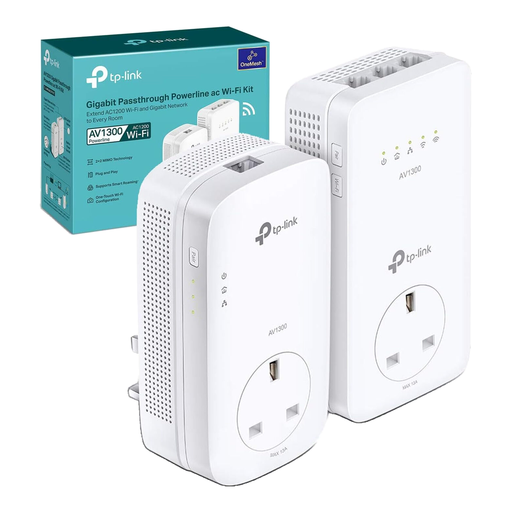
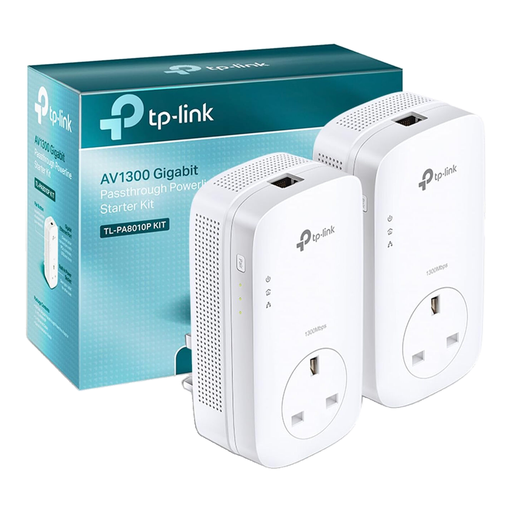
These Joybuy options cover the conditional powerline route for an outbuilding where the house and outbuilding outlets share the same electrical circuit.
 No image available
For an outbuilding with same-circuit mains where both local Wi-Fi and wired connections are needed.
Stated features include HomePlug AV2, dual-band 802.11ac Wi-Fi, three Gigabit Ethernet ports, OneMesh compatibility and a passthrough socket.
Confirm the actual house and outbuilding sockets share one electrical circuit, then test the intended outlet before relying on the link. Use suitable wall outlets rather than power strips or extension leads as instructed for the product.
 No image available
For a same-circuit outbuilding where a wired desk, console or separate access point is the intended endpoint.
This twin-adapter kit is described with Gigabit Ethernet, a passthrough socket and 128-bit AES encryption.
It is described as an Ethernet endpoint rather than a Wi-Fi access point, so add a compatible access point if wireless coverage is needed inside the outbuilding. Confirm and test the circuit arrangement at the actual socket.
Only if the extender or mesh node can receive a strong enough backhaul signal at its planned location. Ofcom says water, metal and glass block Wi-Fi, so exterior walls, insulation and glazing can make an ordinary extender unreliable; assess Ethernet or a point-to-point bridge for a weak or obstructed path.
Treat a clear, unobstructed path as a practical requirement for a building bridge. MikroTik explicitly states that its Wireless Wire approach needs clear line of sight, while directional TP-Link and Ubiquiti bridge equipment needs careful alignment; check trees in leaf, new structures and mounting positions before purchase.
It depends on the frequency band, power and whether the equipment is used as a fixed outdoor service. Ofcom says low-power RLAN use under IR2030 can be licence-exempt, but higher-power and fixed outdoor use in 5725–5850 MHz requires a licence and compliance with IR2007; use the equipment's UK documentation and settings rather than assuming every configuration is licence-free.
It may work only if the relevant outlets are on the same electrical circuit. TP-Link states that adapters on different circuits will not communicate, so pair and test them at the actual outbuilding socket before relying on powerline for work or security equipment.
Use equipment and connections that suit the actual outdoor environment. Electrical Safety First advises outdoor-suitable, weather-resistant cables, connectors and extension equipment, plus RCD protection for outdoor electrical equipment; follow the specific device's stated power and weather-protection requirements.