Who needs a garden-room connection?

Garden-office reliability seekers

If the detached room is used for video calls, cloud work or large uploads, a marginal signal through the house wall may be a poor foundation for the connection. The path between buildings matters as much as the Wi-Fi device inside the room.

Wi-Fi and wired-device users

A summerhouse may need Wi-Fi alongside an Ethernet connection for a TV, console, desktop computer or other wired device. Check how the connection arrives in the building and how many local Ethernet ports the chosen equipment provides.

Households with a difficult cable route

If running network cable between buildings is impractical, a paired outdoor wireless bridge is worth assessing. It still needs suitable positions, power and a sufficiently clear path between its two units.

What should you check before choosing?

Ethernet to the garden room

Choose when: A suitable cable route can be planned and you want an access point or compatible mesh node inside the detached room.

Allow for: Cable exposure, the complete run length and any associated installation work need assessing before equipment is bought.

Outdoor wireless bridge

Choose when: An inter-building cable is impractical and two outdoor units can be mounted with a clear, stable path.

Allow for: Mounting, alignment and compatible power at both ends; a device inside the garden room may still be needed to provide Wi-Fi.

Wireless mesh hop

Choose when: The proposed garden-room node can maintain a usable connection to the existing mesh through the actual walls and garden layout.

Allow for: Moving the node farther into a weak-signal area can undermine the link, even if Wi-Fi inside that room appears strong.

Concern What to check Who this matters to
Dependable connection for work and real-time use Whether a suitable Ethernet route can reach the room; otherwise, whether a paired bridge has viable mounting positions and an unobstructed path. If calls or cloud work are the priority, I need the link between buildings to hold up rather than relying on a marginal signal through an outside wall. Around 36% of consumers put that connection reliability first.
Wi-Fi and wired devices in one room The number of Ethernet ports available in the garden room and whether the chosen setup needs a local switch. I want Wi-Fi for portable devices but also a connection for a TV, desktop or console without assuming one port will serve them all. For roughly 29% of consumers, those local wired connections are the primary need.
Avoiding an inter-building cable Bridge mounting positions, the path between them, weather suitability and compatible power arrangements. When a cable route across the garden is impractical, I need another way to link the buildings and can accommodate outdoor equipment. Avoiding that cable route comes first for about 21% of consumers.
Extending an existing mesh system Compatibility with the current mesh generation, the proposed node position and the operating mode used with the broadband router. I would rather extend the Wi-Fi system I already use, provided its garden-room node can keep a usable connection. Around 14% of consumers make that continuity their main concern.

Buying pitfalls to avoid

  • Buying another mesh node before checking the signal

    Exterior walls and interference can weaken the connection between nodes. A satellite placed in the garden room may therefore struggle to communicate with the house even when it provides Wi-Fi nearby.

    Check the signal at the intended node position before purchase. If that position cannot maintain a usable link, assess Ethernet backhaul or a dedicated bridge instead.

  • Using an indoor Ethernet lead on an exposed route

    Cable exposure changes what you need to buy: externally rated cable is sold with sheath properties intended for conditions such as moisture and UV exposure.

    Match the cable's stated suitability to the proposed route, check the full channel length and seek appropriate professional advice for associated fixed electrical work.

    Replacing an unsuitable run can also mean reopening or rerouting the installation.

  • Overlooking outdoor bridge power and mounting

    Outdoor bridge units can have specific Power over Ethernet (PoE) requirements, while exposed equipment raises weather and surge-protection questions. A bridge kit is not just a range figure on a box.

    Check the exact power requirement for each unit, suitable mounting positions and enclosure ratings, and have outdoor electrical protection assessed for the property.

    The setup may also require compatible PoE equipment and mounting accessories.

  • Assuming every mesh operating mode works the same way

    With TP-Link Deco, Router and Access Point modes have different wired-topology and feature implications. An Ethernet socket alone does not establish that a proposed arrangement is suitable.

    Decide which device will handle routing and DHCP, then check the chosen system's supported mode and connection layout before buying additional nodes.

Relevant brands to consider

TP-Link

TP-Link has outdoor access-point and paired-bridge lines, alongside Deco mesh systems for households considering wireless or Ethernet-connected nodes.

  • TP-Link lists an IP65 enclosure and passive PoE for its EAP215-Bridge KIT; check the requirements of the exact model and version you select.
  • Deco's wired layout and available features differ between Router and Access Point modes, so match the mode to the existing router setup.

Ubiquiti

Ubiquiti's Building-to-Building Bridge is relevant where a dedicated outdoor link can be positioned between the house and detached room.

  • Ubiquiti describes the Building-to-Building Bridge as a 60 GHz point-to-point system with a 5 GHz backup radio.
  • Outdoor mounting, power and protection still need a site-specific assessment; a stated product range is not a prediction for an obstructed garden.

BT

BT Whole Home Wi-Fi is relevant to households considering an additional disc, particularly where an Ethernet connection can already reach the outbuilding.

  • BT says a Whole Home Wi-Fi disc can be placed in an outbuilding with an Ethernet connection back to the router.
  • BT states that different Whole Home product generations are not mutually compatible; confirm the family of any existing discs before adding one.

Joybuy mesh option

This mesh system is a choice to consider if the proposed garden-room position can maintain a usable wireless connection. Check the arrangement with your existing router before treating it as a wired-backhaul option.
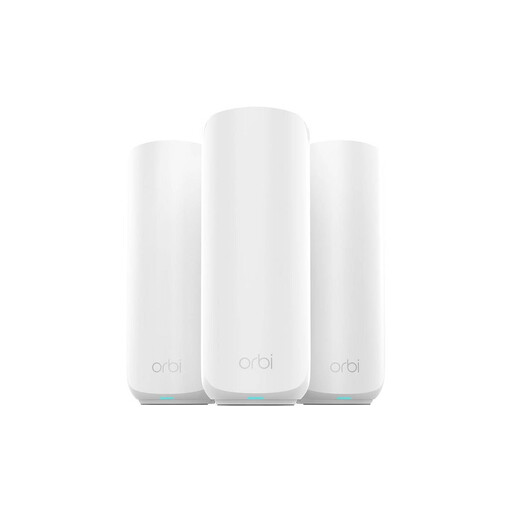
NETGEAR Orbi 370 RBE373 WiFi 7 mesh system, 3-pack, white

NETGEAR Orbi 370 RBE373 WiFi 7 mesh system, 3-pack, dual-band BE3600, white

Consider this mesh system when a node in the garden room can retain a usable connection to the house; check the signal at its intended position before buying.

The listed configuration is a three-pack with dual-band BE3600 WiFi 7 and 2.5Gbps Ethernet. Confirm whether its supported backhaul and router operating modes fit your planned setup, and check placement suitability before putting any equipment outdoors.

Joybuy

Frequently asked questions

Should I use an extender, mesh node, access point or bridge for a detached garden room?

Choose according to the path between buildings: use an Ethernet-connected access point or compatible mesh node if a suitable cable route can reach the room, or assess a paired outdoor bridge if cabling is impractical and the units can have a clear, stable path. Rely on a wireless mesh hop only after checking the signal at the proposed garden-room node position.

Will a garden-room mesh node work with my current broadband router?

It may, but compatibility depends on the exact mesh family and operating mode. BT says Whole Home Wi-Fi works with routers that have an RJ45 Ethernet port, while different Whole Home generations are not mutually compatible. TP-Link says Deco can work with an existing router in Access Point mode, which leaves DHCP to that router but makes some Deco gateway features unavailable.

Can I run an ordinary Ethernet lead outside to the summerhouse?

For an exposed route, choose cable whose stated outdoor suitability matches the conditions rather than assuming an indoor patch lead will do. External-grade Cat6 products can specify UV- and moisture-resistant sheaths. Fluke Networks describes the normal copper Ethernet channel limit as 100 m including patch leads, so assess the complete planned run, not just the distance across the garden.

Who should check power or fixed installation work for a garden office?

Have the proposed work assessed against the requirements that apply where the property is located before arranging fixed electrical work. England's Approved Document P addresses electrical safety in dwellings; GOV.WALES notes that electrical work in gardens and outbuildings may need to comply with building regulations. In Scotland, mygov.scot directs people to their council's building-standards department. Northern Ireland has separate considerations for structural changes associated with a home business, so check the relevant local authority requirements rather than assuming one UK-wide process.