Hosts comparing fat content
If reducing fat in the popcorn selection matters to you, the per-100-g nutrition figure gives you a consistent basis for comparing different pack sizes and flavours.


For a garden party where reducing fat matters, compare popcorn by total fat per 100 g before looking at the amount in a pack or serving. Among four ready-to-eat salted products listed by Sainsbury’s, DDC Foods, ASDA and Tesco, Propercorn Lightly Sea Salted 6x10g has the lowest declared figure at 17.4 g per 100 g; its small packs define a portion but do not, by themselves, establish a low-fat claim. Check salt, sugars and allergen information alongside fat, particularly when serving guests with different needs.
If reducing fat in the popcorn selection matters to you, the per-100-g nutrition figure gives you a consistent basis for comparing different pack sizes and flavours.
Individual packs and sharing bags call for different serving plans. Check salt, sugars, ingredients and precautionary allergen information before setting out the snack table.
NHS Borders advises avoiding popcorn for children under five because of choking risk. Plan a different snack for younger guests rather than putting popcorn within their reach.
Start with a like-for-like nutrition comparison, then consider how you will serve the popcorn and who will be eating it.
| Priority | What to check | Your needs and surveyed shoppers |
|---|---|---|
| Total fat | Compare total fat per 100 g across products. Then check fat per stated serving and the serving weight; a 10 g pack and a 25 g serving are not equivalent amounts. | I want to compare popcorn fairly even when the bags differ in size. A smaller pack tells me how much one pack contains, not whether the popcorn itself has little fat. |
| Salt and sugars | Read salt and sugars per 100 g as well as per serving, particularly when comparing sweet and salted flavours. Check what portion the front-of-pack figures describe. | I’m offering other party snacks too, so I want to see more than the fat figure. In a Food Standards Agency and Ipsos Northern Ireland survey of 611 people conducted in September–November 2024, 49% said they actively used traffic-light labels when shopping for food; that figure concerns food shopping generally, not popcorn. |
| Serving format | Check whether the product contains individual packs or a sharing bag, and read the stated serving weight. For a sharing bag, decide whether to put out bowls or a scoop. | With guests helping themselves, I’d rather plan the amount served than treat a whole sharing bag as one portion. |
| Guest suitability | Read the current pack’s ingredients, allergen statements and any kernel warning. NHS Borders advises avoiding popcorn for children under five. | I need a separate option for younger children and want guests with dietary restrictions to be able to check the pack themselves. |
Sainsbury’s lists 1.7 g fat in a 10 g pack of Propercorn Lightly Sea Salted, but 17.4 g per 100 g of the same popcorn. The pack figure reflects a smaller amount of food.
Use fat per 100 g to compare products, then use the per-pack figure to plan what each guest might take.
ASDA lists 22 g fat and 25 g sugars per 100 g for its Sweet Popcorn. Tesco lists 31.2 g fat and 1.26 g salt per 100 g for its Salted Popcorn. These figures describe different considerations, not an overall winner.
Compare fat, saturates, sugars and salt on the same per-100-g basis, then check the values for the portion you intend to serve.
Tesco describes its 85 g Salted Popcorn bag as approximately four 21 g servings. Guests serving themselves from an open bag may take a different amount.
Decant sharing popcorn into bowls or provide a scoop if defined portions matter for your table.
NHS Borders advises avoiding popcorn for children under five because of choking risk. Unpopped kernels also deserve attention when serving popcorn to other guests.
Offer younger children another snack and keep their access to popcorn in mind when arranging the table.
These label figures refer to the named products and pack formats, not every popcorn sold under each brand.
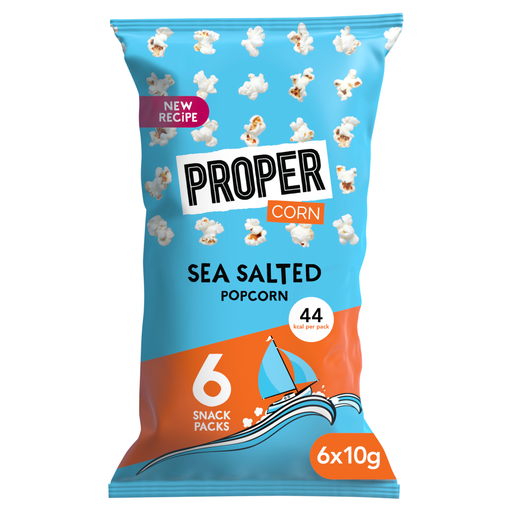
Its Lightly Sea Salted 6x10g multipack offers defined individual portions for a garden-party table.
Metcalfe’s Sea Salt is another ready-to-eat savoury option for comparison.
ASDA’s named salted and sweet products illustrate why flavour alone does not settle a nutrition comparison.
Tesco Salted Popcorn comes in an 85 g sharing bag described by Tesco as approximately four servings.
These options include ready-to-eat individual packs, a sharing bag and microwave popcorn. Their formats and flavours suit different serving plans; use the current pack label for a like-for-like nutrition and allergen check.
 No image available
Six individual packs make it straightforward to offer a defined 10 g portion. Joybuy lists 17.4 g fat per 100 g and 1.7 g per pack; its product information also gives a precautionary milk warning. Check the current pack before serving guests with allergies.
 No image available
The 70 g bag is a sharing format rather than a set of individual portions. If you plan to divide it between guests, check its own nutrition panel and stated serving weight; do not use figures from the 6x10g multipack as though the two packs were identical.
 No image available
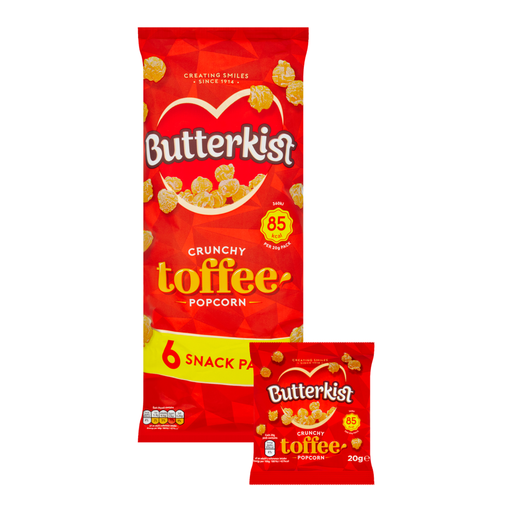
These individual toffee-flavoured packs offer a sweet option with a stated 20 g pack size. Compare the current pack’s fat and sugars per 100 g with savoury choices, and read its ingredients and allergen information before serving.
 No image available
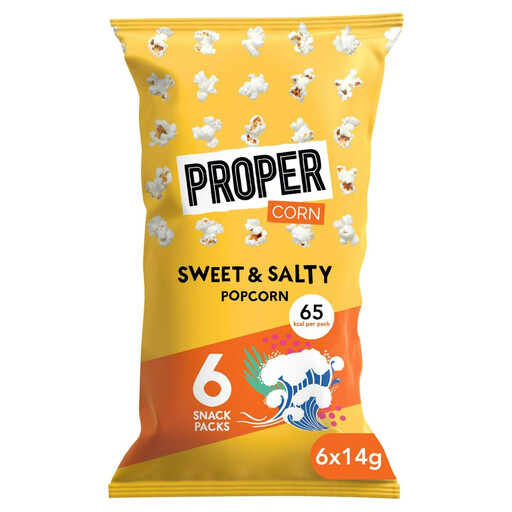
The sweet-and-salty flavour and individual 14 g packs provide another way to serve defined portions. Check both sugars and salt on this variant’s current label when comparing it with lightly salted popcorn.
 No image available
This microwave popcorn needs preparation before it can go on the garden-party table. Check the cooking instructions, the nutrition values for the prepared product and the pack’s warnings about unpopped kernels.
No: the wording describes the flavour, not a comparison of total fat. Sainsbury’s lists 17.4 g fat per 100 g for Propercorn Lightly Sea Salted 6x10g, so compare that figure with the per-100-g value on any other pack you are considering.
Compare total fat per 100 g first, then look at the fat and weight in a stated portion. Sainsbury’s lists 1.7 g fat per 10 g pack for Propercorn Lightly Sea Salted; ASDA lists 6.5 g per 25 g serving for its Salted Popcorn. Those serving figures describe different amounts of popcorn.
No. ASDA lists 22 g fat per 100 g for its Sweet Popcorn and 26 g for its Salted Popcorn, but that comparison applies to those two products. The Sweet Popcorn also lists 25 g sugars per 100 g, so check the particular packs and the values that matter to your choice.
NHS Borders advises avoiding popcorn for children under five because of choking risk. Provide a different snack for younger children at the party and consider where popcorn is placed.
Read the ingredients and precautionary allergen information on the actual pack before serving it. For example, Sainsbury’s states that Propercorn Lightly Sea Salted 6x10g is made in a factory that handles milk; guests who need that information should be able to see the current packaging.