Carry-on business travellers
If you pack lightly and want to touch up a shirt, blouse, dress or jacket after arrival, consider how the steamer folds, what you can store it in and how quickly it heats up.


For a short business trip, a foldable handheld steamer makes sense for light outfit touch-ups if its voltage rating suits your destination. For trips to 120V destinations, choose an explicitly dual-voltage model rather than relying on a plug adaptor, as Electrical Safety First advises; Philips notes that steamers do not produce an iron's finish on thick cotton or linen.
If you pack lightly and want to touch up a shirt, blouse, dress or jacket after arrival, consider how the steamer folds, what you can store it in and how quickly it heats up.
If your trips include destinations with a different electrical supply, check the appliance's rated input before buying. A travel adaptor changes the plug connection, not the supply voltage.
If your main task is easing light travel creases in ironable garments, a handheld steamer may suit you. Keep access to an iron or pressing service if sharply finished heavy shirts are essential.
For a business-trip steamer, check destination voltage first, then decide how much luggage space, steaming time and fabric finish you need.
| Concern | What to check | Who this matters to |
|---|---|---|
| Size and readiness | Check packed dimensions, whether the head folds and the stated heat-up time. | I want a steamer that fits my overnight bag and is ready before a meeting, even if a small tank means refilling more often; around 33% of consumers put compactness and quick readiness first. |
| Voltage abroad | Read the exact model's input rating and check the destination's supply; check that the plug adaptor is suitably rated too. | If my trip takes me to a 120V destination, I need an appliance rated for that supply, not just a plug that fits; around 27% of consumers prioritise voltage compatibility. |
| Time between refills | Compare tank capacity and manufacturer-stated steaming duration where available; do not infer duration from tank size alone. | When I have several work outfits to refresh, I would rather refill less often than pack the smallest unit; roughly 20% of consumers put steaming time between refills first. |
| Fabric finish | Check the garment's care label and whether you need a light refresh or a sharply pressed result. | For delicate workwear, I need a light refresh without expecting iron-sharp creases; around 20% of consumers put fabric finish and care first. |
An adaptor may let a plug fit without making a steamer suitable for the destination's electrical supply. Electrical Safety First advises checking the appliance rating and destination supply.
For a 120V destination, choose a model explicitly rated for that voltage, or check whether the manufacturer permits a correctly rated voltage converter.
Philips says garment steamers do not achieve the same result as an iron on thick cotton or linen, which matters if crisp collars and creases are part of your workwear.
Use a steamer for light touch-ups; arrange access to an iron or hotel pressing when a sharply pressed finish is necessary.
Wattage does not tell you whether a steamer fits your bag, works with the destination's voltage or lasts long enough between refills.
Compare the exact model's packed size, heat-up time, tank, stated steaming duration and electrical rating alongside its power.
A recently used steamer can have hot parts and water in its tank. Airport and airline requirements can also vary, as GOV.UK advises travellers to check before departure.
Follow the model's instructions for unplugging, emptying and cooling it, then check your airport and airline requirements before packing.
Its 3000 Series STH3010/30 is a foldable handheld option for quick clothing touch-ups.
Its travel-oriented models offer different priorities: a folding design in the Access Steam Pocket DT3030 and selectable voltage settings in the Access Steam Travel DT7050.
The foldable CompactSteam VIN430 is relevant when tank capacity matters more than packing the smallest possible unit.
These Philips handheld models are options for quick clothing touch-ups. Check each exact variant's voltage rating and packed size before relying on it for a trip.
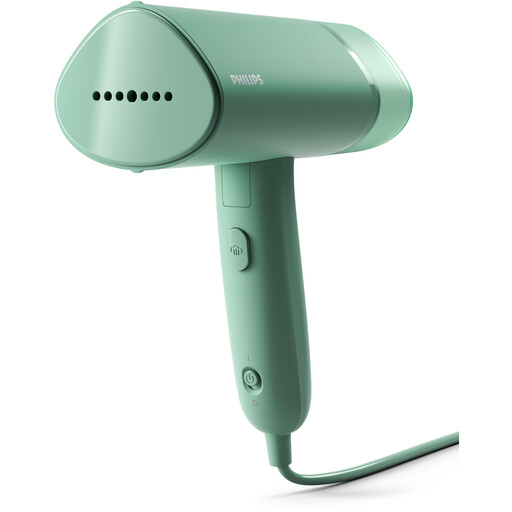 No image available
Consider this handheld model for light touch-ups between meetings. Check the STH3010/76 rating against your destination's supply and confirm its packed dimensions before travelling.
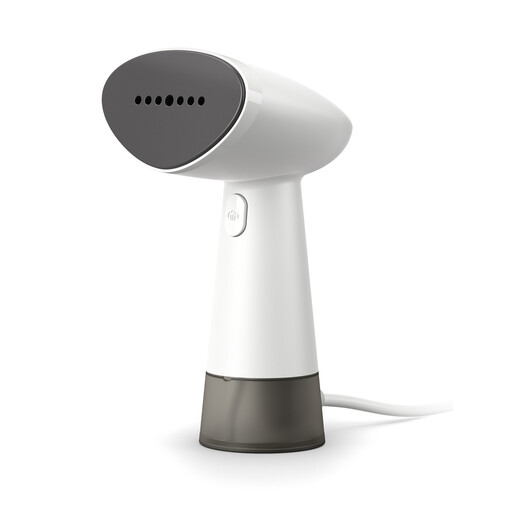 No image available
Consider this handheld model for brief clothing touch-ups when travelling. Its listed power is 900W; check its voltage rating and packed dimensions against your destination and luggage.
Take a handheld steamer for light touch-ups to hanging, ironable garments; choose an iron or hotel pressing if crisp collars, cuffs or heavy cotton and linen shirts matter more. Philips notes that a steamer does not produce the same finish as an iron on those heavier fabrics.
You need an appliance rated for the destination's supply voltage. Electrical Safety First advises that a converter or transformer is needed when the supply differs unless the appliance is dual-voltage rated; Tefal lists 120V/240V settings for its DT7050. A plug adaptor alone does not change voltage.
Check your airport and airline requirements for the specific journey before putting a garment steamer in hand luggage. GOV.UK advises that requirements for electrical items and liquids can vary; empty and cool the appliance in accordance with its instructions before packing it.
Follow the exact model's manual, keep steam away from people and never steam clothes while they are being worn. Breville's VIN430 manual gives that warning; allow a steamer to cool before storing it and follow its instructions for filling and emptying.