Whole-room curtain refreshers
If you plan to steam several panels while they remain hung, consider how often you will refill the tank and whether the cord, hose and appliance support will let you work comfortably across each window.


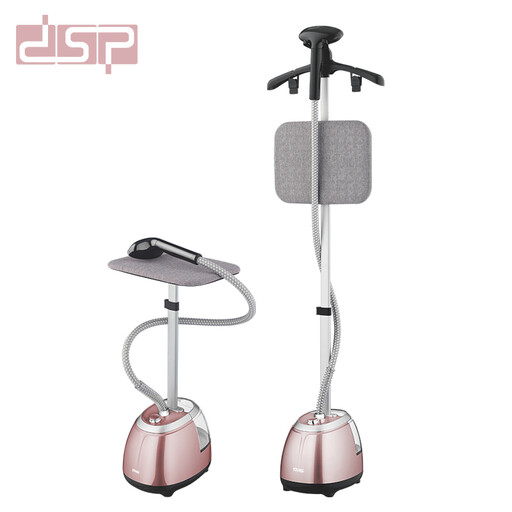
Choose a handheld garment steamer for occasional touch-ups on one or two curtains that can safely be steamed; an upright model is more practical when you regularly cover several large panels and want a larger tank and standing support. Check the curtain’s care instructions before either purchase, and do not assume that a steamer will remove deep creases from heavy cotton or linen.
If you plan to steam several panels while they remain hung, consider how often you will refill the tank and whether the cord, hose and appliance support will let you work comfortably across each window.
If you mainly refresh one or two suitable curtains at a time, a compact appliance may be easier to store and retrieve. Check its tank and reach before relying on it for a larger session.
If a curtain has a sensitive fibre, lining, pile or finish, start with its own care instructions. Adjustable steam does not make a fabric suitable for steaming when its care guidance says otherwise.
Decide whether you need a compact steamer for limited touch-ups or an upright appliance for repeated, larger sessions. Then check fabric suitability and the exact model’s reach, tank and handling arrangements; an iron is an alternative only if both its manual and the curtain instructions permit vertical steaming.
| Concern | What to check | Who this matters to |
|---|---|---|
| Reach and capacity | Compare tank capacity with cord or hose reach and the support arrangement. Capacity alone does not establish runtime. | With several tall panels to cover, I want to work across each window without repeatedly stopping or stretching towards it. Around 27% of consumers put reach and capacity first. |
| Compact setup | Check the handheld model’s size, setup and refill process against the area you expect to treat. | For an occasional touch-up, I would rather retrieve a compact appliance than set up a floor-standing one. Roughly 33% of consumers chiefly value that convenience. |
| Fabric suitability | Read the curtain’s care label and the steamer manual; check whether any steam settings are appropriate for that fabric. | If my curtains have a lining or delicate finish, avoiding heat or moisture damage matters more than finishing quickly. About 20% of consumers make fabric care their primary concern. |
| Persistent creases | Check what treatment the curtain permits before comparing a steamer with an iron that explicitly supports vertical use. | For deeper folds in a heavy curtain, I want to know whether steaming is likely to meet my expectations before buying. Around 20% of consumers put crease reduction first. |
Heat and moisture can affect fibres, linings and finishes differently. General garment-steamer descriptions cannot override a curtain’s specific care instructions.
Read the sewn-in label and any curtain-maker guidance before use. Take particular care with velvet, sueded or waxed materials, plastic or vinyl, and uncertain blends, as noted in general fabric-care guidance.
A handheld tank and an upright tank can make for very different refill routines. Tefal lists a 0.2 L tank for its DT9100, while Morplan lists 1.9 L and 3 L tanks for its cited upright models; those figures do not establish their respective runtimes.
Count the panels you intend to treat, then check tank capacity, cord or hose reach, support and the refill procedure on the exact model.
A smaller tank may mean stopping to refill during a longer session.
A stated steam-output rating does not, by itself, show how an appliance will handle deep folds in a particular hanging curtain. Philips cautions that a garment steamer may not produce the same results as an iron on thick cotton or linen.
For heavy curtains that permit steam, consider whether an iron with an explicitly supported vertical-steam function is a suitable alternative. Follow both the appliance manual and the curtain’s instructions.
Water instructions vary by model, and steaming at a window makes cord placement and safe handling particularly important.
Follow the exact steamer’s water and filling instructions. Check the cord and plug before use, avoid overstretching the lead, and look for relevant safety features such as auto-off when comparing models.
Tefal’s garment-steamer range includes handheld and home-textile formats. Check features against the particular model rather than assuming they apply across the range.
Philips describes its handheld Steam&Go format for compact, no-board touch-ups, including vertical use on applicable fabrics.
Morplan lists curtains among the intended uses of some of its larger clothes steamers.
This garment steamer has a stated 2.1 L tank and adjustable steam settings, which may be relevant if refilling interrupts longer sessions. Before choosing it for hanging curtains, check the exact model’s instructions, reach and support arrangement, alongside the curtains’ care labels.
 No image available
Consider its 2.1 L tank if refilling during a longer session is a concern, but check its reach and handling arrangement before using it at curtain height.
The product name states 10 steam settings, a 2000 W rating and a stainless-steel nozzle. Check the model instructions and curtain care label before selecting a setting or steaming a panel.
No: steam only curtains whose care instructions permit it. Follow the sewn-in care label before general fabric guidance, and be particularly cautious with materials including velvet, sueded or waxed fabrics, and plastic or vinyl. If the instructions are unclear, do not treat a general fabric guide as permission to steam the whole panel.
A handheld steamer suits occasional, limited-area touch-ups when compact storage matters; an upright model is worth considering for several larger curtains if you have room to store it. For scale, Tefal lists a 0.2 L tank for its handheld DT9100, while Morplan lists 1.9 L and 3 L tanks for the upright models described above. Check reach and support as well as capacity.
Use the water specified in your exact model’s manual. For its Access Steam Easy DT7130, Tefal permits untreated tap water and advises a 50/50 mixture of untreated tap water and distilled water when the tap water is very hard. Do not assume those instructions apply to another steamer.
Check that the cord reaches the working area without being overstretched, inspect the plug and cord before use, and follow the appliance’s filling and handling instructions. Electrical Safety First identifies automatic shutoff as a safety feature to look for in steam appliances; confirm whether it is present on the exact steamer you choose.