
24/7 Customer Support

Free returns

Same-day & Next-day Delivery

Quality Guaranteed

Unlock Your Welcome Offers: FREE Delivery | Up to 80% OFF | Free 30-day JoyPlus trial
Download the APP
Choosing a built-in gas hob involves more than selecting a finish that matches your kitchen. The wrong width can leave you with an unusable worktop cut-out, while an impressive-looking burner layout may not suit your cookware or cooking habits.
This guide explains the practical details UK homeowners, landlords, kitchen renovators and home cooks should check before buying gas hobs.
A 60cm gas hob usually refers to the appliance’s approximate external width, not the size of the opening in your worktop. For example, some models measure around 590–600mm wide but require a cut-out close to 560mm wide by 480mm deep.
Always compare:
Do not remove an existing hob until the new model’s installation diagram has been checked.
A five-burner gas hob can be useful for households cooking several dishes at once, but burner count alone does not guarantee convenient multi-pan cooking. Closely positioned burners may make it difficult to use several large pans simultaneously.
A four-burner gas hob can be more suitable for a compact kitchen or everyday cooking. A five-burner gas hob in a 70cm, 75cm or 90cm format may provide more room between cookware, although the available worktop space and cut-out must be suitable.
A black glass surface creates a contemporary gas-on-glass look, but it can show marks and requires care around impacts and sudden temperature changes. Stainless steel is practical and familiar, although splashes and fingerprints may be more visible.
More important than colour is whether the appliance includes a flame failure device. This safety system is designed to interrupt the gas supply if the flame is extinguished. Check that the feature applies to every burner rather than only one zone.
The appliance width is only part of the installation. Review the manufacturer’s stated recess dimensions, minimum clearances and ventilation requirements. Gas appliances should be installed and connected by a Gas Safe registered engineer in the UK. Models with automatic ignition or flame safety systems may also require an electrical connection, so check whether a fused spur or other specified supply is needed.
Look for a useful combination rather than simply the highest quoted output. A typical layout may include:
A wok burner hob can be helpful for stir-fries and large pans, but a high-output burner is not essential for every household. Check the stated power ratings and whether the burner supports match the pans you use.
A stainless steel gas hob is generally straightforward to wipe down and suits traditional or contemporary kitchens. A gas-on-glass hob offers a smooth black surface, but the glass should be treated carefully and cleaned with suitable products.
Cast iron pan supports provide a firm base for heavier cookware. Enamelled supports may also be practical for cleaning. In either case, removable supports and burner caps make routine maintenance easier.
For properties supplied by LPG, confirm whether the model is an LPG convertible gas hob and whether conversion jets or a separate kit are included. Do not assume a natural-gas model can be converted without checking the product specification and installation instructions.
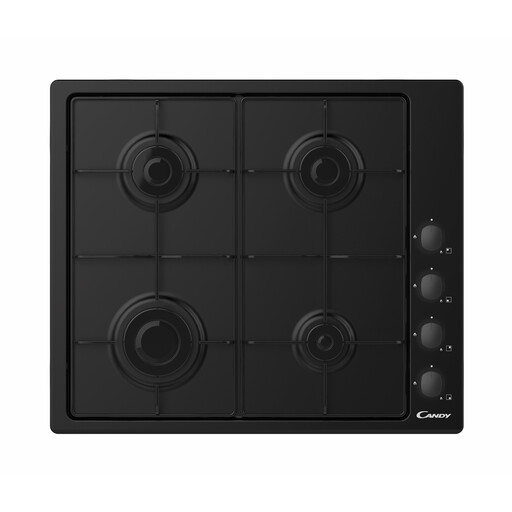
Why This Fits Their Persona: A practical option for first-time replacements, rental properties and kitchens with a standard-sized opening. Its four-burner layout suits everyday family meals without requiring a wider worktop.
The stated dimensions and approximately 560mm cut-out help shoppers compare it with an existing standard installation. Removable supports simplify cleaning.
60cm format, side-mounted rotary controls and four burners. The listed specification includes a flame failure or thermocouple safety device.

Why This Fits Their Persona: Suits renovators seeking a wider black gas hob with a contemporary surface and more room for several pans.
Its specification clearly identifies five burners, a 745mm width, flame failure devices on each burner and a separate LPG conversion option.
Five burners, a 5kW double-ring wok burner, cast iron supports and front-mounted controls. The listed Preci Flame system provides nine marked power settings per burner.
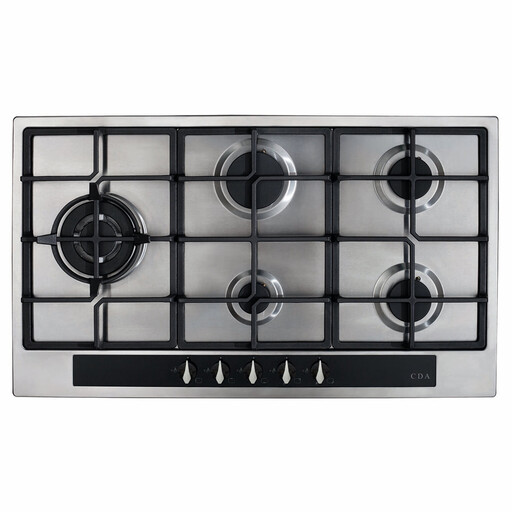
Why This Fits Their Persona: Designed around a broad 90cm cooking area for large households, frequent entertaining and cooks who regularly use several sizeable pans.
The 90cm width and stated 860mm by 480mm cut-out make the space requirement clear before purchase. Its stainless steel surface avoids relying on glass styling alone.
Five burners include a 5kW wok burner, two rapid burners and a simmer burner. The specification lists electronic ignition, flame failure devices and LPG conversion capability.
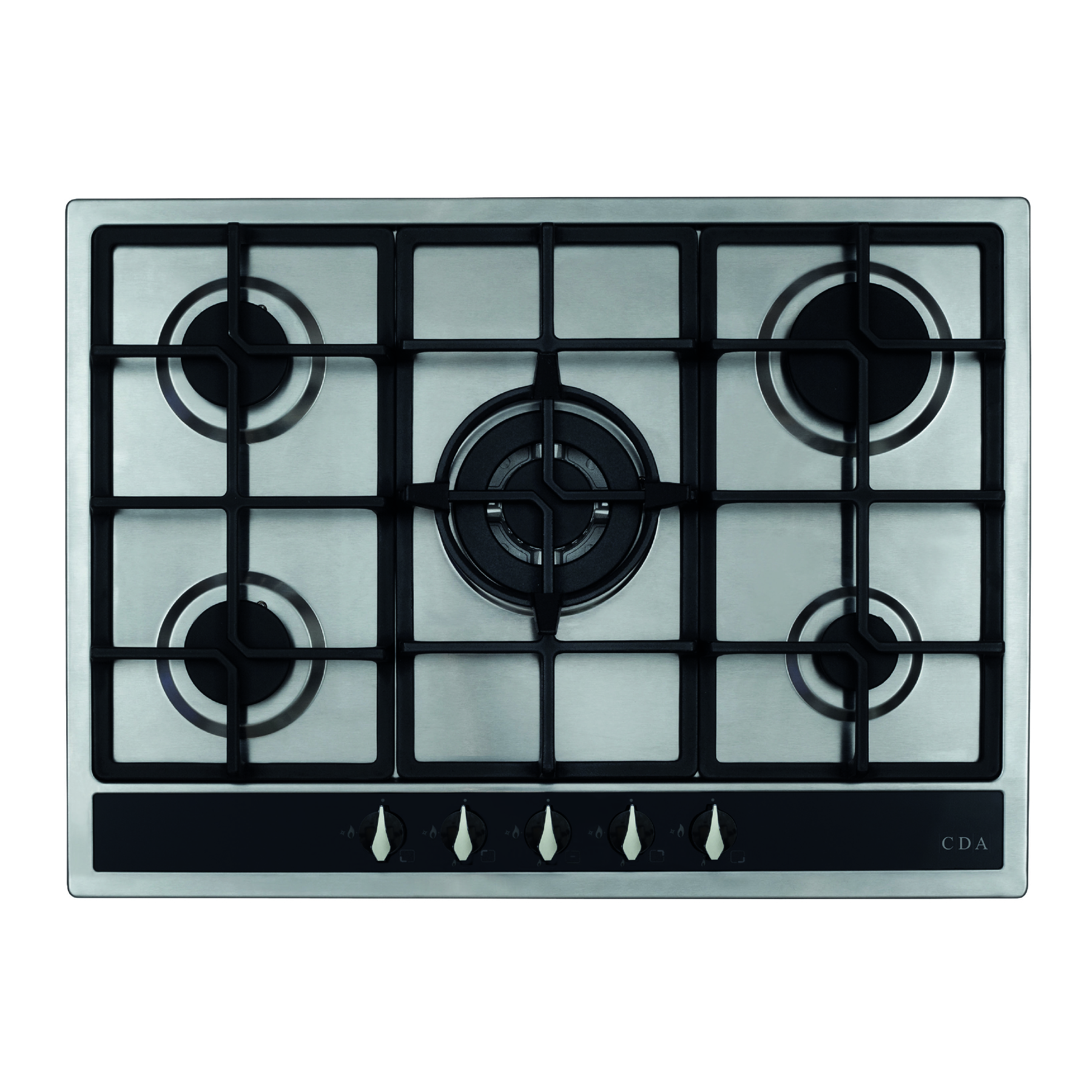
Why This Fits Their Persona: A middle-width choice for cooks who want five burners but cannot accommodate a 90cm gas hob.
The listed 680mm product width, five-burner configuration and 560mm minimum cut-out width help clarify the fit before ordering.
Includes a triple-ring wok burner, cast iron supports, automatic ignition and flame safety devices on all burners.
We have compiled a complete, real-time list of products that fully satisfy these strict selection criteria and UK safety regulations.
Gas connections in UK homes should be completed by a Gas Safe registered engineer. Follow the appliance instructions for ventilation, clearances and any electrical connection required for ignition or flame safety components.
A 60cm gas hob is commonly considered for standard kitchen layouts and replacement installations. A 70cm or 75cm model may offer more room for five burners, while a 90cm model requires substantially more worktop space. Measure the opening rather than relying only on the advertised width.
Running cost depends on gas and electricity tariffs, burner power, cooking duration and how efficiently heat reaches the pan. Choose a burner that matches the cookware size, keep flames beneath the pan base and avoid using a high-output wok burner for low-temperature tasks. Check the product’s fuel compatibility and rated gas load before purchase.