
24/7 Customer Support

Free returns

Same-day & Next-day Delivery

Quality Guaranteed

Unlock Your Welcome Offers: FREE Delivery | Up to 80% OFF | Free 30-day JoyPlus trial
Download the APP
Gel pens can make everyday writing more comfortable and colourful, but the product description does not always reveal how a pen will perform on your paper, in your pencil case or during a long study session. Students, parents, office workers and journalers often need to compare ink flow, tip size, erasability, grip comfort and pack quantity before buying.
A low price can be misleading if several pens skip, dry out quickly or bleed through notebook pages. Equally, decorative pens may look appealing but offer limited value if they are difficult to use for ordinary note-taking. This guide explains the key details to check and matches different types of users with suitable options.
A nib marked 0.5mm does not always create a line that looks exactly 0.5mm wide. The result also depends on ink viscosity, pressure and paper texture. Needle-point and fine point pens are generally useful for small handwriting, diagrams and planner layouts, while wider tips can produce a more noticeable line for everyday writing.
For example, the Pentel Floatune has a 0.8mm nib but is described as producing an approximate 0.4mm medium line width. Always check both the tip measurement and the stated line width where available.
Erasable gel pens use ink that can be removed through friction or heat. This is convenient for drafts, homework, revision notes and journaling, but it is not automatically suitable for signed forms, official records or documents that need permanent ink. Some erasable inks can also respond to heat, so check the product instructions before using them on important paperwork.
Glitter, scents, character toppers and bright barrels can make stationery more enjoyable, particularly for children and creative projects. However, these features may not be the priority for several hours of schoolwork or office writing. Check whether the pen has a comfortable grip, a secure cap or retractable mechanism and an appropriate tip before focusing on its appearance.
If you write small notes or use narrow notebook ruling, fine point pens may be easier to control. For headings and everyday lists, a medium point can provide stronger visibility.
Gel ink is usually valued for its smooth feel and strong colour. Water-based liquid ink rollerball pens can also provide fluid writing, while quick-drying formulas may be more suitable for left-handed users or anyone who often rests a hand over fresh writing.
No-smear claims should still be treated carefully. Drying time varies with paper, writing speed, humidity and the amount of ink applied. Test a pen on the paper you use most often when possible.
A ribbed or non-slip barrel can improve control during long writing sessions. Retractable pens are convenient for desks and pencil cases because there is no loose cap, while capped pens need to be closed securely to help prevent the tip drying out.
Store capped gel pens horizontally in a cool, dry place unless the product instructions state otherwise. Keep pens and small components away from young children and follow age warnings supplied with children’s creative stationery.
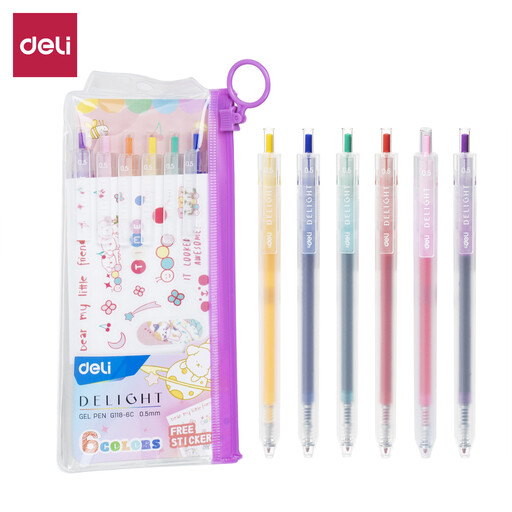
Why This Fits Their Persona: A six-pack with red, blue and yellow ink gives students and households a straightforward selection for homework, colour-coding and everyday lists.
The 0.5mm specification makes the writing format clear, while the basic colour assortment avoids paying mainly for decorative extras.
Fine-point format; six pens in three listed colours for school or office use.
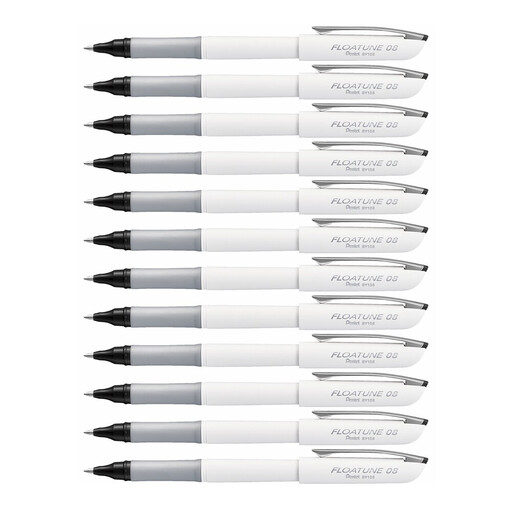
Why This Fits Their Persona: Suitable for office workers and frequent writers who prefer black ink and a fluid rollerball feel for documents, notes and correspondence.
The product information states both the 0.8mm nib and approximate 0.4mm line width, reducing uncertainty about the writing format.
Dual-ball tip; pack of 12 black rollerball pens; water-based ink with an oil-based lubricant.
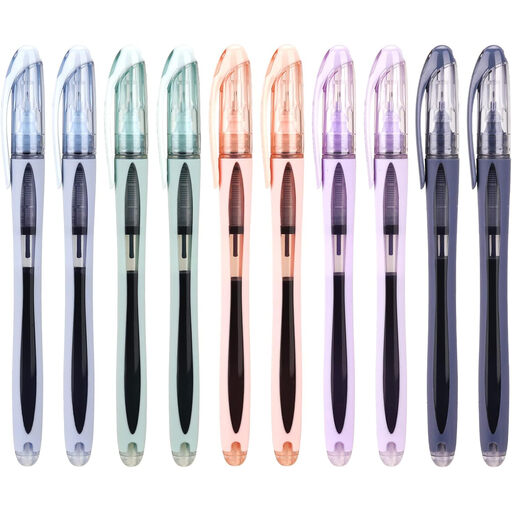
Why This Fits Their Persona: A practical option for students, teachers and office users who write frequently and prefer fine black lines for note-taking and marking.
The product lists a 0.5mm needle tip, snap cap and ergonomic grip, making the functional design easier to assess than appearance-led descriptions.
Extra-fine 0.5mm point; quick-drying liquid ink; 10 black pens in the pack.
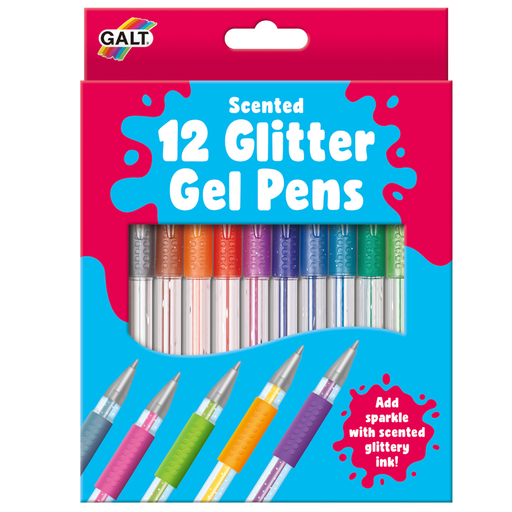
Why This Fits Their Persona: Designed for drawing, colouring and creative projects, this set suits children aged 6 and over, crafters and anyone decorating cards or journals.
Its purpose is clearly creative rather than formal writing, and the age guidance and small-parts warning are stated in the product information.
Twelve scented glitter colours; lightweight design; suitable for colouring and drawing from age 6.
Yes, gel pens can be useful for notes, revision, headings and colour-coding. Check your school’s requirements before using coloured or erasable gel ink in examinations or formal assessments, as rules may differ. Black or blue pens are generally more practical for standard written work.
Their lifespan depends on tip size, writing frequency, ink volume, storage and whether the pen is left uncapped. Fine point pens may use ink more slowly, while glitter and decorative pens can be reserved for occasional creative work. Replacing caps securely after use helps reduce drying.
Both can write smoothly, but the experience varies by ink formulation, nib construction and paper. Rollerball pens commonly use liquid ink and may feel particularly fluid, whereas gel pens often provide stronger colour and a broader choice of decorative or erasable formats. Compare the tip, grip and intended use rather than relying on the category name alone.