24/7 Customer Support

Free returns

Same-day & Next-day Delivery

Quality Guaranteed

Unlock Your Welcome Offers: FREE Delivery | Up to 80% OFF | Free 30-day JoyPlus trial
Download the APP
There is a quiet poetry to watching a child at play. We often observe a state of deep focus, a world shrunk to the dimensions of a screen, thumbs moving with practised speed. Yet, there is another mode of play, one that spills out from the living room into the garden, marked by running, discovery and a tangible connection to the physical world. For a long time, these two modes felt distinct. One digital and still, the other analogue and kinetic. Now, a middle ground is emerging, where technology encourages us to move, to use our bodies as the interface.
This shift is about more than just novelty. It represents a deeper understanding of how we learn and interact. It is about creating a more intuitive, human-centred relationship with the objects around us.
At the heart of this evolution is a new grammar of control. The traditional remote, with its joysticks and buttons, requires a process of translation. We learn that pushing a stick forward makes the object advance. A gesture-based system, however, is more direct. A tilt of the hand, a flick of the wrist—these are not abstract commands but a physical dialogue. When a child learns to pilot a hand controlled car, they are not just mastering a toy. They are developing an innate understanding of cause and effect, of how their own physical expression can manifest as action at a distance.
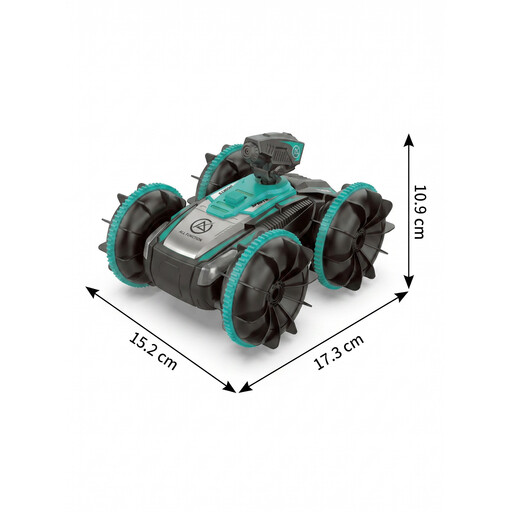
This principle extends to the design of the objects themselves. A modern 4WD off-road toy car is engineered not just for a flat, predictable surface, but for the beautiful imperfections of the real world. It is designed to navigate the damp lawn after a morning shower, the gravel of a driveway or the uneven flagstones of a patio. Its purpose is exploration. Features that once seemed like simple novelties, such as the ability of a 360 rotating rc car to spin on its axis, become tools for problem-solving. A child learns to use momentum and orientation to navigate tight corners or right the vehicle after a tumble. The inclusion of a water resistant rc car body acknowledges the realities of British weather, transforming a rainy afternoon from a limitation into a new landscape for adventure. Play is no longer confined by four walls.
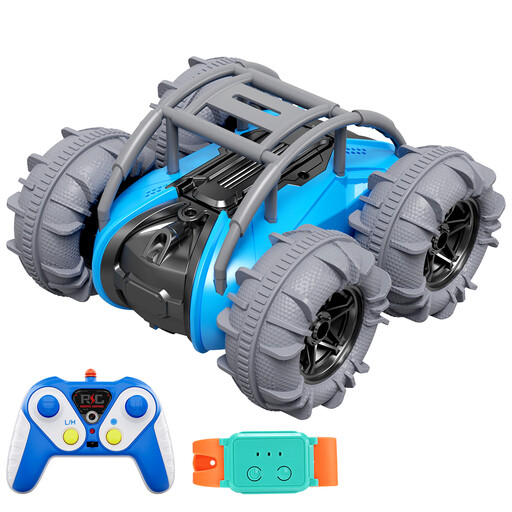
Curating objects for a home is about finding a balance between form, function and the quality of experience they provide. This is especially true for the objects of play. The ideal toy should not only entertain but also engage and endure. A dual control rc car serves as a thoughtful bridge between familiar and future-facing play. Models such as the Tokky Remote Control Toy Car offer both a traditional handset for precise operation and a wrist-mounted gesture controller for a more intuitive, flowing experience. This allows for a gradual adaptation, favouring a learning curve over an instruction manual. The design itself speaks to this purpose, with a robust frame and impact-resistant materials that suggest a life of active use rather than careful preservation.
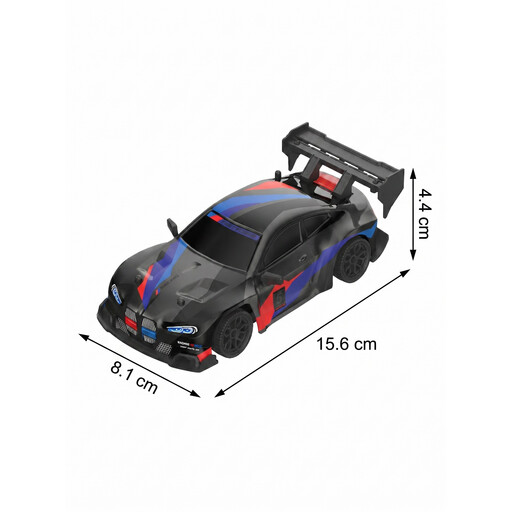
This new mode of interaction is becoming a central theme in contemporary toy design. The 4DRC Y2 Gesture Hand Remote Control Car refines this concept, focusing on agility and acrobatic potential. It is less about traversing terrain and more about the choreography of movement in an open space. For younger children or for those who find joy in narrative, a familiar character can be the most welcoming entry point. A vehicle like the Marvel Spider-Man Remote Control 1:24 Scale Buggy uses a simpler control scheme to build a foundational understanding of remote operation and hand-eye coordination. In all these instances, the move towards a rechargeable stunt car for kids via simple USB connection reflects a more considered approach to longevity and convenience, harmonising with the rhythms of a modern household.
For those wishing to explore a wider curation of objects for modern play, the complete collection of children's remote control cars offers further inspiration.