Afternoon-tea hosts serving a group
A stated biscuit or serving count helps you plan the table. Check the chocolate style and each pack’s allergen information before sharing it with guests.


For an afternoon tea party, choose chocolate-coated ginger biscuits if you want chocolate alongside ginger; choose plain ginger nuts if the familiar uncoated biscuit matters more. Check the biscuit or serving count, chocolate style, ginger format and current allergen label before deciding what to put on a shared table.
A stated biscuit or serving count helps you plan the table. Check the chocolate style and each pack’s allergen information before sharing it with guests.
Compare the biscuit base and whether the ingredients name ground ginger or stem ginger. A coated cookie or shortcake biscuit is a different format from a plain ginger nut.
The Department for Education’s England school food guidance says chocolate-coated products must not be served across the school day. A party choice should not be carried over to school-food purchasing without checking that rule.
Start with the biscuit format you want for tea, then check the pack information that affects serving a group.
| Priority | What to check | Your needs |
|---|---|---|
| Biscuit format | Check whether the pack describes a plain ginger nut, a coated ginger biscuit, a cookie, shortcake or an oat-based biscuit. Look for ground or stem ginger in the ingredients. | I want to know whether guests will be served a traditional plain ginger nut or a different ginger-and-chocolate biscuit. |
| Chocolate | Read whether the coating is described as dark, plain or milk chocolate. Compare stated chocolate proportions only for the exact packs concerned. | Dark chocolate is part of the tea-table choice for me, rather than just any chocolate-coated biscuit. |
| Sharing | Look for a stated biscuit or serving count as well as pack weight. Sainsbury’s lists eight servings for its Taste the Difference cookies; Waitrose lists eight biscuits. | When I’m serving several guests, a count helps me plan more directly than pack weight alone. |
| Ingredients and allergens | Read the current pack’s ingredients, emphasised allergens and precautionary statements. Sainsbury’s says its listed cookies are unsuitable for customers with a nut allergy because of manufacturing methods. | I need to check each guest’s requirements before putting biscuits on a communal table. |
| Serving information | Compare nutrition on the same stated basis, such as per 100g, rather than treating differently sized biscuits as equal servings. Tesco Groceries lists 5.7g sugars per 17g serving for its Border dark chocolate ginger biscuits. | I want to see what one stated serving represents before deciding how many biscuits to put out. |
The listed options include ground-ginger biscuits, stem-ginger cookies, shortcake and oat-based biscuits. Their bases and ginger ingredients are not interchangeable.
Read the biscuit description and ingredients if the traditional plain ginger-nut format is important to you.
A pack’s weight does not tell you how many biscuits it contains. The Sainsbury’s listing states eight servings, while the Waitrose listing states eight biscuits.
Use a stated count when available and check the current pack when planning for a particular number of guests.
The compared biscuits have product-specific allergen declarations and precautionary statements. Sainsbury’s and M&S identify restrictions for customers with nut allergies on their listed products.
Check the current physical pack for each product and arrange a separately suitable option where a guest needs one.
The Department for Education’s guidance for England says chocolate and chocolate-coated products must not be served across the school day. That rule does not establish an HFSS classification for each biscuit.
Do not choose a chocolate-coated ginger biscuit for service during the school day in England. Check the applicable local school-food rules for a school elsewhere in the UK.
These retailer listings illustrate different biscuit formats; check the exact product and current pack rather than treating a brand name as a specification.
Tesco Groceries lists Border dark chocolate ginger biscuits in a 150g pack.
Sainsbury’s describes its dark chocolate and ginger cookies as all-butter biscuits with stem ginger.
Waitrose lists an eight-biscuit dark-chocolate-coated ginger shortcake pack.
M&S describes a dark-chocolate ginger biscuit with stem ginger and an oat base.
Tesco Groceries lists McVitie’s Ginger Nuts as a plain ginger-biscuit option.
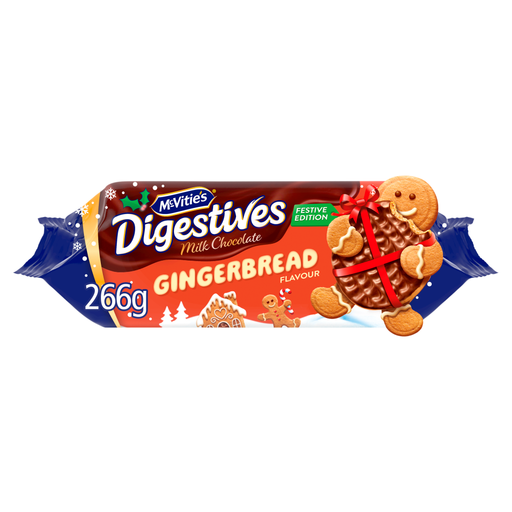
These options cover a dark-chocolate ginger biscuit, a gingerbread-flavoured chocolate digestive and a dark-chocolate ginger oat biscuit. The digestive is a distinct option, not a plain ginger nut.
 No image available
A dark-chocolate ginger biscuit to consider when both flavours belong on the tea table. The pack is 150g; check its biscuit count and current allergen label before planning for guests.
 No image available
Consider this gingerbread-flavoured chocolate digestive if a digestive biscuit suits your tea spread better than a ginger nut. The pack is 266g; check its chocolate description, biscuit count and allergens on the current label.
 No image available
This 285g dark-chocolate ginger oat biscuit is an option if you want an oat-based format for tea. It contains maltitol; check the pack’s warning about excessive consumption, as well as its allergens, before serving it to a group.
They are an option if you want chocolate alongside ginger rather than a plain ginger nut. Plan from a stated count where possible: Sainsbury’s lists eight servings for its Taste the Difference cookies, and Waitrose lists eight biscuits.
Read the current physical pack for every biscuit you intend to serve, including its ingredients and precautionary statements. Sainsbury’s and M&S state nut-allergy restrictions for their listed ginger biscuits, so dark chocolate alone is not a suitability check.
No. The Department for Education’s England school food guidance says chocolate-coated products must not be served across the school day; the Requirements for School Food Regulations 2014 include wholly or partly chocolate-coated products in their definition of confectionery. This school-food rule does not classify every biscuit as HFSS or establish the rules for schools elsewhere in the UK.