Portion-conscious ginger-biscuit shoppers
If you are managing your overall food intake, per-biscuit figures help you plan how many you will eat. Per-100g figures serve a different purpose: comparing products on the same weight basis.


For weight management, choose between a plain ginger nut and a dark-chocolate ginger biscuit by the portion you expect to eat, not by the word ‘dark’ or a cocoa percentage. McVitie’s lists 47kcal for a 10.1g plain Ginger Nut, while Waitrose lists 120kcal for one coated ginger biscuit; those are different biscuits, so their per-biscuit figures are not an equal-weight comparison. If you prefer a coated biscuit, check its whole-biscuit nutrition and plan the number you intend to eat.
If you are managing your overall food intake, per-biscuit figures help you plan how many you will eat. Per-100g figures serve a different purpose: comparing products on the same weight basis.
If the coating is what appeals to you, check the nutrition for the whole biscuit. A percentage describing how much chocolate is in a biscuit is not necessarily the cocoa-solids percentage of that chocolate.
Check the current pack’s ingredients and allergen warnings for the exact biscuit you choose. A ‘dark chocolate’ or ‘Free From’ description does not, by itself, establish suitability for a particular restriction.
Start with the portion you would eat, then compare like-for-like nutrition figures and check whether the biscuit style meets your preference.
| Priority | What to check | Your needs |
|---|---|---|
| Portion and energy | Check kcal per biscuit and the stated biscuit weight when planning a portion. For an equal-weight comparison, use kcal per 100g: McVitie’s lists 461kcal per 100g for Ginger Nuts, while Waitrose lists 522kcal per 100g for its dark-chocolate ginger biscuits. | I want to know what the number of biscuits I plan to eat contributes, without treating two differently sized biscuits as equal portions. |
| Sugars and cocoa wording | Compare sugars per biscuit for your planned portion and per 100g for a common-weight comparison. Waitrose lists 9.9g sugars per biscuit; its 78% chocolate ingredient proportion is distinct from the chocolate’s minimum 49% cocoa solids. | If I choose a dark-coated biscuit, I want to understand its whole-biscuit figures rather than assume the coating makes it lower in sugar. |
| Biscuit style | Decide whether you want a plain ginger nut or a chocolate-coated ginger biscuit. Check the stated biscuit count if you plan portions from a pack; Waitrose lists eight biscuits in its pack. | Some days a plain ginger biscuit is what I want; on others, the chocolate coating is the point of choosing one. |
| Ingredients and allergens | Read the current pack’s ingredient list and allergen statement for the exact variety. Check warnings as well as ingredients when particular allergens matter to you. | I need the biscuit to meet my own ingredient restrictions, regardless of whether its name says ‘dark’ or ‘Free From’. |
Waitrose says dark chocolate makes up 78% of its ginger biscuit, but specifies a minimum of 49% cocoa solids in the chocolate itself. The figures describe different things.
If a particular cocoa percentage matters to you, look for wording that explicitly refers to cocoa solids. Check the finished biscuit’s nutrition separately.
McVitie’s lists 47kcal per 10.1g plain Ginger Nut, while Waitrose lists 120kcal per coated ginger biscuit. Those figures describe the products’ stated biscuit portions, not equal weights.
Use per-100g figures when you need a common-weight comparison, then use per-biscuit figures to plan how many you expect to eat.
Ingredients and allergen warnings differ between coated ginger biscuits. ASDA’s Free From dark-chocolate ginger cookies are labelled gluten-free but declare soya, oats and milk, with a possible nut presence.
Check the current pack against the specific ingredients you need to avoid rather than relying on the product category.
These examples illustrate different biscuit formats and label details; their figures apply to the named products, not to every biscuit from each brand.
Its plain Ginger Nuts provide a reference point if you do not want a chocolate coating.
Its eight-pack of dark-chocolate ginger biscuits has whole-biscuit nutrition figures.
Its dark-chocolate ginger biscuits provide another coated format to assess by the label.
ASDA lists Border Dark Chocolate Ginger as a 150g pack.
Its Dark Chocolate & Ginger Cookies are described as all-butter stem-ginger cookies coated with Belgian dark chocolate.
Its Extra Special Free From dark-chocolate ginger cookies are labelled gluten-free.
This dark-chocolate ginger biscuit is an option to consider if you prefer a coated biscuit. Check its current pack for the portion, nutrition and ingredients relevant to your choice.
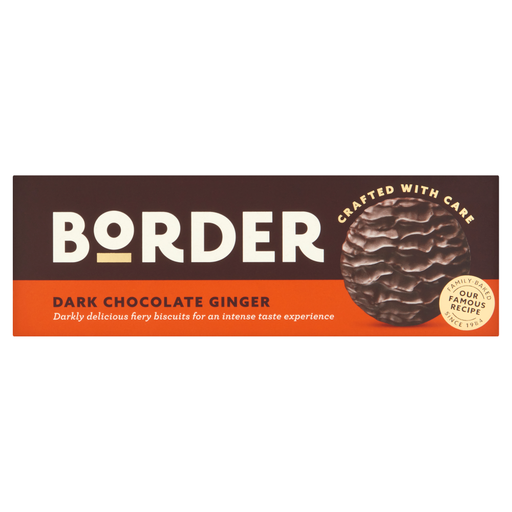 No image available
Consider this 150g dark-chocolate ginger biscuit pack if you want the coated style. For portion planning or ingredient restrictions, check the current pack’s per-biscuit nutrition and allergen statement.
The dark coating alone does not establish a weight-management advantage. Compare the whole biscuit’s energy figure and the portion you expect to eat; NHS weight-management guidance emphasises food choices and portion sizes.
No. Waitrose says dark chocolate makes up 78% of the biscuit and separately specifies that the chocolate contains at least 49% cocoa solids.
Check the current pack’s ingredients and allergen warnings for the exact biscuit before eating it. UK government food-labelling guidance covers ingredient and allergen information on prepacked foods; a description such as ‘dark chocolate’ or ‘Free From’ cannot replace that product-specific check.