Who is choosing?

Shoppers comparing declared sugars

If you want a ginger biscuit for an afternoon break but not a conventional ginger nut, compare the sugar claim with the “of which sugars” figure. Farmhouse Biscuits lists 0.2g sugars per 100g for Sugar Free Mild Ginger; its sugar-free label does not answer every other nutrition question.

Shoppers considering no-added-sugar oat biscuits

If a dark-chocolate ginger oat biscuit appeals, Gullón Zero Ginger Oaties offers a different style from a plain ginger nut. ASDA describes the 285g product as no added sugars and lists 1.0g sugars per 100g. Check its ingredients and allergen information before choosing it.

Classic ginger-nut buyers

If crunch and ginger flavour matter more than a sugar-free claim, a conventional biscuit may still match your snack plans. McVitie's lists 28.9g sugars per 100g for its Ginger Nuts, while Tesco and Sainsbury's each list 25.5g per 100g for the ginger biscuits researched here; all three list added sugar in their ingredients.

What should you compare?

Decide whether the claim, the amount eaten or a particular ingredient matters most to you, then compare the exact packs on the same basis.

Priority What to check Your needs
Sugar claim Read “sugar free” or “no added sugars” alongside sugars per 100g. Check the ingredients for added sugar, syrups or sweeteners. I want to know whether I am buying a sugar-free biscuit, a no-added-sugar biscuit or a regular ginger nut. Farmhouse Biscuits lists 0.2g sugars per 100g for Sugar Free Mild Ginger; ASDA lists 1.0g per 100g for Gullón Zero Ginger Oaties, which it describes as no added sugars.
Whole nutrition panel Compare energy, fat and saturates as well as sugars per 100g. Use the stated biscuit or serving figures when deciding how much you plan to eat. For my afternoon snack, a lower sugar figure is not the only consideration. I also want to compare the full nutrition panels and the portion I would actually eat.
Ingredients and warnings Read the sweeteners, allergen declarations and any excessive-consumption warning on the exact pack. Recheck these when buying a different variant. If I am choosing a sweetener-based biscuit, I need to know what is in it. Farmhouse Biscuits and ASDA both display excessive-consumption warnings for the products discussed here.

Common buying mistakes

  • Reading “no added sugars” as “sugar free”

    The claims describe different products in this comparison: Farmhouse Biscuits lists 0.2g sugars per 100g for Sugar Free Mild Ginger, while ASDA labels Gullón Zero Ginger Oaties no added sugars and lists 1.0g per 100g.

    Compare the claim and the “of which sugars” figure on the exact biscuit you intend to buy.

  • Judging the snack by sugars alone

    A sugar-free label does not establish the biscuit's energy, fat or saturates content. It also does not tell you how the per-100g figures relate to the portion you will eat.

    Read the full nutrition panel and use the pack's biscuit or serving information for your portion comparison.

  • Overlooking sweeteners and pack warnings

    Farmhouse Biscuits lists isomalt and maltitol for its sugar-free ginger biscuit. Both Farmhouse Biscuits and ASDA display warnings that excessive consumption of their respective biscuits may produce a laxative effect.

    Check the sweeteners and warning on the current pack, particularly if you expect to eat several biscuits.

  • Using a sugar claim to judge school-meal suitability

    Department of Health and Social Care guidance concerns restrictions on qualifying retail promotions and placement. Department for Education guidance addresses food provided in state-funded schools in England separately. A biscuit's sugar claim does not, by itself, settle its place on a school menu.

    For school catering, check the requirements applicable to the school and its menu rather than relying on a front-of-pack claim.

Brand and product references

Farmhouse Biscuits

Its Sugar Free Mild Ginger biscuits are a reference point when the declared sugars figure is the main criterion.

  • Farmhouse Biscuits lists 0.2g sugars per 100g and identifies isomalt and maltitol as sweeteners.
  • The product contains wheat and oats, and its label warns that excessive consumption may produce a laxative effect. Check the rest of its nutrition panel separately.

Gullón Zero

The Ginger Oaties range offers an oat-based ginger biscuit; the claim on the exact variant matters.

  • ASDA describes the 285g dark-chocolate Ginger Oaties as no added sugars and lists 1.0g sugars per 100g.
  • Check the variant's allergen declaration and excessive-consumption warning rather than treating “Zero” as a complete description of the biscuit.

McVitie's

McVitie's Ginger Nuts are a conventional ginger-nut reference for shoppers who do not require a sugar-free biscuit.

  • McVitie's describes this biscuit as suitable for dunking.
  • Its product information lists added sugar and 28.9g sugars per 100g; this is not the sugar-free route.

Tesco

Tesco Ginger Nut Biscuits are another conventional option for comparing a familiar biscuit with the alternative sugar claims.

  • The product information states that the 300g biscuits are suitable for vegans.
  • Tesco lists sugar and glucose-fructose syrup in the ingredients and 25.5g sugars per 100g.

M&S

M&S Ginger Snaps and its separate Made Without Wheat Stem Ginger Snaps address different product choices.

  • M&S lists a distinct Made Without Wheat Stem Ginger Snaps product for shoppers comparing wheat-free ranges.
  • Its standard Ginger Snaps contain light brown sugar and list 28.1g sugars per 100g. “Made Without Wheat” should not be read as “sugar free”.

Ginger biscuit options on Joybuy

This option is a dark-chocolate ginger oat biscuit for shoppers considering a no-added-sugar afternoon snack, rather than a plain sugar-free ginger nut.
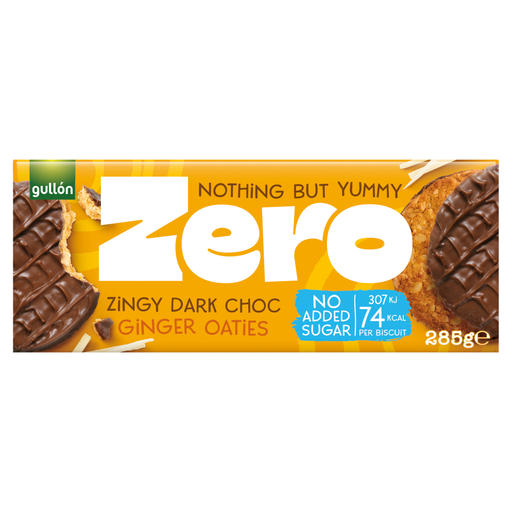
Gullon Zero Dark Chocolate Ginger Oaties 285g pack

Gullon Zero Dark Chocolate Ginger Oaties 285g

For a no-added-sugar ginger biscuit with an oat base and dark chocolate, this 285g variant offers a different choice from a conventional ginger nut. ASDA lists 1.0g sugars per 100g for the matching product. It contains maltitol and carries an excessive-consumption warning; check the current pack's allergen information before buying.

View on Joybuy

Questions about ginger biscuits

Does “sugar free” mean a ginger biscuit is low in energy or fat?

No. “Sugar free” describes the sugar claim, not the biscuit's whole nutrition profile. Read the energy, fat and saturates figures on the same panel, then consider the stated portion alongside the per-100g values.

How do sugar-free and no-added-sugar ginger biscuits differ?

Compare both the wording and the sugars figure. Farmhouse Biscuits labels its Sugar Free Mild Ginger biscuits sugar free and lists 0.2g sugars per 100g. ASDA describes Gullón Zero Ginger Oaties 285g as no added sugars, notes naturally occurring sugars and lists 1.0g sugars per 100g.

What should I check before eating several sweetener-based biscuits?

Read the sweeteners and serving information on the current pack. Farmhouse Biscuits and ASDA both display warnings that excessive consumption of the ginger biscuits discussed here may produce a laxative effect.

Does a sugar-free label tell me whether a biscuit suits an allergy?

No. A sugar claim does not describe allergens. Check the ingredient and allergen declarations, including any “may contain” statement, on the exact pack and variant before choosing it.

Can a sugar-free ginger biscuit automatically be served in a school meal?

No. Department of Health and Social Care guidance on qualifying retail promotions and placement is separate from the school-food requirements described by the Department for Education for state-funded schools in England. The sugar-free claim alone cannot establish whether a particular biscuit meets the requirements applicable to a school's menu.