Families comparing sugar labels
If ginger biscuits are going into the half-term snack cupboard, compare sugars per 100g across packs first. The per-biscuit figure then helps you see what the label states for one biscuit.


For a home half-term snack, compare sugars per 100g before choosing by a biscuit’s name or its per-biscuit figure: ASDA lists 24g per 100g for its Ginger Nuts 250g, against 25.5g for Sainsbury’s standard Ginger Snaps 300g. If a dietary restriction takes priority, check the relevant free-from claims and ingredients separately; Tesco’s Free From Ginger Nuts list 38.2g sugars per 100g, so free-from is not a lower-sugar claim.
If ginger biscuits are going into the half-term snack cupboard, compare sugars per 100g across packs first. The per-biscuit figure then helps you see what the label states for one biscuit.
A gluten-free or vegan claim may determine which biscuits are suitable before sugar figures come into the decision. Check the current pack’s ingredients and allergen declaration for the person who will eat them.
Food supplied to pupils on school premises is a different setting from snacks served at home during half term. In England, the Department for Education’s school food standards are the relevant starting point for state-funded schools.
Start with the requirement that could rule out a biscuit, then compare the nutrition figures on the same basis.
| Priority | What to check | Your needs |
|---|---|---|
| Listed sugars | Compare sugars per 100g across packs, then check sugars per biscuit for the serving you have in mind. Read which nutrient any “lighter” claim describes. | I want to compare biscuits of different sizes fairly, rather than assume a smaller per-biscuit figure means less sugar in the product. |
| Dietary suitability | Check the exact gluten-free, wheat-free or vegan claim needed, plus the ingredients and allergen declaration. Check the physical pack each time you buy. | A dietary restriction comes first in our household; I still want to compare sugar figures among biscuits that meet it. |
| Where it is served | Distinguish a snack served at home from food supplied to pupils by a school. For the latter in England, check the current school food standards and catering requirements. | If I am planning food for a school rather than a family snack, I need to assess it under the rules for that setting. |
Sainsbury’s says its Lighter Ginger Snaps have 35% less fat than its standard Ginger Snaps. Its listings give the Lighter biscuits 28.9g sugars per 100g, compared with 25.5g for the standard biscuits.
Read which nutrient the claim concerns, then compare the sugars line if sugar is your priority.
Biscuits can differ in size, so per-biscuit figures alone are not the same comparison basis across packs.
Shortlist using sugars per 100g; use the labelled per-biscuit figure afterwards when planning a serving.
In England, Department of Health and Social Care guidance addresses promotion and placement by certain retailers, while Department for Education school food standards concern food supplied to pupils at state-funded schools. The retail rules are not a test of whether a school menu complies.
For a home snack, use the pack information and your dietary requirements. For school-supplied food in England, check the current school food standards and the caterer’s requirements.
Tesco lists its Free From Ginger Nuts as gluten free and vegan, but gives 38.2g sugars per 100g—above the figures for the conventional products discussed here.
Use the free-from claim to assess the dietary requirement, then make a separate sugar comparison.
ASDA’s Ginger Nuts come in packs whose nutrition figures should not be treated as interchangeable.
The standard and Lighter Ginger Snaps listings answer different nutrition questions.
McVitie’s Ginger Nuts 250g provide a conventional ginger-nut reference for comparing labels.
Tesco Free From Ginger Nuts address specific dietary requirements rather than a lower-sugar goal.
M&S Ginger Snaps offer another labelled per-100g figure for comparison.
Waitrose lists Essential Ginger Nuts as a conventional ginger-nut option.
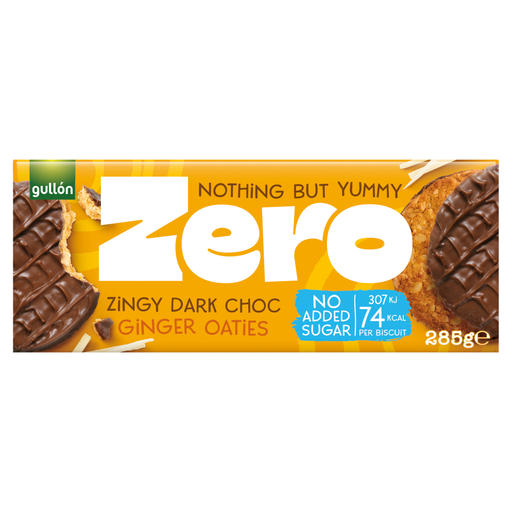
This ginger-oat biscuit with dark chocolate is a different format from a conventional ginger nut. If sugar is the deciding factor, compare its pack’s sugars-per-100g figure with the ginger-nut labels above.
 No image available
For a half-term ginger-biscuit snack, this is a ginger-oat option with dark chocolate rather than a conventional ginger nut. Check the pack’s nutrition panel, ingredients and allergen declaration; the word “Zero” alone does not identify which nutrient to compare.
No. Sainsbury’s states that its Lighter Ginger Snaps have 35% less fat than its standard Ginger Snaps. The respective listings give 28.9g and 25.5g sugars per 100g, so compare the sugars line rather than using “lighter” as a sugar claim.
Among the conventional products compared here, ASDA Ginger Nuts 250g has the lowest listed figure: ASDA Groceries gives 24g sugars per 100g and 2.4g per biscuit. That comparison is not a “reduced sugar” claim; check the exact pack, as ASDA’s separate 300g listing has different values.
Check the dietary claim and sugar figure separately. Tesco labels its Free From Ginger Nuts gluten free and vegan, but lists 38.2g sugars per 100g and includes soya flour. ASDA labels its Ginger Nuts 250g suitable for vegans; confirm the current pack meets any other dietary requirement before serving.
They do not turn a family snack served at home into school-supplied food. In England, the Department for Education’s school food standards concern food provided to pupils on school premises at state-funded schools; separate Department of Health and Social Care guidance concerns promotion and placement by certain retailers selling to England. If the food is being supplied by a school, check the current school food standards and catering requirements.