What should you check first?
Start with dietary suitability, then compare the nutrition information for the serving and biscuit type you would buy.
Classic ginger nuts
Choose when: You want a conventional crunchy ginger biscuit and wheat is suitable for the child.
Bear in mind: Tesco and essential Waitrose ginger nuts contain wheat and each lists 2.6g sugars per biscuit, with a high-sugars label indicator.
Regular oat-based ginger biscuits
Choose when: You prefer an oat-based ginger biscuit and want to compare fibre and sugars per 100g.
Bear in mind: Waitrose lists Nairn’s Stem Ginger Oat Biscuits at 5.9g fibre and 17.2g sugars per 100g; the regular product has gluten-related allergen information, so it is not the gluten-free route.
Gluten-free biscuit breaks
Choose when: A gluten-free product is required and oats are suitable for the child.
Bear in mind: Waitrose lists Nairn’s Gluten Free Oat & Ginger Biscuit Breaks as suitable for coeliacs, but says they may contain milk and nuts and are unsuitable for people who react to oat avenin.
| Priority |
What to check |
Your needs |
| Dietary fit |
Read the current pack for wheat and gluten, an explicit gluten-free statement where needed, and named or precautionary allergens. Check whether oats are suitable. |
If a child needs a gluten-free biscuit, I need more than an oat-based description. Milk, nuts or oats may also affect which pack I can choose. |
| Sugars and saturates |
Compare traffic-light indicators and figures per biscuit as well as per 100g. Use the same basis when comparing different pack sizes or biscuit types. |
I want to know what is in the portion I plan to serve, rather than judging a ginger biscuit by its name or the pack size. |
| Fibre |
Compare stated fibre values per 100g on the current labels. An oat-based product still needs separate checks for sugars and allergens. |
An oat biscuit interests me, but fibre alone will not tell me whether its other label details fit our snack choice. |
| Serving format |
Check biscuit size, the number in a pouch and the nutrition basis used on the label. A pouch is not necessarily a single-biscuit serving. |
For a day out, I may prefer a planned portion; at home, I can check the serving without assuming the whole pack is one snack. |
Brand and product-line references
These examples show how named ginger-biscuit lines differ; a brand name alone does not establish a product’s ingredients or dietary suitability.
McVitie’s
McVitie’s Ginger Nuts are a classic wheat-based ginger biscuit.
- McVitie’s lists 47kcal, 2.9g sugars and 0.8g saturates per 10.1g biscuit.
- The Ginger Nuts contain wheat; check the pack if gluten must be avoided.
Tesco
Tesco Ginger Nuts are a 300g own-label classic labelled suitable for vegans.
- Tesco lists 2.6g sugars per biscuit, making the serving figure easy to find.
- The biscuits contain wheat, and Tesco marks sugars as high per biscuit.
Waitrose essential
Essential Ginger Nuts are a 300g classic ginger-biscuit line labelled suitable for vegans.
- Waitrose lists 2.60g sugars per biscuit.
- The product contains wheat, and its listing marks sugars as high per biscuit.
Nairn’s
Nairn’s has both regular Stem Ginger Oat Biscuits and a distinct Gluten Free Oat & Ginger Biscuit Breaks product.
- Waitrose lists 5.9g fibre and 17.2g sugars per 100g for the regular Stem Ginger Oat Biscuits.
- Do not interchange the two lines: the regular biscuits have gluten-related allergen information, while the gluten-free breaks may contain milk and nuts and are unsuitable for people who react to oat avenin.
M&S
M&S Ginger Snaps are a separate ginger-snap option to compare with classic ginger nuts.
- M&S lists nutrition per 100g, including 28.1g sugars and 9.1g saturates.
- The snaps contain wheat and are not suitable for people with a milk allergy.
Ginger-flavoured options on Joybuy
These options cover an oat-and-ginger biscuit, a gingerbread-flavoured chocolate Digestive and a chocolate-coated ginger biscuit. They are different formats from the plain ginger nuts discussed above; compare their own labels before choosing a snack for a child.
 No image available
Gullon Zero Dark Chocolate Ginger Oaties 285g
An oat-and-ginger option for comparing with a conventional ginger nut. Check the current ingredient and allergen label for wheat, milk, soya and possible nuts; the product information also flags a sweetener and a warning about excessive consumption.
View on Joybuy
 No image available
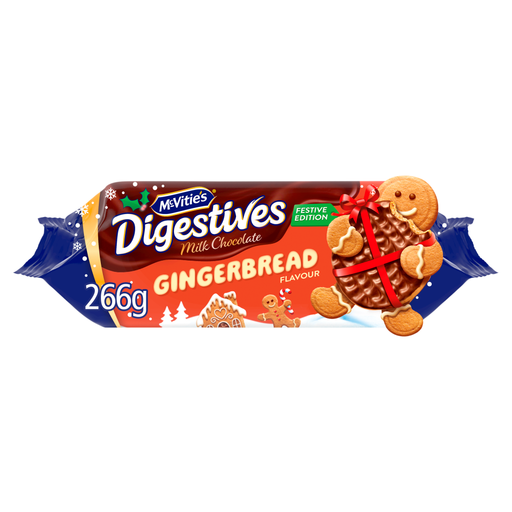
McVitie’s Gingerbread Chocolate Digestives 266g
Choose this format if you want a chocolate Digestive with gingerbread flavour rather than a plain ginger nut. Check its per-biscuit nutrition for the serving you plan to offer, and read the current label for wheat, milk and soya.
View on Joybuy
 No image available
Border Biscuits Dark Chocolate Gingers 150g
A dark-chocolate-coated ginger biscuit rather than a plain ginger nut. The product information cautions that its spicy flavour may not suit younger children; check the current pack for sugars, wheat, milk and soya, as well as its egg and nut precautionary statements.
View on Joybuy
Questions about ginger biscuits
Should ginger nuts be the default school-holiday snack?
Treat ginger nuts as an occasional packaged snack rather than a replacement for fruit and vegetables. NHS Healthier Families advises no more than two packaged snacks a day and recommends looking at traffic-light labels when choosing them.
Does “digestive” mean a ginger biscuit helps digestion?
No digestive benefit follows from a biscuit’s name. Ginger nuts and chocolate Digestives are different biscuit formats; compare their actual ingredients, fibre, sugars and allergen statements for the choice you are making.
Do HFSS rules ban ginger nuts as snacks at home?
The cited government rules do not establish a general ban on serving ginger nuts at home during school holidays. Government guidance addresses restrictions on advertising less healthy food and, in England, certain retail promotions and product placement; these are not the same as household snack rules.
Can a school serve ginger nuts with a meal?
Check the school’s policy and the rules for its UK nation rather than applying home-snack or retail-promotion rules to a school meal. Department for Education guidance describes legal school-food requirements for state-funded schools in England; it does not, by itself, settle whether a particular ginger-nut product may be served in a particular meal.
Is a gluten-free ginger biscuit suitable for every allergy?
No. Waitrose lists Nairn’s Gluten Free Oat & Ginger Biscuit Breaks as gluten free and suitable for coeliacs, but says they may contain milk and nuts and are unsuitable for people who react to oat avenin. Check the current pack against the child’s specific requirements.


