Hosts comparing sugars
You want to put out a ginger biscuit with afternoon tea and need to distinguish a sweetener-based sugar-free product from conventional ginger nuts with different labelled sugar figures.


If the biscuit’s listed sugars are your main concern, Farmhouse Biscuits’ Sugar Free Ginger Carton lists 0.2 g sugars per 100 g, but it uses sweeteners and is not a conventional ginger nut. If you want a traditional ginger nut or snap for afternoon tea, compare the same per-100-g measure: Asda lists 24 g for its Ginger Nuts, while the checked Tesco, Sainsbury’s and Waitrose products each list 25.5 g. A lower figure in this group does not, by itself, establish a reduced-sugars claim.
You want to put out a ginger biscuit with afternoon tea and need to distinguish a sweetener-based sugar-free product from conventional ginger nuts with different labelled sugar figures.
You prefer a conventional nut or snap and want to compare its sugars per 100 g and per biscuit without assuming that a lower number makes it a reduced-sugars product.
You need to read the particular pack’s ingredients, allergens and any sweetener warning before serving it. The products discussed here do not have identical ingredient statements.
Choose the biscuit style first, then compare sugars on a per-100-g basis and check the ingredients of the pack you intend to serve.
Consider it: Farmhouse Biscuits’ Sugar Free Ginger Carton is an option when its listed 0.2 g sugars per 100 g matters more to you than choosing a conventional ginger nut.
Check: Farmhouse lists isomalt, maltitol and 485 kcal per 100 g, and warns that excessive consumption may produce laxative effects.
Consider it: Choose this style if you want a traditional ginger nut or snap and are comparing labelled sugars rather than seeking a sugar-free biscuit.
Check: Asda lists 24 g sugars per 100 g for its Ginger Nuts, compared with 25.5 g on the checked Tesco, Sainsbury’s and Waitrose products; those figures do not establish a reduced-sugars claim.
| Priority | What to check | Your needs |
|---|---|---|
| Labelled sugars | Compare grams of sugars per 100 g across products. For portions, also read the stated biscuit weight: Tesco lists 2.6 g sugars per 10 g biscuit, while McVitie’s lists 2.9 g per 10.1 g biscuit. | I want to compare recipes on the same basis, then see what the label says for a biscuit of the size I plan to serve. |
| Sweeteners and energy | Read the sweetener list, energy per 100 g and any pack warning. Farmhouse lists isomalt, maltitol and 485 kcal per 100 g for its Sugar Free Ginger Carton. | A sugar-free biscuit interests me, but I also want to know what replaces the sugar and how its energy is labelled. |
| Ingredients and allergens | Check the purchased pack’s ingredients and allergen statements. Farmhouse identifies wheat and oats and lists other possible allergens; do not transfer its statements to another biscuit. | Before putting biscuits out for guests, I need to check the exact pack against anything they avoid. |
| Style and storage | Check whether the product is a ginger nut, snap or another ginger biscuit. Follow its own after-opening directions; Waitrose recommends an airtight container and consumption within seven days for the quality of its Essential Ginger Nuts. | I want a biscuit style that suits the tea table and clear instructions for keeping an opened pack. |
Asda lists 24 g sugars per 100 g for its checked Ginger Nuts, below the figures published for several other named conventional products. That comparison alone does not establish a regulated nutrition claim.
Use the product’s labelled figure when comparing biscuits. UK Department of Health & Social Care guidance explains that nutrition claims have conditions; do not treat a smaller number as proof that a product qualifies for “reduced sugars”.
Farmhouse Biscuits lists 485 kcal per 100 g for its Sugar Free Ginger Carton, alongside 0.2 g sugars per 100 g. Its isomalt and maltitol also come with a manufacturer warning about excessive consumption.
Read energy, ingredients and the sweetener warning alongside the sugar figure when deciding what to serve.
Farmhouse identifies wheat and oats in its sugar-free product. Ingredient and allergen statements for one biscuit cannot be applied to another, even when the names look similar.
Check the purchased pack before serving guests, particularly when an ingredient or allergen matters to them.
These figures describe the named products, not every biscuit made by each brand; check the current pack when buying.
Its Sugar Free Ginger Carton offers a sweetener-based ginger biscuit rather than a conventional ginger nut.
Its 250 g Ginger Nuts provide a conventional product for comparing labelled sugars.
Its 300 g Ginger Nut Biscuits show both per-100-g and per-biscuit sugar figures.
Its 300 g Ginger Snaps are a conventional ginger-biscuit option.
Essential Ginger Nuts provide another named conventional comparison.
Its Ginger Nuts are a named conventional option; the maker describes them as crunchy and suitable for dunking.
Its 250 g Ginger Snaps offer another conventional biscuit style for the tea table.
This Joybuy option is a dark-chocolate ginger oatie rather than a plain ginger nut. If that biscuit style appeals for afternoon tea, compare the pack’s sugars and ingredients with the named products above.
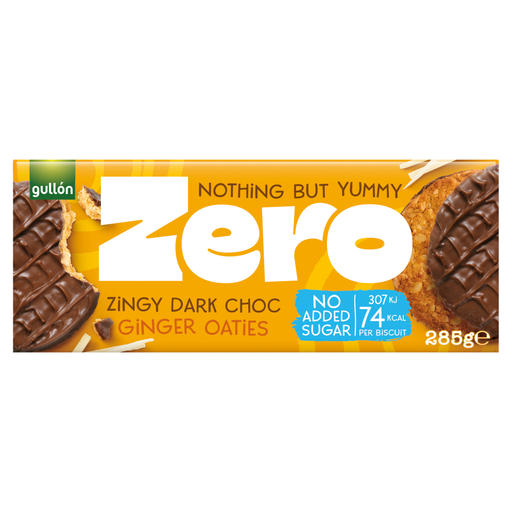 Image unavailable
For afternoon tea, this is a ginger oatie with dark chocolate rather than a plain ginger nut. The listed pack is 285g; check its sugars per 100g, ingredients and allergen statement on the pack before serving.
No: sugar content and energy are different label measures. Farmhouse Biscuits lists 0.2 g sugars but 485 kcal per 100 g for its Sugar Free Ginger Carton, so read both figures if both matter to your choice.
Read the ingredient, allergen and precautionary statements on the pack you bought. Farmhouse identifies wheat and oats in its Sugar Free Ginger Carton and lists possible additional allergens; those statements do not describe every ginger biscuit.
Not on the strength of a comparison with another biscuit alone. UK Department of Health & Social Care guidance sets conditions for nutrition claims; use the named product’s labelled sugars per 100 g when making a straightforward comparison.
Follow the directions on the particular pack. Tesco advises an airtight container for its Ginger Nut Biscuits, while Waitrose recommends an airtight container and consumption within seven days after opening for the quality of its Essential Ginger Nuts.