People managing carbohydrate intake with diabetes
Diabetes UK advises checking total carbohydrate on the label. If you count carbohydrate, compare the amount in the portion you plan to eat, not just the sugars figure per 100g.


If your aim is to reduce declared sugars, a sugar-free ginger biscuit is an option, but it is not necessarily low in total carbohydrate. Farmhouse Biscuits declares 0.2g sugars and 68g carbohydrate per 100g for its Sugar Free Ginger, while McVitie’s declares 28.9g sugars and 71.3g carbohydrate per 100g for Ginger Nuts. Compare the portion you would eat, total carbohydrate and sweeteners before choosing.
Diabetes UK advises checking total carbohydrate on the label. If you count carbohydrate, compare the amount in the portion you plan to eat, not just the sugars figure per 100g.
A lower sugars figure does not settle the whole comparison. Check total carbohydrate, the intended portion and the sweeteners alongside the sugars declaration.
Farmhouse Sugar Free Ginger lists isomalt and maltitol and carries a warning about excessive consumption. Its allergen information also needs checking if gluten-containing cereals or other listed allergens matter to you.
Compare products per 100g first, then use the biscuit weight or your planned portion to judge the amount you would eat.
| Priority | What to check | Your needs |
|---|---|---|
| Total carbohydrate | Read carbohydrate per 100g and per biscuit where stated. Check the listed biscuit weight against the number you intend to eat. | I count carbohydrate, so the sugars line alone will not tell me how the portion fits my plan. Diabetes UK advises checking total carbohydrate on the pack. |
| Declared sugars | Compare sugars per 100g on like-for-like labels. Farmhouse Biscuits declares 0.2g for Sugar Free Ginger; McVitie’s declares 28.9g for Ginger Nuts. | If I am choosing a biscuit specifically for its lower declared sugars, I still want to see its total carbohydrate before deciding. |
| Portion size | Check whether the nutrition panel gives a per-biscuit value and its serving weight. McVitie’s lists 7.2g carbohydrate per 10.1g biscuit; Tesco lists 7.4g per 10g biscuit. | One biscuit may be easier for me to compare than an unspecified portion, provided I check how many biscuits I actually plan to have. |
| Sweeteners and warnings | Read the ingredients for polyols such as isomalt or maltitol, and check any warning on the pack. Diabetes UK notes that counting polyols when adjusting insulin is not straightforward. | I want to know which sweeteners are in the biscuit and whether its warning affects my choice. |
| Other label details | Compare energy and fat as well as carbohydrate. Check the current allergen statement for the exact product and variant. | I do not want a lower sugars figure to distract me from other nutrition information or ingredients I need to avoid. |
Farmhouse Biscuits declares 0.2g sugars but 68g carbohydrate per 100g for Sugar Free Ginger. Diabetes UK advises looking at total carbohydrate when reading food labels.
Compare carbohydrate for the portion you intend to eat, as well as sugars per 100g.
Farmhouse Sugar Free Ginger lists isomalt and maltitol, and warns that excessive consumption may produce laxative effects.
Read the ingredients and warning before deciding how this biscuit compares with a regular ginger nut.
Such wording does not tell you the biscuit’s total carbohydrate, portion size or ingredients. Diabetes UK advises using the nutrition label rather than treating a special description as a shortcut.
Use the current nutrition panel and allergen statement for the product you are buying.
A product name alone is not enough to establish that the nutrition and ingredient details still match the pack in hand.
Check the current pack before using its figures for carbohydrate counting or making an allergen decision.
These figures describe the named products, not every biscuit made by each brand.
Its Sugar Free Ginger Carton is a sweetener-containing alternative to a conventional ginger nut.
McVitie’s Ginger Nuts provide a conventional ginger-nut comparison with a stated biscuit weight.
Tesco Ginger Nut Biscuits are another conventional option with a stated 10g biscuit serving.
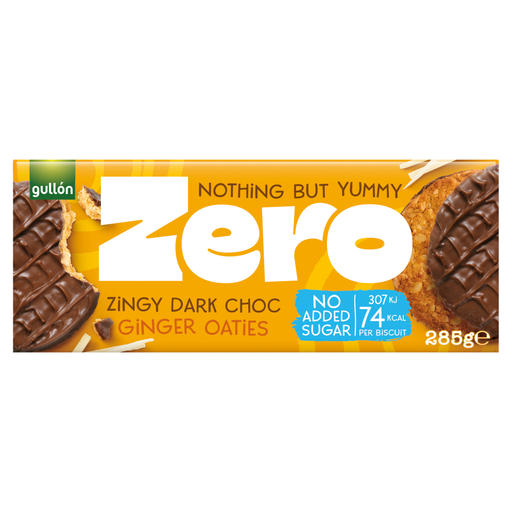
Gullón describes its Ginger Oaties Zero as a sugar-free ginger-oat biscuit rather than a traditional ginger nut.
This ginger-flavoured oat biscuit offers a different format from a traditional ginger nut. Check its own label when comparing portions and nutrition.
 No image available
Choose this ginger-flavoured oat-biscuit format only if it suits the type of biscuit you want; it is not a traditional ginger nut. The pack is the 285g dark-chocolate variant. Check its carbohydrate, sugars, sweeteners and allergens for the portion you intend to eat.
No. Diabetes UK says there is no one-size-fits-all diabetes diet and advises checking carbohydrate as well as sugars. Farmhouse Sugar Free Ginger, for example, declares 68g carbohydrate per 100g despite having 0.2g sugars per 100g.
Check the sugars figure, then read total carbohydrate and the ingredients separately. A sugar-free description does not mean carbohydrate-free; Farmhouse Biscuits declares 68g carbohydrate per 100g for its Sugar Free Ginger.
Not on its own. Diabetes UK explains that front-of-pack traffic lights do not include total carbohydrate. Use the nutrition table to compare carbohydrate per 100g and, where provided, per biscuit or serving.
Read the ingredients and any warning on the pack. Diabetes UK notes that polyols contain carbohydrate and calories, and that how to count them when adjusting insulin is not straightforward. Farmhouse Sugar Free Ginger lists both sweeteners and carries a warning about excessive consumption.