If your priority is less sugar in the biscuit, Farmhouse Biscuits lists 0.2g sugars per 100g for its sugar-free ginger carton, compared with 24–28.9g per 100g on the conventional ginger biscuits considered here. If guests prefer conventional ginger nuts or want to avoid polyol sweeteners, use the labelled per-biscuit figures to plan how many to serve instead. Sugar-free does not mean low in calories or carbohydrate: check the full nutrition label, ingredients, allergen information and sweetener warning before sharing.
Who are the biscuits for?
Hosts comparing sugar in each biscuit
If you want a ginger-flavoured biscuit with less labelled sugar, compare sugars per 100g before looking at the amount per biscuit. A sugar-free option also calls for a look at its sweeteners, carbohydrate and allergen information.
Hosts serving different preferences
Offering a conventional ginger nut alongside a sugar-free ginger biscuit gives guests a choice of biscuit styles and ingredients. Keep the packets available so people can check sweeteners and allergens for themselves.
What should you check before choosing?
Compare sugars per 100g to judge the biscuits on the same weight basis, then use the labelled amount per biscuit when deciding how many to put out.
| Priority |
What to check |
Your needs |
| Sugar figures |
Farmhouse Biscuits lists 0.2g sugars per 100g for its sugar-free ginger carton. Asda, Tesco and Tesco’s McVitie's listing give 24g, 25.5g and 28.9g per 100g respectively for conventional ginger nuts. Check the current packets before comparing. |
I want to tell a sugar-free ginger biscuit from a conventional ginger nut, rather than judging either by a small per-biscuit number alone. |
| Portion planning |
Check both biscuit weight and sugars per biscuit: Asda lists 2.4g per biscuit, Tesco 2.6g per 10g biscuit and Tesco’s McVitie's listing 2.9g per 10.1g biscuit. The figures describe different products and biscuit sizes. |
If I put out conventional ginger nuts, I want to know what a biscuit contributes without treating one biscuit as a prescribed serving. |
| Sweeteners and nutrition |
Read the ingredients and warning as well as the nutrition table. Farmhouse Biscuits lists isomalt, maltitol, 68g carbohydrate and 485kcal per 100g for its sugar-free ginger carton, and warns about excessive consumption. |
Some guests may prefer not to choose a polyol-sweetened biscuit. Others may want to compare carbohydrate or energy as well as sugar. |
| Allergens |
Check each current packet’s ingredients and precautionary statements. Farmhouse lists wheat and oats and possible traces of egg, milk, soya and tree nuts; Asda lists wheat and possible traces of rye, barley and oats. |
Before sharing biscuits with a guest who has an allergy, I need the information for the particular packet on the table. |
| Sharing and storage |
Use the pack size and any biscuit count to plan quantities. Waitrose describes approximately 30 biscuits in its 300g Essential Ginger Nuts pack; Tesco and Waitrose advise keeping their products in an airtight container after opening. |
I want enough biscuits for the group and a way to keep an opened pack for later. |
What mistakes are easy to make?
-
Reading sugar-free as low in calories or carbohydrate
Farmhouse Biscuits lists 0.2g sugars per 100g for its sugar-free ginger carton, alongside 485kcal and 68g carbohydrate per 100g. The sugar figure does not describe the whole nutrition profile.
Compare the full nutrition table according to what matters to your guests, rather than relying on the sugar-free description.
-
Putting out a polyol-sweetened biscuit without its warning
Farmhouse lists isomalt and maltitol and warns that excessive consumption may produce laxative effects. Guests cannot account for that warning if the packet has been put away.
Keep the ingredient and warning information available, and consider offering a conventional option too.
-
Treating a per-biscuit figure as a like-for-like comparison
Asda, Tesco and Tesco’s McVitie's listing give 2.4g, 2.6g and 2.9g sugars per biscuit respectively, but their listed biscuit weights differ. Their per-100g figures provide a common weight basis for comparing sugar content.
Use sugars per 100g to compare products and sugars per biscuit when planning what to serve.
Which brands offer relevant options?
These product references include a sugar-free ginger biscuit and several conventional styles; the figures apply to the named products, not every biscuit from each brand.
Farmhouse Biscuits
Its Sugar Free Ginger Carton is a sweetener-based ginger-biscuit option rather than a conventional ginger nut.
- Farmhouse lists 0.2g sugars per 100g for this product.
- It lists isomalt, maltitol, 68g carbohydrate and 485kcal per 100g, with an excessive-consumption warning.
McVitie's
Its Ginger Nuts are a conventional ginger-nut reference for a planned serving.
- Tesco lists 2.9g sugars per 10.1g biscuit for the 250g pack.
- The same listing gives 28.9g sugars per 100g; this is not a sugar-free option.
Asda
Its 250g own-label Ginger Nuts offer a conventional option with a labelled per-biscuit figure.
- Asda lists 24g sugars per 100g and 2.4g per biscuit.
- Those figures do not establish a reduced-sugar formulation; check the pack’s allergen information before sharing.
Tesco
Its own-label Ginger Nut Biscuits come in a 300g pack.
- Tesco lists 25.5g sugars per 100g and 2.6g per 10g biscuit.
- Tesco advises checking the pack because product information can change.
Sainsbury's
Its Ginger Snaps are a conventional ginger-flavoured biscuit, rather than an identical ginger-nut product.
- Sainsbury's lists 25.5g sugars per 100g and 2.6g per biscuit.
- The ginger-snap name does not establish that its texture matches another brand’s ginger nuts.
Waitrose
Essential Ginger Nuts are conventional biscuits in a 300g pack.
- Waitrose lists 25.5g sugars per 100g, 2.6g per biscuit and approximately 30 biscuits per pack.
- For this product, Waitrose recommends an airtight container after opening and consumption within seven days for quality.
M&S
Its Ginger Snaps are another conventional ginger-biscuit style.
- M&S lists 28.1g sugars per 100g for its 250g pack.
- The listing does not give a per-biscuit sugar figure for portion planning.
A ginger-flavoured option on Joybuy
This ginger-and-oat biscuit is an alternative format to consider for game night, not a conventional ginger nut. Check its current packet if sugar content, sweeteners or allergens are deciding factors.
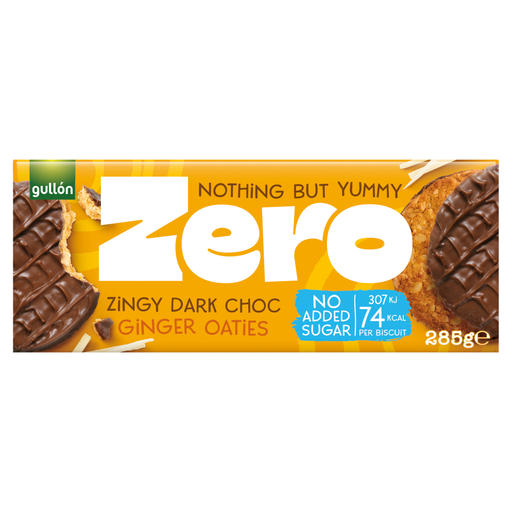 Image unavailable
Gullon Zero Dark Chocolate Ginger Oaties 285g
The ginger-and-oat format offers a different biscuit from a conventional ginger nut for the sharing table. This option is described with maltitol and an excessive-consumption warning; check the packet’s ingredients and allergen information before serving.
View on Joybuy
Questions about serving ginger biscuits
Does sugar-free mean a ginger biscuit is low in calories or carbohydrate?
No. Farmhouse Biscuits lists 0.2g sugars per 100g for its sugar-free ginger carton, but also 485kcal and 68g carbohydrate per 100g. Compare the full nutrition table rather than using the sugar figure as a substitute for it.
What should I check before serving someone with a food allergy?
Check the current packet’s ingredients and precautionary allergen information for the particular guest and biscuit. Ginger biscuits can have different ingredient profiles: Farmhouse lists wheat and oats for its sugar-free carton, while Asda lists wheat for its Ginger Nuts and different possible traces.
Does the sweetener warning matter for the sugar-free option?
Yes. Farmhouse Biscuits warns that excessive consumption of its sugar-free ginger biscuits may produce laxative effects. Keep the packet available so guests can see its ingredients and warning before choosing.
How should I store ginger biscuits after game night?
Follow the instructions on the pack you opened. Tesco and Waitrose advise keeping their ginger biscuits in an airtight container after opening; Waitrose recommends consuming its Essential Ginger Nuts within seven days for best quality.


