Hosts preparing welcome drinks
If each guest should find an unopened drink on arrival, individual glass bottles fit that plan. A larger bottle makes more sense when guests are expected to share it.


For a welcome drink that each guest can open themselves, consider a 250ml glass bottle, such as the Folkington’s 12-pack listed by Nisbets. A larger still bottle suits guests sharing breakfast, while a sparkling bottle suits a shared arrival drink; in either case, check the storage instructions for juice left after opening. If glass packaging is essential, confirm it for the exact product and arrange a suitable recycling or bottle-return route.
If each guest should find an unopened drink on arrival, individual glass bottles fit that plan. A larger bottle makes more sense when guests are expected to share it.
For shared breakfasts, consider how much fridge space is available and whether guests are likely to finish an opened bottle. Tesco’s listings say Copella 900ml should be used within four days of opening and its pressed apple juice within five days; the M&S Pink Lady listing gives four days.
Guests need to know where ordinary glass bottles go. Returnable bottles need a different arrangement: The Modern Milkman asks customers to rinse its bottles and leave them out for collection.
Start with how guests will serve the juice, then check the exact bottle, drink style and storage instructions.
| Priority | What to check | Your needs |
|---|---|---|
| Portion format | Check the volume per bottle and the number of bottles in a pack. Nisbets lists Folkington’s as 12 glass bottles of 250ml each. | I would rather leave one unopened drink per guest than a partly used bottle in the cottage fridge. |
| Drink style | Check whether the juice is still or sparkling and whether it is from concentrate. Frobishers describes its glass-bottled juice as never from concentrate; ASDA lists 750ml glass-bottled Appletiser as carbonated apple juice from concentrate. | For breakfast, I’m looking for still juice; for a shared arrival drink, sparkling juice may suit the occasion. |
| Packaging | Confirm glass on the exact pack description or label. A product name that says only “bottle” does not establish its material. | Glass matters for the welcome table, so I need to check the pack I am actually ordering. |
| Storage | Read both unopened and opened storage instructions. ASDA says its 750ml Appletiser should be refrigerated and used within four days after opening; Tesco says Copella 900ml must be kept refrigerated and used within four days of opening. | Fridge space is limited, and guests on a short stay might leave some juice unfinished. |
| Serving information | Compare sugars per 100ml on the exact label; ASDA lists 10.5g per 100ml for its 750ml Appletiser. The NHS advises limiting fruit juice and smoothies to a combined 150ml a day and having juice at mealtimes. | I want clear serving information rather than assuming that “100% juice” means no sugars. |
| Bottle collection | Check local glass collection for ordinary bottles. Recycle Now advises emptying and quickly rinsing them, then replacing lids and caps; supplier-owned returnable bottles should go back through their collection service. | Guests should be able to tell which bottles go into local recycling and which need to be left for collection. |
The Tesco and M&S listings for the chilled juices discussed here describe the drinks and their storage, but do not identify those packs as glass bottles.
Check the material on the exact product listing or physical pack before choosing it for a glass-bottle welcome table.
A short stay or small group may leave juice in the fridge. Tesco instructs customers to use opened Copella within four days and its pressed apple juice within five days; M&S gives four days for its Pink Lady juice.
Choose individual bottles when guests are likely to have one drink each; choose a shared bottle when it is likely to be used within its stated opened life.
ASDA lists 10.5g sugars per 100ml for its 750ml Appletiser. The figure applies to that product, not to every apple juice.
Read the nutrition panel for the exact bottle and consider how it will be served. The NHS advises having juice with meals and limiting combined juice and smoothie intake to 150ml a day.
Returnable milk-round bottles have a supplier collection route rather than the usual glass-recycling route.
Give guests separate instructions: follow local collection arrangements for ordinary glass, and leave returnable bottles for the supplier as directed.
Nisbets lists a 12-pack of 250ml glass-bottled apple juice, a format for separate welcome drinks.
Frobishers describes a glass-bottled still apple juice pressed from Jonagold and Gala apples.
ASDA lists a 750ml glass bottle of sparkling apple juice for a shared drink.
Tesco lists a 900ml cloudy apple juice made with handpicked apples and described as not from concentrate.
Tesco lists a 1-litre pressed apple juice described as not from concentrate for shared serving.
M&S lists a 1-litre Pressed Pink Lady Apple Juice for shared serving.
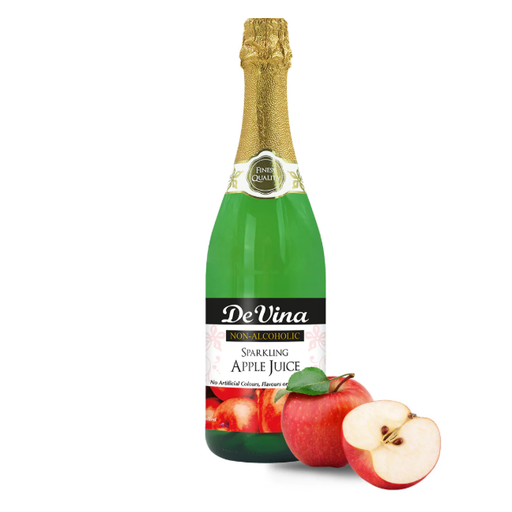
A 750ml sparkling apple drink is an option for guests sharing an arrival drink. If the bottle must be glass, confirm the material on the exact pack before ordering.
 No image available
The 750ml sparkling apple drink is a shared-drink option rather than an individual portion. Check the bottle material, nutrition label and instructions for storage after opening before leaving it for guests; if young children will handle it, check any packaging warning too.
Individual bottles suit a hamper where each guest should receive an unopened drink. Nisbets lists Folkington’s in 12 glass bottles of 250ml each; a larger bottle is more practical when guests are expected to share it and can follow its storage instructions after opening.
Only if sparkling juice is the drink you intend to provide. ASDA describes its 750ml Appletiser as carbonated apple juice from concentrate, while Frobishers describes its glass-bottled apple juice as never from concentrate. Check the product style before substituting one for the other.
Check the exact bottle’s nutrition panel and serving information. The NHS advises limiting fruit juice and smoothies to a combined 150ml a day and having juice at mealtimes; a 250ml bottle should not be mistaken for that 150ml guidance amount.
For ordinary glass bottles, Recycle Now advises emptying and quickly rinsing them, replacing lids and caps, and following local collection arrangements. Returnable bottles are different: The Modern Milkman asks customers to rinse its bottles and leave them out for driver collection.