
24/7 Customer Support

Free returns

Same-day & Next-day Delivery

Quality Guaranteed

Unlock Your Welcome Offers: FREE Delivery | Up to 80% OFF | Free 30-day JoyPlus trial
Download the APP
Navigating the world of food storage can be surprisingly frustrating. You invest in a new set of containers, hoping for organised meal preps and leak-free lunches, only to be met with disappointment. A soggy bag from a failed "leak-proof" lid, a cracked container straight from the freezer or a lid that warps after one trip through the dishwasher are all too common.
As the Joybuy Product Recommendation Officer, my role is to help you sidestep these issues. Many products make bold claims, but only a few deliver on the fundamentals. Before you buy another set, let’s look at the common pitfalls and the key features that truly matter.
A cheap price tag can often hide long-term costs and daily frustrations. Here are a few marketing traps to watch out for:
To ensure you get a durable and reliable product, focus on these non-negotiable specifications.
When looking for microwave safe food containers, the type of glass is paramount. You will see two main types: soda-lime and borosilicate. While soda-lime glass is perfectly fine for drinking glasses, it has poor thermal shock resistance.
Borosilicate glass, on the other hand, is engineered to withstand rapid temperature changes. This is the same type of glass used in laboratory beakers and high-quality cookware. A borosilicate glass lunch box can typically go from the freezer to the microwave (often after a brief rest at room temperature) without the risk of cracking. This durability is essential for anyone who relies on batch cooking and reheating.
A truly leak proof meal prep container depends entirely on its lid and sealing mechanism. Look for two key features:
Without both of these components working together, a container is merely "spill-resistant," not truly leak-proof.
A single, large container has its uses, but a versatile set offers far more utility. For effective meal prepping and organising leftovers, a multi-piece set with varied sizes is more practical. A 10 piece airtight container set, for example, might include larger containers for main meals and smaller ones for snacks, sauces or side dishes. This allows you to portion food correctly and make the most of your fridge and freezer storage containers.
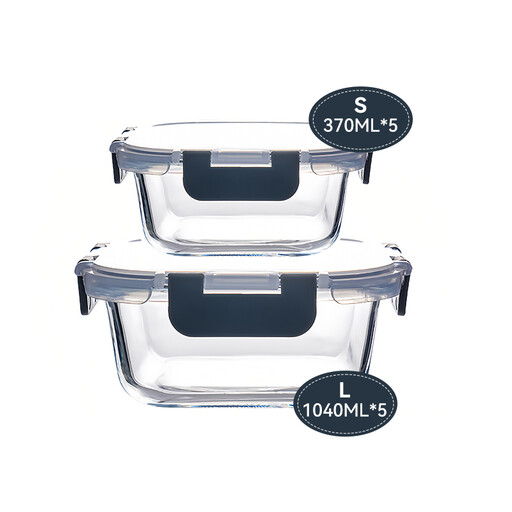
Why This Fits Their Persona: This comprehensive set is ideal for anyone serious about meal prepping. With five large 1040ml containers for main courses and five smaller 370ml containers for snacks or sides, it covers a full week of lunches and leftovers for individuals or families.
It uses high borosilicate glass to resist thermal shock and features secure, four-sided snap-lock lids with silicone seals to prevent leaks during the commute to the office.
A complete 10 piece airtight container set provides excellent value and versatility. The two distinct sizes are highly practical for portion control and food organisation.
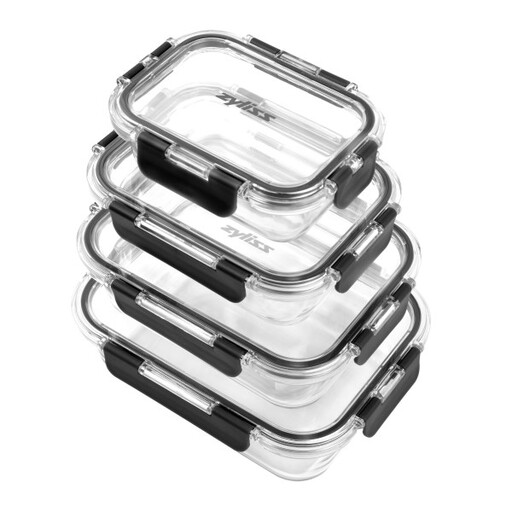
Why This Fits Their Persona: This smaller set is perfect for individuals or couples who want a few high-quality containers for storing dinner leftovers or packing the occasional lunch. It provides the core benefits of glass without the need to store a large collection.
This set is made from durable glass with airtight lids designed to keep food fresh, directly addressing the common issues of leaks and poor longevity found in lower-quality alternatives.
A compact and manageable 4-piece set that is easy to store. The transparent glass makes it simple to identify contents in the fridge or freezer.
We have compiled a complete, real-time list of products that fully satisfy these strict selection criteria and UK safety regulations.
Even with borosilicate glass, it is wise to exercise caution. While it is resistant to thermal shock, allowing very hot food (like soup straight from the hob) to cool for a few minutes before sealing it in a container is good practice. This prevents pressure build-up and reduces the already low risk of cracking. Never pour boiling liquid into a glass container that has just come from the freezer.
Glass is naturally non-porous and far less likely to retain odours than plastic. However, the silicone gasket in the lid can sometimes hold onto strong smells from foods like curry or garlic. To clean it, remove the gasket from the lid and wash it separately with warm, soapy water. For persistent odours, soaking the gasket in a solution of water and white vinegar or bicarbonate of soda can help neutralise them.
This depends on the manufacturer's instructions. Many snap-lock lids are made from polypropylene (PP), which is generally considered microwave-safe. However, it is often recommended to either remove the lid completely or place it loosely on top of the container when reheating. Sealing the lid can cause a dangerous build-up of steam pressure. Always check the product details, but hand-washing lids is often recommended to prolong the life of the seal.