Parents packing a gluten-free nursery lunch
A carton intended for drinking may fit the lunchbox, but the gluten-free wording, storage directions and ingredients need to work with the nursery’s arrangements.


For a drink or something to pour on cereal, start with a carton coconut drink rather than canned coconut milk intended for cooking. Check the current pack for a gluten-free claim, follow the child’s allergy plan and the nursery’s instructions, and compare age guidance and fortification if the drink will contribute to the child’s regular milk intake.
A carton intended for drinking may fit the lunchbox, but the gluten-free wording, storage directions and ingredients need to work with the nursery’s arrangements.
Check the exact product’s milk-allergy advice against the child’s plan. If it forms part of their usual milk intake, compare fortification and age guidance too.
A gluten-free statement and a separate certification mark are different things. If the Crossed Grain Trademark is a requirement, check for it on the current pack.
Decide first whether the coconut product is for drinking or cooking. For a carton drink, check gluten wording and allergy advice before considering how it fits the child’s usual diet and the nursery’s lunch routine.
| Priority | What to check | Your needs |
|---|---|---|
| Gluten-free assurance | Read the current pack for a gluten-free claim. If you require a separate certification mark, look for it on the pack rather than assuming the claim includes one. The Food Standards Agency states that a gluten-free claim means no more than 20 mg/kg of gluten in food sold to the final consumer. | I need clear gluten-free wording for my child’s lunch. In Coeliac UK’s 2025 Shopping Habits survey, 74.7% of responding members said they trusted its Crossed Grain Trademark more than a gluten-free statement; that preference does not establish certification for any particular drink. |
| Milk-allergy advice | Read the product-specific allergy statement and ingredients, then follow the child’s allergy plan. Do not use vegan branding in place of milk-allergy advice. | If my child has a milk allergy, I need the exact carton to fit their plan, not just to have a plant-based name. |
| Regular milk use | Compare calcium and iodine fortification, the nutrition panel and age guidance. Kingston and Richmond NHS Foundation Trust advises calcium- and iodine-fortified dairy substitutes for children who cannot consume dairy products. | A drink used regularly in place of milk needs a closer look than an occasional ingredient in lunch. |
| Product type | Check whether the product is presented as a carton drink or a cooking ingredient. Tesco describes Pride canned coconut milk for curries, desserts and baking. | For a drink or cereal at nursery, I want a product intended for pouring, rather than assuming a cooking can serves the same purpose. |
| Lunch handling | Follow the exact pack’s directions after opening and confirm how the nursery stores and serves drinks. | A chilled carton needs to fit the nursery’s arrangements from drop-off to lunchtime. |
Marks & Spencer describes its Creamy Coconut Drink as vegan but explicitly says it is not suitable for people with a milk allergy.
Read the exact pack’s allergy advice and follow the child’s nursery allergy plan.
Tesco presents Pride canned coconut milk for cooking and baking, while carton coconut drinks are presented as drinks. They should not be treated as interchangeable milk alternatives.
Choose according to whether lunch calls for an ingredient or a drink, and check the carton’s nutrition and allergy information if it will be poured or served to drink.
A gluten-free statement does not, by itself, show that a carton carries the Crossed Grain Trademark.
If that mark matters to your decision, look for it on the current pack.
Ingredient and allergy information can change, which matters when a child has a specific avoidance plan.
Check the carton you are sending to nursery, including its allergy statement and storage directions.
These examples illustrate why the exact variant matters; a statement about one drink does not apply to every product from the brand.
Tesco lists Koko Dairy Free Unsweetened Alternative Drink as a coconut-based carton drink.
Tesco describes Alpro Coconut No Sugar Long Life Dairy Free Drink as gluten free.
Waitrose describes Rude Health Chilled Coconut Drink as gluten free and fortified with calcium.
M&S Creamy Coconut Drink shows why a plant-based description is not enough for an allergy decision.
This long-life Alpro Barista carton is an option to assess when a coconut drink, rather than a canned cooking ingredient, is wanted for lunch. Check the exact variant against the child’s allergy plan and the nursery’s arrangements.
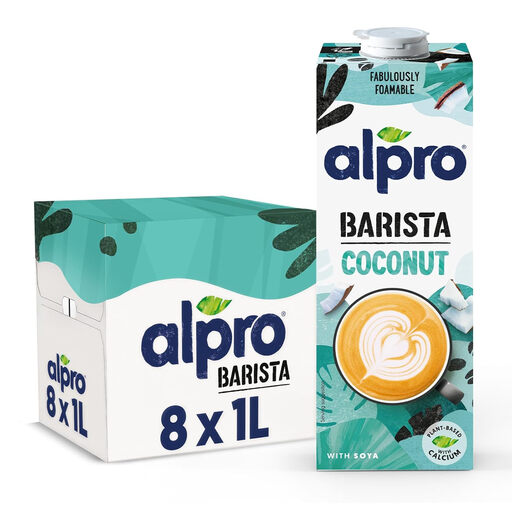 Image unavailable
The listing describes this long-life Barista drink as gluten free and dairy free, but also declares soya; check the child’s allergy plan and the current pack. If it will be used regularly as a milk alternative, check its fortification and age guidance for that use.
The Food Standards Agency states that a gluten-free claim means no more than 20 mg/kg of gluten in food sold to the final consumer. That claim does not, on its own, show that the product carries a separate certification mark.
Not on the strength of vegan wording alone. M&S says its vegan Creamy Coconut Drink is not suitable for people with a milk allergy, so check the exact carton’s advice against the child’s allergy plan.
Check the child’s age and the exact drink’s nutrition before using it regularly in place of milk. Kingston and Richmond NHS Foundation Trust advises calcium- and iodine-fortified dairy substitutes for children who cannot consume dairy products; seek individual dietary advice where needed.
A can sold as a cooking ingredient is not automatically equivalent to a carton drink. Tesco presents Pride Coconut Milk for curries, desserts and baking; for drinking or pouring on cereal, check a carton product’s intended use, ingredients and nutrition instead.
Follow the storage directions on that carton after opening, and confirm the nursery’s rules for transporting, storing and serving drinks. A long-life carton’s unopened storage conditions do not replace its instructions once opened.