What should you check before buying?
Start with the gluten-free claim on the product you will actually serve. Then choose a serving format you can keep separate from ordinary biscuits throughout the event.
| Priority |
What to check |
Your needs |
| Gluten-free labelling |
Look for an explicit gluten-free claim on the supplied pack. Check its current ingredients and allergen information rather than relying on a familiar custard-cream name. The Food Standards Agency states that a gluten-free label applies to food containing no more than 20 mg/kg of gluten as sold. |
I need a biscuit clearly identified as gluten-free, not an ordinary custard cream assumed to be suitable. |
| Separation while serving |
Keep gluten-free biscuits apart from ordinary biscuits and crumbs. Use clean hands, surfaces and serving equipment; keep the original packaging available for guests to inspect. |
At a mixed refreshment table, I want guests to be able to choose without the gluten-free biscuits touching shared tongs or loose crumbs. |
| Handout format |
Asda lists the 125 g Schär pack as five 25 g portion packs. If serving from an opened carton instead, plan how to keep the biscuits protected and identifiable. |
Enclosed portions would help me hand out biscuits without opening a shared pack for every guest. |
| Other dietary requirements |
Check each claim separately: Tesco lists its product as milk-free and suitable for vegans; Asda lists Schär as lactose-free and suitable for vegans. Confirm the details on the pack you receive. |
If someone also avoids milk, I need to check for a milk-free claim rather than treating a lactose-free claim as equivalent. |
Brand references
These references concern the specified custard-cream products, not every biscuit sold under either name.
Schär
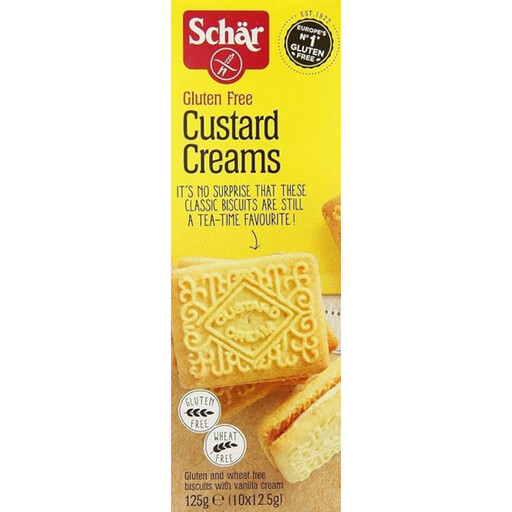
Schär describes its Custard Creams as gluten- and wheat-free biscuits with vanilla cream, supplied in portion packs.
- Asda lists the 125 g product as five 25 g portion packs, allowing each serving to remain enclosed until opened.
- Keep the outer packaging available: a portion pack alone may not give guests all the ingredient information they want to check.
Tesco Free From
Tesco lists its 125 g Free From Custard Creams as gluten-free, milk-free rice-flour biscuits suitable for vegans.
- The listed milk-free claim is relevant when a guest needs to check that requirement as well as gluten.
- If serving biscuits from an opened carton, keep them separate from ordinary biscuits and retain the carton for ingredient checks.
Joybuy product options
This option is a portion-packed gluten-free custard cream for handing out at a car boot sale. Its enclosed servings do not replace the need to keep packaging information available and the biscuits separate from foods containing gluten.
 No image available
Schär Gluten Free Custard Creams 125 g
For handing out enclosed servings at a mixed biscuit table. The 125 g product is listed as five 25 g portion packs; keep the packaging available for ingredient checks and the portions away from ordinary biscuit crumbs.
View on Joybuy
Common questions
Can gluten-free custard creams go straight onto a mixed biscuit table?
Keep them separate from ordinary biscuits, especially once opened. Coeliac UK advises preventing gluten-free food from coming into contact with food containing gluten; clean serving equipment and enclosed portions help you manage that risk.
What do Schär’s portion packs change at a car boot sale?
Asda lists the 125 g Schär Custard Creams as five 25 g portion packs, so you can hand out enclosed servings without opening one shared pack. Keep the outer packaging available for anyone checking ingredients.
Should I keep the biscuit packaging on the table?
Yes, keep the original packaging accessible so guests can check the ingredients and allergen information for the biscuits being served. This is useful even when you hand out individually enclosed portions.
Do I need to register to sell packaged biscuits at a car boot sale?
Registration depends on the nature of your activity; a car boot sale is not automatically exempt. GOV.UK says people who sell, store, handle or distribute food may be considered food businesses and may need to register with their local authority. Ask the relevant authority if you are unsure what applies before trading.


