For a guest who needs gluten-free food, choose custard creams whose exact pack is labelled gluten-free rather than relying on a familiar brand or biscuit name. Schär’s listed 125 g pack has five separate portions; Tesco, Sainsbury’s and Asda list 125 g free-from alternatives described as milk-free and vegan. Check any other dietary requirements on the pack, and serve the biscuits away from ordinary biscuit crumbs and contaminated shared spreads.
Who is choosing?
Hosts serving a gluten-free guest
Look for an explicit gluten-free claim on the biscuit pack. When setting out the cream tea, keep the biscuits clear of ordinary crumbs and use clean cutlery for shared spreads, in line with Coeliac UK’s preparation guidance.
Hosts accommodating several diets
Check each requirement separately. The listed Tesco, Sainsbury’s and Asda free-from custard creams are described as milk-free and vegan; Schär’s listed product is described as lactose-free and vegan. Lactose-free wording does not establish milk-allergy suitability.
What should you check?
Start with the gluten-free claim on the exact pack, then consider how you will serve the biscuits and whether guests have other dietary requirements.
| Priority |
What to check |
What matters to me |
| Gluten-free labelling |
Look for an explicit gluten-free claim on the exact pack, then read its ingredients and allergen information. The Food Standards Agency gives a limit of no more than 20 mg/kg of gluten for food labelled gluten-free as sold to consumers. |
I need to distinguish a labelled gluten-free custard cream from an ordinary one. Tesco’s listed conventional custard creams, for example, contain wheat flour. |
| Serving without crumbs |
Set out the biscuits on a clean surface with clean utensils. Coeliac UK advises using separate spreads or clean cutlery with shared butter, jam and other spreads to avoid transferring crumbs. |
Ordinary scones or biscuits will be on the table too, so I want to keep their crumbs away from the gluten-free serving. |
| Other dietary requirements |
Check milk-allergen and other dietary information on the exact pack. The listed Tesco, Sainsbury’s and Asda 125 g free-from products are described as milk-free and vegan; Asda describes the Schär product as lactose-free and vegan. |
Someone coming to tea may have a separate milk or vegan requirement. A gluten-free claim alone does not answer that question. |
| Portions |
Compare the amount needed for guests with the pack format. Asda lists five 25 g portion packs for Schär; the listed own-brand free-from packs are 125 g each, which alone does not establish a biscuit count. |
Separate portions would be useful when putting biscuits out for several people; otherwise, I can check the pack before deciding how much to serve. |
Serving and labelling mistakes
-
Assuming a familiar custard cream is gluten-free
The checked conventional Crawford’s, Asda and M&S products list wheat ingredients, while the identified free-from products explicitly claim gluten-free status.
Match the full product name to the pack and look for its gluten-free statement rather than judging by brand or appearance.
-
Putting suitable biscuits on a crumb-covered serving area
A gluten-free label describes the food as sold; it cannot prevent crumbs reaching the biscuits after the pack is opened.
Use a clean surface and utensils, and keep crumbs out of shared spreads. Coeliac UK also advises separate condiments or clean cutlery for shared butter and jam.
-
Treating lactose-free as milk-free
Asda describes the listed Schär biscuits as lactose-free, while the checked Tesco, Sainsbury’s and Asda free-from listings use milk-free wording. These claims are not interchangeable.
If a guest has a milk allergy, check the exact pack’s milk-allergen information separately from its gluten-free claim.
Relevant brand references
The distinctions below concern the named products, not every biscuit sold under each brand.
Schär
A portioned gluten-free custard cream for serving alongside a cream tea.
- Asda lists the 125 g product as five portion packs and identifies a Crossed Grain symbol.
- Its lactose-free claim does not replace a check of milk-allergen information for someone with a milk allergy.
Tesco
Its Free From custard creams are distinct from its conventional custard creams.
- Tesco lists the 125 g Free From product as gluten-free, milk-free and vegan.
- Its listed conventional 400 g custard creams contain wheat flour and wheat starch.
Sainsbury’s
The named Free From product is a 125 g vanilla-filled custard cream.
- Sainsbury’s lists this product as gluten-free, milk-free and vegan, and describes it as suitable for coeliacs.
- Those claims apply to the named product rather than every Sainsbury’s biscuit.
Asda
Its Free From custard creams and conventional custard creams have different listed ingredients and dietary claims.
- Asda lists its 125 g Free From product as gluten-free, milk-free and vegan.
- Its listed conventional 400 g custard creams contain wheat and milk.
Crawford’s
A conventional custard cream to distinguish from a labelled gluten-free choice.
- Tesco’s listing for the checked 300 g product includes wheat flour and wheat starch.
M&S
The checked Extra Cream Custard Creams are a conventional product, not the gluten-free option described here.
- Marks & Spencer’s ingredient listing for that product includes wheatflour.
A Joybuy product option
This portioned custard cream is an option for serving a labelled gluten-free biscuit at a cream tea.
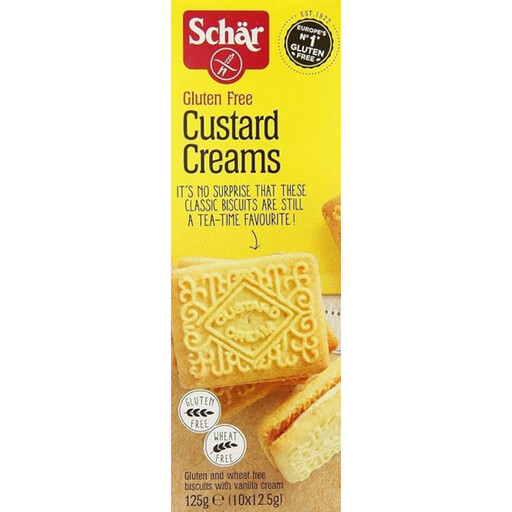 No image available
Schär Gluten Free Custard Creams 125g
For a cream tea with a gluten-free guest, this is a labelled gluten-free custard cream with five separate portion packs. Asda lists the pack as 5 x 25 g and describes it as lactose-free and vegan. Check the exact pack for any milk-allergen requirement: lactose-free does not mean milk-free. The product description warns that the biscuits are not suitable for young children because of a choking risk.
View on Joybuy
Common questions
Does wheat-free mean a custard cream is gluten-free?
No. Choose a product with an explicit gluten-free claim on its exact pack rather than substituting another dietary term. For UK food sold to consumers, the Food Standards Agency gives a limit of no more than 20 mg/kg of gluten for that claim.
How can I serve gluten-free biscuits alongside ordinary scones?
Use a clean serving surface and utensils, and prevent crumbs from reaching the gluten-free biscuits. Coeliac UK advises separate condiments or clean cutlery for shared butter, jam and other spreads.
Is an online ingredient list enough when a guest has another allergy?
Check the ingredients and allergen information on the exact pack before serving, and resolve any separate allergy requirement from that pack or with the manufacturer. A gluten-free or lactose-free claim does not, by itself, establish milk-allergy suitability.
What does a UK gluten-free label tell me?
It is a regulated claim about the labelled food, not about other biscuits in the range or how the food is served after opening. The Food Standards Agency states a limit of no more than 20 mg/kg of gluten in the food as sold to the final consumer.


