Choose a biscuit with a gluten-free claim for the exact variant, then compare the carbohydrate in the portion you will carry and how it is packed. Portion packs can help you organise ride snacks, but British Cycling’s guidance covers food and fluids throughout a ride; a biscuit is not a complete plan. Check the current pack for other allergens, including oats if avenin is a concern.
Who is this choice for?
Cyclists with coeliac disease
Check the gluten-free claim on the exact biscuit, rather than relying on a familiar brand name. Coeliac UK notes that some people with coeliac disease cannot tolerate avenin in oats; keep unpacked gluten-free food separate from ordinary biscuits to avoid cross-contact.
Long-ride snack planners
Use the stated carbohydrate amount for the portion you intend to carry. British Cycling discusses regular food and fluid intake on longer rides, so account for biscuits alongside other food and drinks rather than treating a packet as the whole plan.
Shoppers avoiding another allergen
A gluten-free claim does not establish that a biscuit is free from milk, soya, egg or nuts. Read the ingredients and precautionary statements for the specific variant.
What should you check before packing a biscuit?
Start with suitability for your diet, then work out what the portion contributes and whether you can carry and eat it at a convenient point in the ride.
| Priority |
What to check |
Your needs |
| Gluten-free claim |
Look for the claim on the exact product and check its current ingredients. The Food Standards Agency states that food sold as gluten free must contain no more than 20 mg/kg gluten as sold. |
I need the biscuit itself to be labelled gluten free; a chocolate coating or a familiar brand does not establish that. |
| Carbohydrate portion |
Compare amounts on the same basis. Nairn’s lists 6.2 g per Chocolate Chip Oat Biscuit Break; McVitie’s lists 10.0 g per 18.8 g Gluten Free Milk Chocolate Hobnob. For a per-100 g figure, check or weigh the portion rather than assuming an amount per biscuit. |
For a longer ride, I want to count what the biscuits I carry contribute alongside my other food and drinks. |
| Pack and eating point |
Nairn’s describes pouch packs for its Chocolate Chip Oat Biscuit Breaks; Schär describes three-cookie portions for Choco Chip Cookies. Consider where you will keep the pack and when you can eat it. |
A pre-divided portion would be useful in my bag or pocket, but I may prefer to eat a chocolate-coated biscuit at a stop. |
| Other allergens |
Read both ingredients and possible cross-contact statements for the exact variant. Coeliac UK notes that avenin in oats is not tolerated by everyone with coeliac disease. |
I also avoid another ingredient, so I cannot take “gluten free” to mean milk free, soya free or suitable for me personally. |
Common buying mistakes
-
Choosing by brand instead of by variant
McVitie’s lists wheat flour in Penguin Original and Club Orange, while Fox’s & Burton’s Biscuits lists wheat flour in Fox’s Classic Biscuit Selection. Those products cannot be treated as gluten free because another chocolate biscuit has a gluten-free variant.
Check the current gluten-free claim and ingredient list for the exact pack you intend to buy.
-
Assuming gluten-free oats suit everyone
Gluten-free-labelled oats address gluten contamination, but Coeliac UK notes that some people with coeliac disease cannot tolerate the oat protein avenin.
If oats are a concern for you, check the biscuit’s ingredients rather than assuming every labelled gluten-free oat biscuit is suitable.
-
Comparing a whole packet with a single biscuit
Nutrition figures may be given per biscuit or only per 100 g. Neither chocolate content nor the packet’s total tells you the carbohydrate in the portion you will eat.
Use a consistent portion basis, and plan other food and drinks separately. British Cycling’s ride guidance addresses both eating and drinking.
-
Treating different pack sizes as the same recipe
Tesco’s 166 g and 200 g Free From Chocolate Digestives listings state different ingredients and nutrition figures.
Match the pack size and check its current label before using a listed figure to plan a portion.
Relevant brand and product references
These examples concern named products, not every biscuit made by each brand; check the variant on the pack.
Nairn’s
Nairn’s describes pouch packs for its gluten-free Chocolate Chip Oat Biscuit Breaks.
- Nairn’s lists 6.2 g carbohydrate per biscuit for that product, making its stated portion straightforward to count.
- It contains gluten-free oats and milk; the manufacturer warns that it is unsuitable for people who react to avenin.
McVitie’s
The Gluten Free Milk Chocolate Hobnob is a specifically named gluten-free chocolate-coated oat biscuit.
- McVitie’s lists 10.0 g carbohydrate per 18.8 g biscuit.
- The brand’s Penguin Original and Club Orange ingredient lists contain wheat flour; the Hobnob’s gluten-free claim does not extend to them.
Schär
Schär lists gluten-free Choco Chip Cookies, Digestive Choc and Chocolate Fingers in different biscuit formats.
- The manufacturer describes Choco Chip Cookies in three-cookie portions.
- Ingredients and possible-allergen statements differ by variant; a per-100 g nutrition figure should not be treated as an amount per cookie or finger.
Tesco
Tesco lists a 166 g Free From Chocolate Digestives pack containing gluten-free oats.
- Tesco lists 10.1 g carbohydrate per 17 g biscuit for the 166 g pack.
- That pack carries a possible peanuts and nuts warning. Tesco’s separate 200 g listing states different ingredients and nutrition figures.
Fox’s
Fox’s Classic Biscuit Selection illustrates why a brand name alone cannot establish gluten-free suitability.
- Fox’s & Burton’s Biscuits lists wheat flour in that selection. This does not determine the ingredients of every Fox’s product.
A Joybuy biscuit option
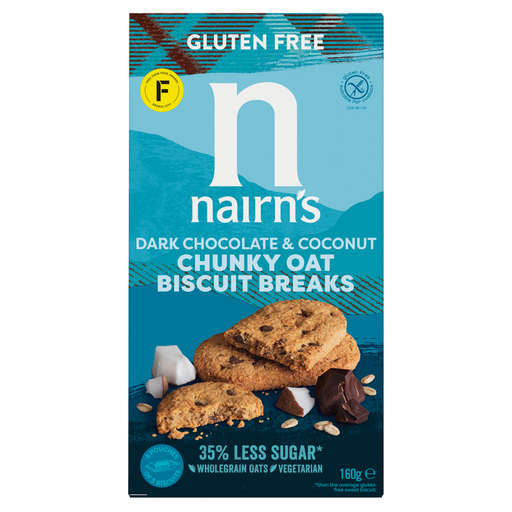
This gluten-free oat-biscuit option comes in pouch packs that may be convenient to carry. Check its own variant and nutrition label rather than applying figures from other Nairn’s biscuits.
 No image available
Nairn’s Gluten Free Biscuit Breaks Chunky Oats, Dark & Coconut 160g
Pouch packs provide portions to carry for a ride. Check the current pack for carbohydrate per biscuit when planning what to eat. This variant contains gluten-free oats and is unsuitable for people who react to avenin; its product information also says it may contain traces of milk.
View on Joybuy
Questions about biscuits for a ride
Does a UK gluten-free claim mean there is absolutely no gluten?
No. The Food Standards Agency states that food sold as gluten free must contain no more than 20 mg/kg (20 ppm) gluten as sold. Check the claim on the specific biscuit rather than inferring it from the brand or flavour.
Are gluten-free oat biscuits suitable for everyone with coeliac disease?
Not necessarily. Coeliac UK notes that some people with coeliac disease cannot tolerate avenin, a protein in oats. Check whether an oat-based variant is appropriate for you before choosing it.
How do I account for biscuits on a long ride?
Use the carbohydrate figure for the portion you will actually carry, checking or weighing it if the label gives only a per-100 g figure. British Cycling’s guidance covers regular food and fluid intake during a ride; a biscuit does not replace planning either separately.
Are gluten-free chocolate biscuits also free from milk or nuts?
Not automatically. McVitie’s lists milk and soya in its Gluten Free Milk Chocolate Hobnobs and warns of possible nuts and egg; Tesco’s 166 g Free From Chocolate Digestives list milk and soya and warn of possible peanuts and nuts. Read the exact pack for the allergens relevant to you.
What if I serve gluten-free biscuits alongside ordinary ones?
Keep unpacked gluten-free biscuits away from crumbs and shared surfaces or utensils. Coeliac UK’s cross-contact guidance includes cleaning surfaces and utensils before preparing gluten-free food.


