Organisers buying for coeliac attendees
Look for an explicit gluten-free claim on the biscuit pack. Keep its ingredient information available and serve it apart from ordinary refreshments so attendees can identify what they are taking.


Choose a digestive biscuit explicitly labelled gluten free, then check the pack against attendees’ other dietary needs. The oat-based Tesco, Sainsbury’s and Asda digestives are options when gluten-free oats are suitable; Asda’s listing for Schär’s 150 g digestive describes a different recipe and three inner packs, but also lists soya and a possible lupin presence. Keep the chosen pack identifiable and separate from ordinary biscuits when serving.
Look for an explicit gluten-free claim on the biscuit pack. Keep its ingredient information available and serve it apart from ordinary refreshments so attendees can identify what they are taking.
A gluten-free claim does not answer questions about oats, nuts, soya or lupin. Check the ingredients and precautionary wording on the pack you intend to serve.
Consider whether a sharing pack or separate inner packs will be easier to identify and set aside. Asda lists three 50 g inner packs for its Schär 150 g digestive; the checked supermarket own-label digestives come in sharing packs.
Start with the exact biscuit’s gluten-free label, then check its other ingredients and how you will serve it.
| Priority | What to check | Your needs |
|---|---|---|
| Gluten-free identification | Check for an explicit gluten-free claim on the biscuit you buy, then read its current ingredient and allergen label. The Food Standards Agency defines a gluten-free claim as no more than 20 mg/kg of gluten in the food as sold. | I need a biscuit identified as gluten free, rather than assuming that the word “digestive” or a familiar brand makes it suitable. |
| Oat ingredients | Tesco, Sainsbury’s and Asda list gluten-free oat ingredients in their checked Free From digestives. Coeliac UK notes that some people with coeliac disease remain sensitive to gluten-free oats. | If an attendee cannot eat gluten-free oats, I need to check the ingredients of a different gluten-free digestive. |
| Other allergens | Check the actual pack’s ingredients and precautionary statements. Asda lists soya and possible lupin for the Schär 150 g digestive; nut wording differs across the checked Tesco, Sainsbury’s and Asda own-label packs. | Gluten is not the only ingredient I need to account for when colleagues have different dietary requirements. |
| Ordering and serving | Check availability before the meeting and confirm the delivered pack’s details. Keep its label available and set gluten-free biscuits apart from ordinary ones; Food Standards Agency research describes separation at the table and checking labels as practical precautions. | I want attendees to recognise the gluten-free option and reach its ingredient information without mixing it with the other biscuits. |
McVitie’s Original Digestives, the Crawford’s Digestives in Henderson Foodservice’s mini-pack assortment and M&S standard Digestive Biscuits list wheat. McVitie’s Gluten Free Original Hobnobs are a different biscuit.
Check the gluten-free claim and ingredients on the exact digestive pack, not another product from the same brand.
The checked own-label digestives contain gluten-free oat ingredients. Asda’s listing for Schär’s 150 g digestive instead lists soya and a possible lupin presence; the own-label listings also carry differing nut precautions.
Match the pack’s ingredient and precautionary statements to the needs of the people attending.
Without the pack, attendees may be unable to check which biscuits are gluten free or read their other allergen information.
Keep the packaging accessible and use a distinct serving area or separate handling for the gluten-free biscuits.
These details apply to the named products, not to every biscuit made or sold by each brand.
A gluten-free digestive with a different listed recipe and pack format from the checked oat-based own-label digestives.
Its checked 188 g Free From digestive is a gluten-free, oat-based sharing-pack option.
Its checked 188 g Free From digestive is another gluten-free, oat-based sharing-pack option.
Its checked 160 g Free From digestive is made with gluten-free oat flour.
Its standard digestive and its gluten-free Hobnobs should not be treated as the same product.
Its mini-pack digestives illustrate why portioned packaging is not enough to establish gluten-free suitability.
Its standard digestive must be distinguished from biscuits in its separate free-from range.
This Schär 150 g gluten-free digestive is an option to examine when choosing biscuits for a work meeting. Check the current pack’s ingredients and format against attendees’ needs before serving.
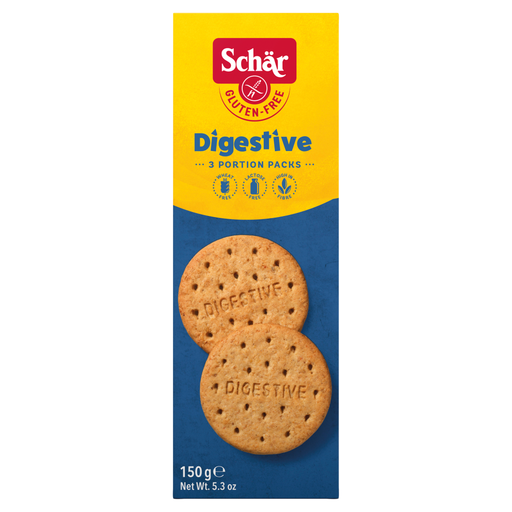 Image unavailable
A gluten-free digestive to consider for meeting refreshments. If avoiding oats or other allergens matters, check this pack’s current ingredients and precautions; also confirm the inner-pack format if separate portions are important.
No. The checked McVitie’s Original and M&S standard digestives list wheat, so look for an explicit gluten-free claim on the product you choose. Asda’s Schär listing also explains that “digestive” is a traditional biscuit name, not a claim that it aids digestion.
No single oat-based option suits everyone. Coeliac UK says most people with coeliac disease can eat gluten-free oats, but a small number remain sensitive to them. Ask whether gluten-free oats are suitable for the attendee before choosing an oat-based digestive.
Keep the gluten-free pack available for ingredient checks and put its biscuits apart from ordinary ones, using separate handling or serving equipment. Food Standards Agency research describes checking labels and physical separation at the table as practical precautions.
Check availability for the meeting date and read the delivered pack’s gluten-free claim, ingredients and allergen precautions before putting the biscuits out. An online listing helps identify an option, but the pack you serve is the one attendees need to be able to check.