Shoppers replacing plain digestives
If you want the familiar plain biscuit format for someone with coeliac disease, look for an explicit gluten-free label. Conventional digestives can contain wheat or barley.


For coeliac shopping, start with a digestive explicitly labelled gluten free rather than assuming a familiar biscuit or a wheat-free claim is suitable. The Tesco, Sainsbury’s and Asda plain gluten-free digestives described here contain gluten-free oats; Schär’s listed 150g Digestive uses maize, soya and buckwheat ingredients instead. Check the physical pack for oat ingredients and other allergens before choosing.
If you want the familiar plain biscuit format for someone with coeliac disease, look for an explicit gluten-free label. Conventional digestives can contain wheat or barley.
Several plain gluten-free digestives contain oats. Coeliac UK says most people with coeliac disease can eat gluten-free oats, but a small number are sensitive to them. An ingredient list without oats offers a different route if oats are a concern.
A gluten-free claim does not settle questions about milk, nuts, soya or lupin. Compare each product’s ingredients and allergy advice with the needs of the person who will eat it.
Check the gluten-free label first, then decide whether the oat ingredients and any other allergen warnings suit the person you are shopping for.
| Priority | What to check | Your needs |
|---|---|---|
| Gluten-free label | Look for “gluten free” on the exact pack. Read the ingredients and allergen statement rather than relying on the word “digestive” or the brand. | I need a clearly labelled choice, not an assumption based on a familiar biscuit. In Coeliac UK’s Shopping Habits 2025 survey of 3,785 members, 74% said they trusted its Crossed Grain Trademark more than a gluten-free statement; that measures trust, not digestive-biscuit purchases. |
| Oat ingredients | For an oat-based biscuit, check that the oats are labelled gluten free. If avoiding oats, examine the current ingredient list rather than assuming every gluten-free digestive is oat-free. | Gluten-free oats may work for me, or I may need to avoid oat ingredients. Coeliac UK notes that a small number of people with coeliac disease are sensitive even to gluten-free oats. |
| Other allergens | Check both ingredients and precautionary warnings for relevant allergens. The listed Schär Digestive contains soya and may contain lupin; the oat-based options have differing nut warnings. | If I am shopping around another allergy as well, a gluten-free claim alone does not answer whether I can choose the biscuit. |
| Pack format | Check the pack weight and whether the biscuits are in a single pack or smaller wrapped portions. Confirm the details on the pack you receive. | For sharing at home, I may want a different format from individually wrapped portions, provided the ingredients and warnings suit me. |
McVitie’s Original Digestives carry a cereals-containing-gluten warning, while the listed M&S Digestives contain wheat flour and barley malt extract. A familiar name does not identify a gluten-free variant.
Check that the exact biscuit pack is explicitly labelled gluten free; do not transfer a claim from another product in the same brand range.
Some gluten-free digestives contain oats or carry warnings about other allergens. Schär’s listed Digestive contains soya and may contain lupin.
Read the current ingredient list and allergy advice for the person you are shopping for. If avoiding oat ingredients, check the alternative’s other allergens too.
These references concern specific biscuits and ranges, not every product sold under each brand.
Tesco lists a 188g plain gluten-free digestive made with gluten-free oat flour.
Sainsbury’s lists a 188g oat-based plain digestive described as milk and gluten free.
Asda lists a 188g plain digestive made with gluten-free oat ingredients.
The listed 150g Gluten-Free Digestive uses maize, soya and buckwheat ingredients rather than oats.
McVitie’s lists Gluten Free Original Hobnobs, but these are not its plain Original Digestives.
The standard M&S Digestive Biscuits 400g are a conventional wheat-based product.
This Schär digestive is an option to examine if you want a gluten-free biscuit whose listed ingredients do not include oats. Its soya and lupin information still matters when choosing.
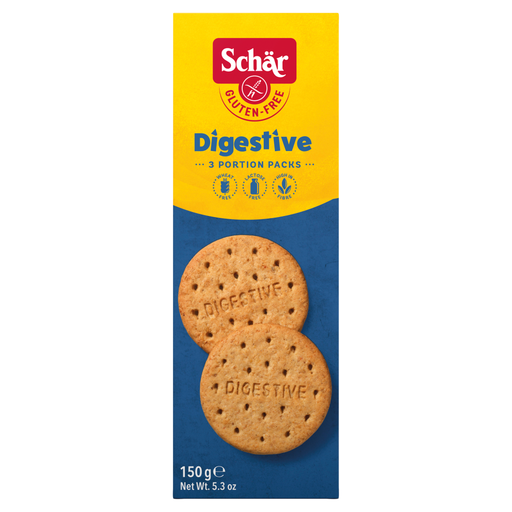 Image unavailable
A gluten-free digestive to consider when avoiding oat ingredients: the listed 150g formulation uses maize, soya and buckwheat. It contains soya and may contain lupin, so check the current pack against any other allergies.
An explicitly gluten-free label is the starting point for choosing the exact biscuit, alongside a check of any other relevant allergens. The Food Standards Agency defines “gluten-free” for food sold to consumers as no more than 20 mg/kg of gluten.
No. Coeliac UK says most people with coeliac disease can eat gluten-free oats, but a small number are sensitive to them. Check that oat ingredients are labelled gluten free; if oats are associated with ongoing symptoms, discuss them with a health professional.
No. Gluten is also found in rye and barley, according to Coeliac UK. Choose by the product’s explicit gluten-free label and check its full ingredients and allergen information rather than relying on a wheat-free description.
Yes. Check the physical pack before use because ingredients and allergy information can change. Pay particular attention to oat ingredients and any milk, nut, soya or lupin information relevant to the person eating the biscuits.