People with coeliac disease choosing a breakfast drink
Check the exact carton for a gluten-free declaration or explicitly gluten-free oats. Coeliac UK notes that standard oats can be contaminated with wheat, barley or rye during production.


Start with a gluten-free declaration or explicitly gluten-free oats for the exact drink: being oat-based, vegan or organic is not enough. Plenish Organic Gluten Free Longlife Oat Drink has a short ingredient list for cereal or overnight oats, while Minor Figures describes Everyday Oat as a gluten-free, fortified option for several breakfast uses. If coffee is the main use, consider a gluten-free barista drink, but compare its ingredients and nutrient information separately.
Check the exact carton for a gluten-free declaration or explicitly gluten-free oats. Coeliac UK notes that standard oats can be contaminated with wheat, barley or rye during production.
If the same carton goes on cereal and into tea or smoothies, check its stated uses as well as its ingredients and nutrient panel. A short organic ingredient list and added nutrients are different selection priorities.
A barista oat drink may match a latte or cappuccino routine, but barista positioning alone does not establish gluten-free suitability. Check the claim for the exact product.
Establish gluten-free suitability for the exact oat drink first. Then compare how you will use it at breakfast and what its ingredient and nutrient information says.
| Priority | What to check | Your needs |
|---|---|---|
| Gluten-free claim | Look for a current gluten-free declaration or explicitly gluten-free oats on the exact product. Read its allergen information; organic and dairy-free descriptions are not substitutes. | I need the particular carton I buy to meet my gluten-free requirement, not just to belong to the oat-drink category. |
| Breakfast use | Check whether the product is described for cereal, overnight oats, tea or coffee. Minor Figures describes Everyday Oat for cereals and tea, and Barista Oat for lattes and cappuccinos. | For cereal on weekdays, I want a drink described for that use; if I mainly make coffee, barista positioning matters more to me. |
| Ingredients and nutrients | Compare ingredient lists and nutrient panels for the same serving size. Tesco lists water, organic gluten-free oats and sea salt for Plenish Organic Gluten Free Longlife Oat Drink; Minor Figures describes Everyday Oat as fortified. | If oat drink regularly takes the place of another drink at breakfast, I want to know what the carton contains rather than assume all oat drinks have the same nutrient profile. |
| Oats themselves | A gluten-free oat drink still contains oats. Check the ingredients if oats are something you must avoid. | Gluten-free labelling would not answer my separate question about whether I can have oats. |
Coeliac UK says standard oats can be contaminated with wheat, barley or rye during production. Vegan, dairy-free and organic descriptions do not resolve that issue.
Check the gluten-free information for the exact carton before choosing it for a gluten-free breakfast.
Added nutrients and gluten-free suitability answer different questions. Ocado’s information for M&S Plant Kitchen Whole Oat Drink says it may contain wheat and is not suitable for people with coeliac disease.
Check gluten-free suitability first, then compare nutrients on products that meet that requirement.
Tesco lists water, organic gluten-free oats and sea salt for Plenish Organic Gluten Free Longlife Oat Drink. That ingredient list should not be treated as equivalent to a fortified drink.
If added nutrients matter to your choice, compare the current nutrient panels rather than relying on an organic or simple-ingredients description.
Gluten-free oat drink still contains oats, so the label does not address a need to avoid oats themselves.
Read the ingredient list and choose a different type of drink if oats are an ingredient you must avoid.
Gluten-free information applies to specific products, not every oat drink sold under a brand or by a retailer.
Its Everyday Oat and Barista Oat are distinct options for mixed breakfast use and coffee respectively.
Its Organic Gluten Free Longlife Oat Drink is a short-ingredient-list option for breakfast use.
Alpro has oat drinks with added nutrients, but fortification does not establish gluten-free suitability.
Oatly’s UK Organic and No Sugars oat drinks have different ingredient formulations.
Its oat-drink range includes varieties intended for different uses.
Tesco lists oat drinks from other brands as well as other oat-drink options.
Its own-brand Oat Drink and Oat Barista are separate products to assess by their current labels.
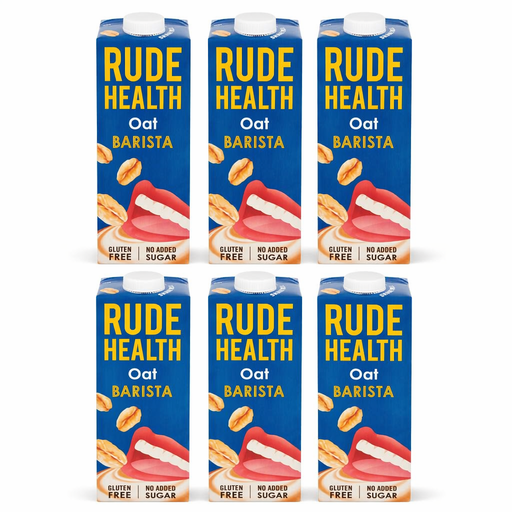
This barista oat drink is an option to consider when weekday coffee is a main use and you also pour oat drink over cereal.
 No image available
The product information identifies gluten-free oats and describes both barista and cereal use. If added nutrients matter to your choice, compare the current carton’s nutrient panel; the listed storage instruction is to refrigerate after opening and use within five days.
No. Coeliac UK notes that standard oats can be contaminated with wheat, barley or rye during production. For a gluten-free breakfast, check for a gluten-free declaration or explicitly gluten-free oats on the exact product.
No. The Food Standards Agency defines gluten-free as no more than 20 mg/kg of gluten in food as sold to the final consumer. A gluten-free oat drink still contains oats, so the claim does not address a need to avoid oats.
Compare their current ingredient lists and nutrient panels according to the role the drink has at breakfast. Tesco lists water, organic gluten-free oats and sea salt for Plenish Organic Gluten Free Longlife Oat Drink, while Minor Figures describes its gluten-free Everyday Oat as fortified.
No: barista describes an intended coffee use, not gluten-free suitability. Minor Figures describes its Barista Oat as gluten free, but you should check the exact product’s current label when choosing a drink for both coffee and a gluten-free breakfast.
Follow the instruction on the exact carton. Joybuy’s listing for Minor Figures Everyday Oat says to refrigerate after opening and consume within seven days; another product may have a different instruction.