Hosts planning a shared platter
Plain gluten-free oatcakes give guests a base for different toppings. Serve toppings separately, with clean utensils for the gluten-free food; Coeliac UK advises against transferring crumbs through shared spreads.


Choose plain gluten-free oatcakes if you want a base for several toppings and need a plant-based option. Seeded oatcakes offer a different texture, while cheese oatcakes suit a table where milk is acceptable and toppings are optional. For a guest with coeliac disease, check that the pack is labelled gluten free, ask about oat sensitivity and keep the serving area free from gluten-containing crumbs.
Plain gluten-free oatcakes give guests a base for different toppings. Serve toppings separately, with clean utensils for the gluten-free food; Coeliac UK advises against transferring crumbs through shared spreads.
Look for oatcakes explicitly labelled gluten free rather than relying on the word “oat”. Coeliac UK notes that a small number of people with coeliac disease are sensitive even to gluten-free oat products.
Nairn's original and super seeded gluten-free oatcakes are described as plant based, while its cheese version contains milk. Check the current pack’s ingredients and allergen statement for the option you intend to serve.
Start with the dietary requirements of your guests, then choose the oatcake format and plan how to serve it.
| Priority | What to check | Your needs |
|---|---|---|
| Gluten-free label | Check the physical pack for an explicit gluten-free claim and read its ingredients. The Food Standards Agency defines “gluten-free” as no more than 20 mg/kg of gluten in food as sold to the final consumer; Coeliac UK advises avoiding oat products without that label. | I’m serving someone who needs gluten-free food, so an ordinary oatcake—or one containing wheat flour—will not do. |
| Oats and milk | Ask whether the guest eats gluten-free oats and check the current allergen statement. Nairn's cheese oatcakes contain milk; its original and super seeded versions are described as plant based. | If a guest reacts to oats or avoids milk, I need to choose for that requirement rather than assume every gluten-free oatcake is suitable. |
| Serving format | Choose plain oatcakes for varied toppings, seeded ones for a different texture, or cheese oatcakes for a ready-flavoured option. The listed Nairn's original pack contains four pouches of six oatcakes. | Will everyone choose their own topping, or would a savoury oatcake that needs no topping be more useful at this table? |
| Shared serving | Use a separate plate and clean utensils for gluten-free oatcakes. Coeliac UK advises separate condiments or clean cutlery for shared spreads to avoid transferring breadcrumbs. | There may also be bread, crackers or cake on the table, so I want guests to be able to identify and serve the gluten-free option without sharing crumbs. |
Some oatcake recipes contain wheat flour: M&S Food lists it in its Scottish Oatcakes, and Waitrose & Partners lists it in Stockan's Orkney Oatcakes Thin. Coeliac UK also advises avoiding oat products that are not labelled gluten free.
Choose a pack explicitly labelled gluten free and check its current ingredient list, even if you have bought the product before.
Coeliac UK says a small number of people with coeliac disease remain sensitive to gluten-free oat products.
Ask a guest whether they eat oats before serving oatcakes. If they do not, keep a suitable non-oat gluten-free option separate.
Nairn's gluten-free cheese oatcakes list cheese containing milk, so they do not serve as a dairy-free or vegan option.
Check guests’ requirements and the current pack. If serving cheese oatcakes alongside other varieties, identify them separately.
Crumbs from gluten-containing bread or crackers can reach gluten-free food through shared utensils and spreads.
Give gluten-free oatcakes their own plate and clean utensils. Follow Coeliac UK’s advice to use separate condiments or clean cutlery for shared spreads.
Its listed gluten-free original, super seeded and cheese oatcakes give hosts distinct choices for toppings, texture and milk content.
Its Scottish Oatcakes illustrate why a familiar oatcake name does not establish gluten-free suitability.
Its Orkney Oatcakes Thin provide another example of an oatcake recipe that includes wheat.
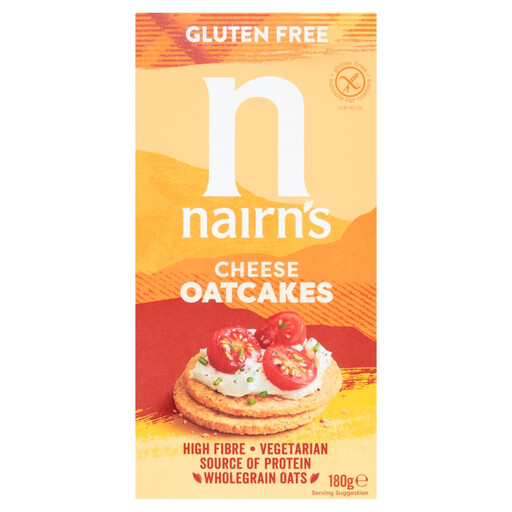
This cheese oatcake option fits a book-club table where milk is acceptable and guests want a savoury oatcake that can be served without toppings.
 No image available
A ready-flavoured option for guests who eat milk and gluten-free oats. This is a 180g pack labelled gluten free; Waitrose & Partners lists cheese containing milk at 15% for this variety. Ask guests with oat sensitivity before serving.
No. Some recipes contain wheat flour, and Coeliac UK advises avoiding oat products that are not labelled gluten free. Check the pack for the claim and read its ingredients; the Food Standards Agency defines “gluten-free” as no more than 20 mg/kg of gluten in the food as sold.
Do not assume they can. Coeliac UK says a small number of people with coeliac disease are sensitive to gluten-free oat products, so ask the guest whether they eat oats before choosing an oatcake for them.
Plain gluten-free oatcakes provide a plant-based base for separately served toppings. Choose seeded oatcakes if their added seeds appeal to the group, or cheese oatcakes if milk is acceptable and you want an option that can be served without toppings.
Put the gluten-free oatcakes on a separate plate with clean utensils. Coeliac UK advises using separate condiments or clean cutlery for shared spreads so that breadcrumbs are not transferred to gluten-free food.
Yes. Before serving, check the physical pack’s gluten-free claim, ingredients and allergen statement for the particular variety, especially when choosing between plant-based oatcakes and ones containing cheese.