What to check before buying
Start with the allergen you need to avoid, then compare the current pack wording for the exact product. The Food Standards Agency distinguishes declared allergenic ingredients from precautionary statements such as “may contain”, so both need to be considered.
| Priority |
What to check |
Your needs |
| Current allergen wording |
Read the full ingredient list and allergen emphasis. Check every precautionary statement, including “may contain”. Confirm the exact flavour and pack size. |
I need the pack in my hand to match the allergen I avoid, not an older listing or a similar product. |
| Gluten-free and wheat checks |
For coeliac shopping, look for an explicit gluten-free label. Check separately for a wheat precautionary statement. Do not treat ordinary or organic oats as automatically gluten free. |
I may need gluten-free oats, but a wheat warning can still rule out a sachet when wheat allergy is the concern. |
| Format and added ingredients |
Compare dry sachets, ready-to-add-water pots and protein variants as separate products. Check for deliberately added milk or soya as well as cross-contact wording. |
I want a convenient portion without finding that the format or flavour adds an allergen I need to avoid. |
Joybuy product options
Joybuy single-serve porridge options for a solo breakfast, with allergen suitability depending on the current pack wording and the allergen you need to avoid.
 No image available
Quaker Oat So Simple Big Bowl Original, 6 x 38.5g
Six separate sachets provide measured portions for a solo breakfast.
The supplied listing states wholegrain rolled oats and allows preparation with water or milk in about 2½ minutes. Check the current physical pack for precautionary statements and do not assume gluten-free suitability.
Joybuy
 No image available
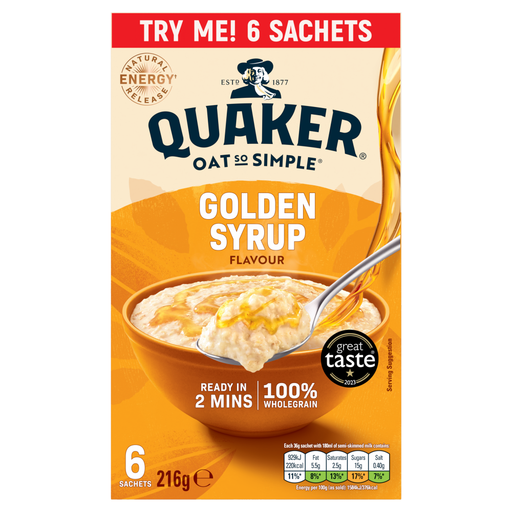
Quaker Oat So Simple Golden Syrup, 6 x 36g
Six 36g sachets offer measured individual breakfast portions.
The supplied allergen statement identifies oats and warns that barley, soya and wheat may be present. It is not presented as gluten free; prepare with water or an appropriate alternative where milk is an allergen concern.
Joybuy
Frequently asked questions
Are plain single-serve porridge oats automatically suitable for a food allergy?
No. The Food Standards Agency explains that food businesses must provide information when regulated allergens are used as ingredients, while product-specific precautionary statements can indicate cross-contact risk. Check the actual pack each time, including any warnings for milk, nuts, wheat, barley or soya.
Can gluten-free oat sachets be chosen for coeliac disease?
Choose oats explicitly labelled gluten free rather than ordinary, organic or 100% oats products. Coeliac UK says standard oats can be contaminated with wheat, barley or rye, and that a small number of people remain sensitive even to gluten-free oats.
Is a gluten-free porridge sachet suitable for wheat allergy?
Not necessarily. The reviewed Quaker Gluten Free sachets meet the gluten-free standard but state “May Contain Wheat” and say they may not be suitable for people with wheat allergy. Treat gluten-free and wheat-allergy suitability as separate checks.
What does “may contain” mean on porridge oats?
It is precautionary allergen labelling used to communicate that a regulated allergen could be unintentionally present through cross-contact. It is separate from the ingredients list, so use both pieces of information when deciding whether a product fits your allergy-management plan.
Can an online grocery allergen listing be relied on?
Use an online listing to shortlist products, then confirm the physical product label before eating. Waitrose notes that recipes can change, which can affect allergen information.


