Carers planning dinner for a child aged one or over
An unsweetened, calcium-fortified drink fits the NHS guidance for milk alternatives from age one. If the child needs to avoid gluten, check the individual drink for an explicit gluten-free claim.


For a child aged one or over who can have soya, an unsweetened, calcium-fortified soya drink can accompany dinner as part of a balanced diet, according to NHS guidance. If gluten avoidance matters, choose a carton explicitly labelled gluten-free; dairy-free wording does not establish gluten status or make soya suitable for a child with a soya allergy.
An unsweetened, calcium-fortified drink fits the NHS guidance for milk alternatives from age one. If the child needs to avoid gluten, check the individual drink for an explicit gluten-free claim.
A dairy-free soya drink may be an option, but soya is itself an allergen. For a child with a diagnosed or suspected milk or soya allergy, follow their clinical advice rather than treating dairy-free wording as an allergy clearance.
A drink marketed for toddlers addresses a different selection question from its gluten status. Check the current carton for both age guidance and an explicit gluten-free claim.
Start with the child’s age and any allergy requirements, then compare the exact carton’s gluten-free wording, unsweetened status and calcium fortification.
| Priority | What to check | Your needs |
|---|---|---|
| Gluten-free label | Look for an explicit claim on the individual carton and check its current ingredients and allergen information. The Food Standards Agency states that a food labelled gluten-free must contain no more than 20 mg/kg gluten when sold to the final consumer. | If my toddler needs to avoid gluten, I cannot rely on a drink being plant-based or made from soya to establish that it is gluten-free. |
| Age and fortification | Check any age warning, whether the drink is unsweetened and whether calcium is added. The NHS says unsweetened, calcium-fortified milk alternatives can be given from age one as part of a balanced diet. | I want a dinner drink appropriate for my child’s age, rather than assuming that every fortified soya drink suits every toddler. |
| Milk and soya allergens | Check dairy-free wording if milk avoidance matters, and read the ingredients for soya and other allergens relevant to the child. The Food Standards Agency identifies soya as an allergen and requires allergens in prepacked-food ingredients lists to be emphasised. | Our family may need to avoid dairy, but I also need to know whether my child can have soya. |
Plant-based and dairy-free describe different characteristics from gluten status.
For a gluten-free requirement, look for an explicit claim on the current carton rather than relying on its product category or shelf placement.
Soya is an allergen, and NHS clinical guidance notes that it may not suit some children with cow’s-milk allergy.
Read the emphasised allergens in the ingredients list and follow the child’s clinical plan for a diagnosed or suspected allergy.
The NHS guidance for unsweetened, calcium-fortified milk alternatives begins at age one; a standard soya drink is not an infant milk substitute.
Apply the toddler-dinner checks to children aged one or over, and follow individual clinical advice where needed.
Waitrose & Partners labels its Essential Unsweetened Soya Drink as unsuitable for children under two, despite listing added vitamins and minerals.
Read the age guidance on the exact carton before choosing it for a younger toddler.
These examples illustrate label differences to check; a brand name alone does not establish the suitability of every drink it makes.
Waitrose & Partners describes Alpro Soya No Sugars as gluten-free, dairy-free and calcium-fortified. Sainsbury’s positions Alpro Soya Growing Up for children aged 1–3+.
Sainsbury’s lists an unsweetened, long-life soya drink fortified with calcium, iodine, vitamin D and B12.
M&S describes its Unsweetened Soya Drink as fortified with calcium, iodine, vitamin D and B12.
Waitrose & Partners lists its Essential Unsweetened Soya Drink with added calcium, vitamin D, vitamin B12, vitamin B2 and iodine.
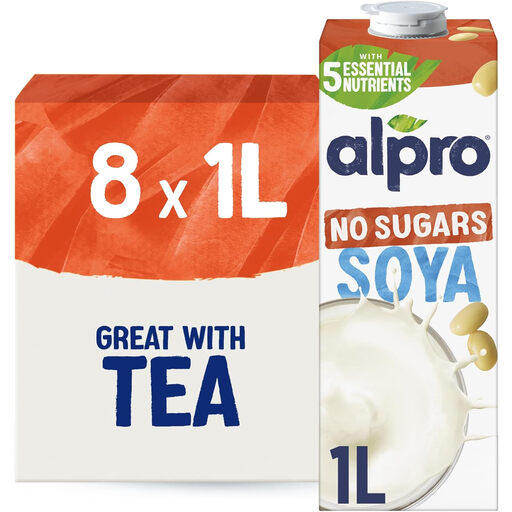
This Alpro pack represents the unsweetened soya-drink option for a toddler dinner. Check the carton’s gluten-free claim, allergen information and age guidance before serving it.
 No image available
For a child aged one or over who can have soya, this unsweetened drink can be considered alongside dinner under NHS guidance. The product information describes it as gluten-free and calcium-fortified; check those details on the current carton. It contains soya and is not an infant milk substitute.
From age one, the NHS says an unsweetened, calcium-fortified milk alternative such as a soya drink can be given as part of a balanced diet. Check the particular drink’s age warning and whether the child can have soya.
The Food Standards Agency states that food labelled gluten-free must contain no more than 20 mg/kg gluten when sold to the final consumer. Choose a drink with an explicit claim on its own carton rather than assuming all soya drinks qualify.
The referenced Alpro Soya No Sugars drink is described as dairy-free, but that does not establish the ingredients of every soya drink. It still contains soya, an allergen, so check the individual product and the child’s allergy requirements.
Check the gluten-free claim if needed, unsweetened status, calcium fortification, ingredients, allergen information and any age warning. The Food Standards Agency requires allergens in the ingredients list of prepacked food and drink to be emphasised.
Not automatically. NHS clinical guidance notes that soya may not suit some children with cow’s-milk allergy; a child who is also allergic to soya must avoid it. Follow the child’s clinician or dietitian plan before changing their milk alternative.