
24/7 Customer Support

Free returns

Same-day & Next-day Delivery

Quality Guaranteed

Unlock Your Welcome Offers: FREE Delivery | Up to 80% OFF | Free 30-day JoyPlus trial
Download the APP
Buying goose feather badminton shuttlecocks can appear straightforward: choose a speed, pick a tube and start playing. In practice, the wrong shuttlecock may wobble in flight, lose feathers after a few rallies or perform poorly when a British breeze reaches the court. For clubs, coaches, tournament players and families, selecting the right construction and speed can make a noticeable difference to value.
This guide explains what to check before buying, how Speed 76 and Speed 77 shuttlecocks differ in practical use and which options may suit different playing habits.
Durability depends on several components working together. Feather thickness, the quality of the coil, the ball head and the bonding process can all affect how well a shuttlecock handles repeated impacts. A product described simply as “durable” may not provide enough detail for meaningful comparison.
Look for clear information about goose feather quality, structural reinforcement and the head material. Natural cork or a durable composite ball head may help provide a consistent striking surface, but shuttlecocks will still wear faster when used for powerful smashes or mishits.
Speed numbers such as Speed 76 badminton shuttlecocks and Speed 77 badminton shuttlecocks are useful starting points, but they do not remove the need to consider your court and surroundings. Temperature, altitude, playing style and air movement can influence how a shuttle travels.
A speed suitable for a draught-free sports hall may feel different in a cooler community centre or outdoor garden. Check the product’s intended use and, where possible, buy a speed that matches your usual playing conditions rather than relying on the number alone.
Feather shuttlecocks are affected by wind and moisture. Even a shuttlecock designed for outdoor training is unlikely to behave like a plastic model in strong or shifting wind. Outdoor users should prioritise secure storage, inspect the feathers before each session and accept that lawn or park play can shorten service life.
For regular matches, indoor courts remain the more predictable environment. For family games and occasional outdoor training, a design with stated wind-resistance features may offer a more suitable compromise.
Straight, thick feathers are intended to support a more even skirt and steadier rotation. Uneven feathers can cause the shuttlecock to veer or slow unpredictably, making it harder to judge clears, drops and defensive returns.
For tournament badminton shuttlecocks or club use, prioritise descriptions that explain feather selection and flight consistency rather than relying only on phrases such as “pro quality”. A stable flight path is a practical feature that players can assess during use.
The difference between Speed 76 and Speed 77 is not a simple quality ranking. The appropriate choice depends on how quickly the shuttle travels in your regular venue.
If you are buying for a club, ask players or the coach which speed is already used in training. Matching the existing supply can make drills and match preparation more consistent.
A tightly formed coil can help hold the feather skirt in place, while a firm ball head supports repeated racket contact. Products using a high-intensity coil, composite head, natural cork or carefully applied adhesive provide more useful specification detail than listings that only mention “premium materials”.
Storage is equally important. Keep feather shuttlecocks in a cool, humid environment, away from direct heat and sunlight. Excessive dryness can make feathers brittle, while damp conditions after outdoor play may affect the materials. Inspect every shuttlecock before use and discard one with loose, split or badly bent feathers.
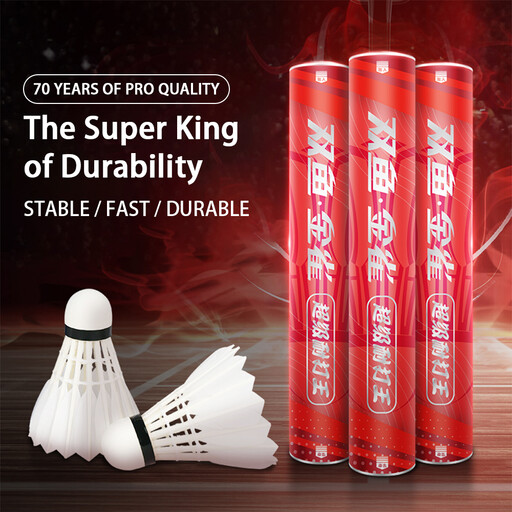
Why This Fits Their Persona: A practical 12-pack format for new players, families and regular home sessions where replacing individual shuttlecocks can be inconvenient. The Speed 76 specification gives buyers a clearly defined starting point for controlled play.
The listing specifies thick goose feathers, a high-intensity coil, a composite ball head and natural cork rather than using durability as an unexplained slogan.
12-pack format; goose feather construction; Speed 76 option; stated wind-resistant design for outdoor training.
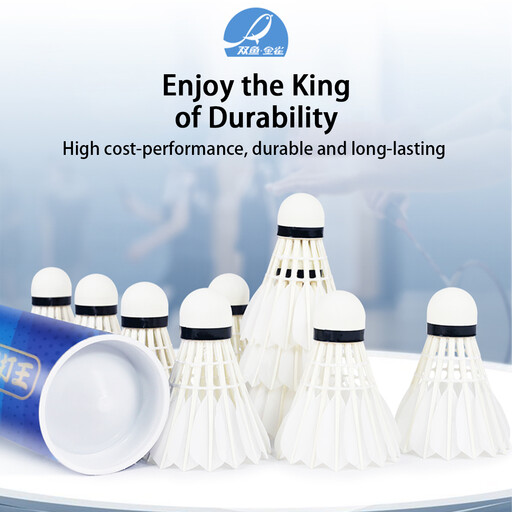
Why This Fits Their Persona: Suited to players who want detailed material information for club sessions, structured practice and match preparation rather than an unspecified recreational model.
The product information identifies selected thick goose feathers, an industrial-grade coil, eco-glue bonding and a compound ball head.
Speed 76/77 options; designed for club training and matches; high-frequency impact is an intended use case.
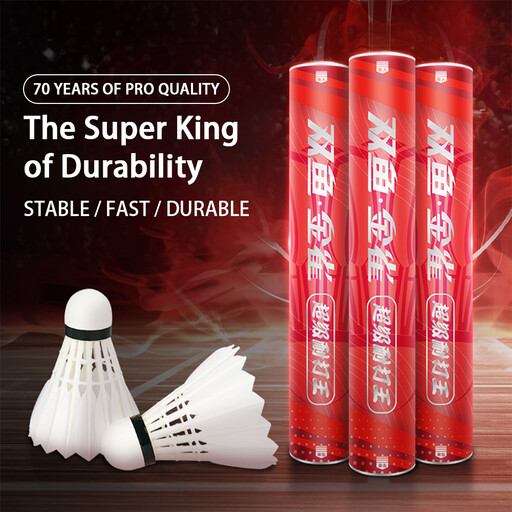
Why This Fits Their Persona: A suitable consideration for coaches, frequent trainees and families wanting one tube for indoor drills and occasional outdoor sessions in calmer UK conditions.
Its stated outdoor-training purpose and wind-resistance feature are more relevant than choosing a standard indoor shuttlecock for exposed play.
Thick goose feathers; natural cork; composite ball head; Speed 77 specification; stated wind-resistant design.
Even durable badminton shuttlecocks are consumable sports equipment. To help extend usable life:
These habits can reduce unnecessary waste, although lifespan will vary with racket impact, playing intensity and storage.
We have compiled a complete, real-time list of products that fully satisfy these strict selection criteria and UK safety regulations.
They can be used for outdoor training in calmer conditions, particularly when the product lists wind-resistance as a feature. However, wind still changes direction and speed, so outdoor play will generally be less predictable than indoor court play. Store them carefully after use to protect the feathers.
There is no fixed lifespan. A shuttlecock may last several rallies or multiple sessions depending on smash frequency, contact quality, court conditions and storage. Frequent club training typically consumes shuttlecocks faster than light family play. Inspecting and rotating them can help avoid discarding usable stock too early.
Choose according to your venue and established club preference. Speed 76 may suit a more controlled pace, while Speed 77 may suit players seeking a quicker response. If you are replacing an existing tube, matching its speed is usually the simplest way to maintain familiar play characteristics.