Who this is for

Families sharing one breakfast cereal

One granola can work for a household, but a manufacturer portion is not a universal serving. Diabetes UK explains that the total carbohydrate eaten has the greatest effect on glucose levels after a meal, so individual bowls may need different amounts.

People with diabetes choosing granola

Compare total carbohydrate, sugars, fibre and ingredients on the current label rather than assuming a granola suits everyone because of a front-of-pack claim. Diabetes UK and East Lancashire Hospitals NHS Trust both emphasise using total carbohydrate for carbohydrate counting.

Households managing cereal or nut allergies

Check ingredients and allergen information before sharing a pack. Current granolas can include cereals containing gluten, nuts and milk, as well as precautionary cross-contact statements; GOV.UK explains that specified allergens used as ingredients must be clearly labelled on prepacked food.

Buying priorities

Start with the amount served, then compare the full nutrition panel and ingredients list. Diabetes UK and East Lancashire Hospitals NHS Trust guidance makes total carbohydrate and portion size more useful comparison points than a sugar-related claim alone.

Priority What to check Your needs
Total carbohydrate per bowl Compare total carbohydrate per stated serving and per 100g. Measure the bowl you plan to serve, especially when household portions differ. I want to know the carbohydrate in the amount I actually eat, rather than treating the pack serving as a personalised meal plan.
Claim versus full label Read the carbohydrate row, sugars row, serving size and ingredient list. Check for ingredients such as syrups, honey, dried fruit or other sweeteners where relevant. A low-sugar, no-added-sugar or sugar-free description should not replace a look at the full nutrition panel.
Fibre and wholegrains Use the fibre declaration and wholegrain ingredients as comparison points, while still checking total carbohydrate, sugars and portion size. I may prefer oats or other wholegrain ingredients, but I still need to understand what is in each served bowl.
Allergens for the household Read the highlighted allergen ingredients and any relevant “may contain” statement on the current pack. Check cereals containing gluten, nuts, milk, peanuts, soya and sesame where applicable. A shared granola needs to fit the people eating it, not just the person choosing it.

Common buying pitfalls

  • Choosing the biggest bag from a sugar-related claim alone

    Total carbohydrate includes starch and sugars, and it is the figure used for carbohydrate counting. A 1kg Sussex Wholefoods granola marketed as sugar free lists 64.61g carbohydrate per 100g on its label.

    Compare total carbohydrate for the intended bowl, sugars, fibre and ingredients before committing to a large pack. A smaller pack can be a practical first purchase if the household has not tried that product.

    A bulk bag may go unused if its ingredients, carbohydrate amount or flavour does not suit the household.

  • Assuming wholegrain or fibre removes every trade-off

    Wholegrains and fibre can be useful comparison factors, but they do not replace checking the full label. Dorset Cereals Oaty Granola, for example, lists golden syrup among its ingredients and 28.1g carbohydrate with 7.4g sugars per 45g serving.

    Use fibre and wholegrain information alongside the nutrition panel and ingredient list, rather than treating either term as a pass on its own.

  • Serving the same bowl to every family member

    The carbohydrate eaten matters for glucose management, while individual requirements can vary with activity and health goals. A manufacturer portion is a comparison reference, not a universal serving.

    Use a scoop or kitchen scale where carbohydrate counting is needed, and offer another breakfast option when household dietary needs differ.

  • Missing allergen and cross-contact information

    Current granolas can contain cereals containing gluten, nuts and milk, and some carry precautionary statements for other allergens. GOV.UK states that specified allergens used as ingredients in prepacked food must be clearly declared.

    Read the physical or retailer-pack label each time you buy, including relevant “may contain” wording, before opening a large shared pack.

    Replacing an opened pack after discovering an allergy conflict can create avoidable waste.

Relevant granola brands

Lizi's

A UK granola brand with a dedicated low-sugar range. Its Low Sugar Nuts & Seeds Granola is listed by Tesco in a 400g pack with approximately eight 50g portions.

  • The Tesco label gives 24.3g carbohydrate, 1.7g sugars and 4.0g fibre per 50g portion, making serving-based comparison straightforward.
  • The product contains oats, wheat or barley-derived crisped rice ingredients, almonds and hazelnuts; check the current label for household allergen needs.

Jordans

A mainstream UK cereal brand with conventional sweetened granolas alongside low-sugar and no-added-sugar granola lines.

  • Low Sugar Almond & Hazelnut Granola states 25.1g carbohydrate, 1.3g sugars and 3.6g fibre per 45g portion.
  • Exact varieties differ: No Added Sugar Apple & Berry lists 22g carbohydrate and 4.4g sugars per 45g portion, so the claim does not replace checking each label.

Eat Natural

A UK brand offering a specifically labelled Low Sugar Granola made with wholegrain oats, seeds, almonds, coconut and buckwheat.

  • The product page states 16.5g carbohydrate, 2.2g sugars and 6.4g fibre per 50g portion.
  • It contains oats and almonds and may contain other nuts, peanuts, soya, sesame and milk.

Dorset Cereals

A granola-focused UK cereal brand with oat-based varieties including Oaty Granola in a 500g pack and Nutty Granola in a 450g pack.

  • These varieties provide clear serving information for label comparison: Oaty Granola lists 28.1g carbohydrate per 45g serving, while Nutty Granola lists 27.9g.
  • The researched labels list golden syrup in Oaty Granola; Nutty Granola contains almonds, hazelnuts and cashew pieces, and both contain cereals containing gluten.

Nature's Path

An organic cereal and granola brand with UK-facing products including Nice and Nobbly berry-and-yogurt-chunk granola.

  • The researched Nice and Nobbly variety is labelled gluten free and sold in a resealable pouch.
  • Its ingredients include raw cane sugar and milk-containing yoghurt chips, and the label should also be checked for its peanut and tree-nut trace statement.

Joybuy product options

Joybuy product options for shared family breakfasts, with a stated serving size and nutrition information that can be compared against the portion each person will eat.
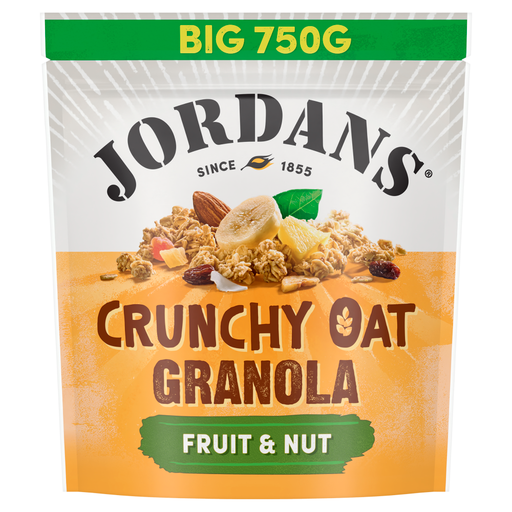
Jordans Crunchy Oat Granola Fruit and Nut 750g

Jordans Crunchy Oat Granola Fruit & Nut 750g

A 750g resealable pack stated to provide approximately 16 portions, so separate bowls can be measured for a shared breakfast.

The stated 45g portion contains 29g carbohydrate, 11g sugars and 2.7g fibre.

Contains oats and almonds and may contain peanuts, other nuts and cereals containing gluten. Added sugar, honey and sweetened dried fruit are listed.

View on Joybuy

Frequently asked questions

Can granola be described as diabetic friendly simply because it is low in sugar?

No single sugar-related claim establishes suitability for every person with diabetes. Compare total carbohydrate for the portion you will eat, alongside sugars, fibre and ingredients; Diabetes UK notes that carbohydrate amount and portion size affect glucose management.

Why should family members measure their own portions?

A manufacturer serving is a comparison reference rather than a universal portion. Diabetes UK states that carbohydrate needs can vary with factors such as activity and health goals, while the total carbohydrate consumed has the greatest effect on glucose levels after eating.

Does no added sugar mean low carbohydrate?

No. Jordans No Added Sugar Apple & Berry Granola lists 22g carbohydrate and 4.4g sugars per 45g portion. Check the carbohydrate row and stated serving size on the current pack.

Can a large sugar-free granola bag be assumed to suit carbohydrate counting?

No. A Sussex Wholefoods 1kg granola marketed as sugar free lists 64.61g carbohydrate and 13.51g sugars per 100g, with barley malt extract, raisins and apple juice concentrate in its ingredients. Use the nutrition panel rather than the product name alone.

What allergy information should UK shoppers check?

For prepacked foods, specified allergens used as ingredients must be clearly labelled in the ingredients list, according to GOV.UK. Granolas commonly include cereals containing gluten and nuts, and some also contain or may contain milk, peanuts, soya or sesame.