Parents and carers making snacks at home
Plain yoghurt can be served with fruit or added to a snack plate. The NHS gives plain unsweetened yoghurt with sliced banana and yoghurt with mandarin segments as snack examples.


For a half-term snack you can serve with fruit or use as a dip, start with plain, unsweetened yoghurt and look for strained or authentic Greek yoghurt if a thick texture matters. Greek-style natural yoghurt is another option when that texture is less important; choose a ready-flavoured pot or pouch when individual portions are more useful, checking its ingredients, sugars and serving instructions on the current pack.
Plain yoghurt can be served with fruit or added to a snack plate. The NHS gives plain unsweetened yoghurt with sliced banana and yoghurt with mandarin segments as snack examples.
A larger natural tub allows several servings, while individual fruit-yoghurt portions are ready to serve. Consider the texture you need, the amount you will use and how you will keep it chilled.
A plain yoghurt lets you choose the fruit and serving size yourself. Check the nutrition label on the exact yoghurt rather than assuming that every plain or Greek-style product has the same composition.
Choose the format for the snack you plan to serve, then compare the exact packs for texture, nutrition and storage instructions.
Choose when: You want a thick base for fruit bowls or dips and prefer to add the fruit yourself.
Bear in mind: Fat and saturated-fat figures differ between strained products, so compare the exact tub.
Choose when: You want a plain yoghurt for several servings and a strained texture is not essential.
Bear in mind: The Independent notes that Greek-style yoghurt may be unstrained or lightly strained, so it can be thinner.
Choose when: A ready-flavoured individual portion is more useful than preparing a bowl.
Bear in mind: The fruit or flavour is already incorporated; check the ingredients, sugars and serving directions on the current pack.
| Priority | What to check | Your needs |
|---|---|---|
| Fruit and flavour | Check whether the yoghurt is plain or flavoured; read the ingredients and sugars per 100g on the exact pack. | I would rather add sliced fruit myself than choose a ready-flavoured pot. The NHS gives plain unsweetened yoghurt with banana as one snack example for young children. |
| Texture | Look for “strained” or “authentic” if thickness matters. The Independent explains that Greek-style yoghurt can be unstrained or lightly strained. | For a dip or a thick fruit bowl, I want to know how the yoghurt is made, not rely on “Greek-style” alone. |
| Fat and saturates | Compare the per-100g figures: FAGE UK lists 5.0g fat and 3.6g saturates for Total 5%, while Sainsbury's lists 9.7g fat and 7.1g saturates for its Authentic Greek Yogurt. | I want to compare the tubs I might actually serve rather than assume all plain Greek yoghurts have the same nutrition. |
| Portions | Check the pack size and serving directions. A large tub and an individual pouch call for different serving plans. | Will I serve yoghurt to several people at home, or do I need a portion I can take out? |
| Chilled storage | Follow the pack's refrigeration and opened-life instructions. Sainsbury's specifies use within three days of opening for its Authentic Greek Yogurt. | If I am taking yoghurt out for the day, I need a way to keep it chilled until it is served. |
| Milk allergen | Read the exact pack's ingredients and allergen declaration. The Food Standards Agency identifies milk as a common ingredient in yoghurt. | Someone I am serving has a milk allergy, so I need to check the product before offering it. |
A Greek-style yoghurt may be thinner than the strained yoghurt you intended to use for dipping. The Independent distinguishes strained or authentic products from Greek-style alternatives on this basis.
If thickness is important, check the product description for “strained” or “authentic” and consider the texture indicated on the pack.
A flavoured yoghurt has its additions already incorporated, so it does not offer the same choice of fruit and serving amount as a plain tub.
Choose plain yoghurt if you want to add fruit yourself. For a flavoured pot or pouch, check the current ingredients and sugars information, including the figures per 100g and per portion where shown.
Yoghurt needs to be handled according to its chilled-storage instructions, and dairy yoghurt is unsuitable for someone with a milk allergy. The Food Standards Agency lists milk as a common yoghurt ingredient.
Keep the product chilled as its label directs, check how long it can be used after opening and read the allergen declaration before serving.
These examples show why the exact product line and pack matter more than a brand name alone.
FAGE Total 5% is a plain strained yoghurt with live cultures, according to FAGE UK.
Yeo Valley describes a Greek Recipe range alongside its organic yoghurt lines.
Sainsbury's describes its 500g Authentic Greek Yogurt as a natural strained yoghurt from the Macedonian region of Greece.
Tesco lists Greek-style natural yoghurt in a 1kg tub and plain Greek-style yoghurt in a 4 × 90g pack.
Ocado describes M&S Collection 10% Fat Natural Greek Yogurt as strained yoghurt with live cultures.
Sainsbury's lists a Müller Light Greek Style Luscious Lemon yoghurt multipack among its Greek-style products.
These individual fruit-yoghurt pouches suit a ready-to-serve snack; neither takes the place of a plain tub when you want to add fruit yourself or choose a strained texture.
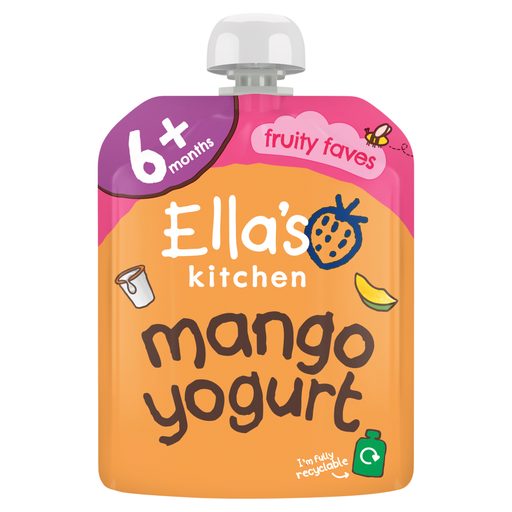 Image unavailable
A 90g fruit-yoghurt pouch for a ready-to-serve portion, rather than a plain base for adding fruit separately.
The product information describes mango, apple and banana blended with Greek-style yoghurt. It contains milk. For a child, follow the pouch directions to serve the contents in a bowl or on a spoon; keep the cap away from children under 36 months. Refrigerate unused contents after opening and use within 24 hours.
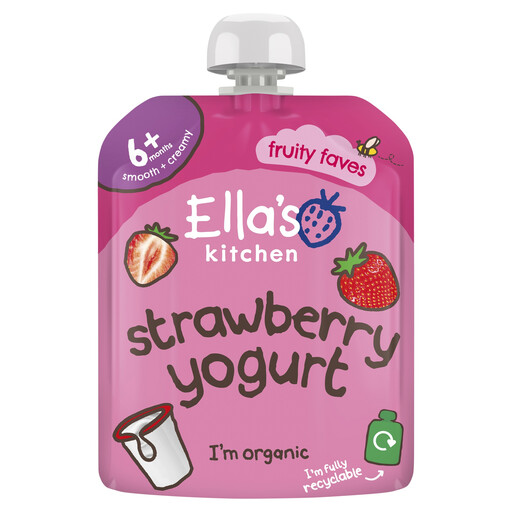 Image unavailable
A 90g fruit-yoghurt pouch for an individual snack, with fruit already blended in rather than served alongside plain yoghurt.
The product information describes Greek-style yoghurt with strawberries, bananas and apples. It contains milk. Follow the adult-supervision directions when serving from the pouch and keep the cap away from children under 36 months. Refrigerate after opening, use within 24 hours and do not freeze.
Yes. The NHS gives plain unsweetened yoghurt with sliced banana as one snack example for young children. Check the particular product's ingredients and serve it in a way appropriate for the child.
The Independent explains that traditional Greek yoghurt is strained to remove whey, while Greek-style yoghurt may be unstrained or lightly strained and can be thinner. If you need a thick dip or bowl topping, check for “strained” or “authentic” in the description; the wording does not establish a nutrition ranking.
Compare the whole label of the products you are considering rather than choosing by the front-of-pack percentage alone. Per 100g, FAGE UK lists 5.0g fat and 3.6g saturates for Total 5%; Sainsbury's lists 9.7g fat and 7.1g saturates for its Authentic Greek Yogurt; and Ocado lists 10.1g fat and 7.0g saturates for M&S Collection 10% Fat Natural Greek Yogurt.
Yes, if you can keep it chilled and follow the particular pack's storage and serving instructions. Check its opened-life directions too: Sainsbury's specifies three days after opening for its Authentic Greek Yogurt, while the Ella's Kitchen pouches shown here specify 24 hours for unused contents.
No. The Food Standards Agency identifies milk as a common ingredient in yoghurt. Check the exact product's allergen declaration and choose an appropriate milk-free alternative instead.